
Microsoft's Work Trend Index found that the average knowledge worker spends 57% of their time in meetings, chats, and email.
More than half of the working day, consumed by communication overhead rather than the actual work that drives results.
That makes meeting design one of the highest-leverage skills any corporate professional can develop.
And yet, most meetings are still run on autopilot.
- Same recurring invites.
- Same meandering conversations.
- Same vague wrap-ups with no clear next steps.
We're spending more time in meetings than ever before, but accomplishing less.
The problem isn't meetings themselves. It's how we run them.
Done right, a business meeting is one of the most powerful tools a manager has. It aligns teams and builds the kind of trust that no Slack message ever could. Done wrong, it's a calendar black hole that kills morale, momentum, and time.
This blog is your playbook. And in this playbook, you'll walk away with a practical, step-by-step framework for running meetings that people actually value.
What Is a Business Meeting?
A business meeting is a structured, purposeful gathering in person or virtual where two or more professionals come together to make decisions, solve problems, share critical information, or align on a shared direction.
Simply put, a business meeting is where work gets decided, not just discussed.
And you know what, there is precisely just 3 elements that make it a true business meeting:
Defined Objective
There should be a clear reason for gathering.
Real-time Human Interaction
It happens live, not asynchronously.
An Expected Outcome
Something concrete should result from it.
When all three boxes are checked, the meeting belongs on the calendar.
But if even one is missing?
Honestly, there's a good chance an email, a Slack message, or a shared doc would get the job done faster. And with a lot less disruption to everyone's day.
Read This Blog: Workplace Communication: Why It Matters and How to Improve It
12 Types of Business Meetings (and When to Use Each)
Not all meetings are created equal.
You've got the 15-minute standup that keeps a team on track, and the two-hour strategy session that sets the direction for the next quarter. They're both called "meetings." But they need completely different approaches.
The problem is that most teams treat them the same way. Same invite style, same agenda format, same default 60-minute block regardless of what they're actually trying to accomplish. And that mismatch is where meeting culture starts to break down.
You might have come across different frameworks. Some talk about 4 types of meetings (Decision, Information-sharing, Problem-solving, Relationship-building), others break it into 7 categories or 5 types. They're all looking at the same reality from different angles.
For you, here are the 12 below cover the full picture, so you can match the right format to the right situation.
| Type | Purpose | Frequency | Optimal Duration | Decision Output |
|---|---|---|---|---|
| Status / Standup | Team sync | Daily / Weekly | 15 min | Low |
| Decision-Making | Make a call | As needed | 30–60 min | High |
| Strategy & Planning | Set direction | Quarterly / Annual | 2–4 hrs | High |
| Brainstorming | Generate ideas | As needed | 60–90 min | Medium |
| Problem-Solving | Fix a specific issue | As needed | 30–60 min | High |
| Team-Building | Strengthen relationships | Monthly | 60–90 min | Low |
| One-on-One | Individual development & feedback | Weekly / Biweekly | 30 min | Medium |
| All-Hands / Town Hall | Company-wide alignment | Monthly / Quarterly | 60 min | Low |
| Quarterly Business Review | Assess and plan | Quarterly | 2–3 hrs | High |
| Retrospective / Post-Mortem | Learn from past | End of sprint / project | 60–90 min | Medium |
| Kickoff | Align before starting | Once per project | 60 min | Medium |
| Client / External | Build and manage relationships | As needed | 30–60 min | Varies |
1. Status / Standup Meetings
The most common meeting on any calendar. A standup is a quick, structured check-in, usually 15 minutes where each person covers what they're working on, what's next, and what's in their way.
The rule is simple, keep it short. The moment it runs past 20 minutes, it has quietly become something else entirely.
2. Decision-Making Meetings (DACI / RAPID)
These exist for one reason: to make a call. Whether you're using a DACI framework (Driver, Approver, Contributor, Informed) or RAPID, the invite list should only include people who have a direct role in the decision.
Packing the room with observers doesn't make a better decision. It just makes a slower one.
After a decision meeting, send a 2-3 line decision brief to everyone not in the room. What was decided, why, and who's affected. Most teams send lengthy minutes that nobody reads. A decision brief takes 2 minutes to write and actually gets read.
3. Strategy and Planning Meetings
Big-picture thinking needs big-picture time. Strategy meetings quarterly reviews, annual planning, roadmap discussions are longer by design. But they still need a tight structure, or two hours will pass and the only output will be a vague sense of alignment.
Come in with pre-reads. Leave with clear priorities.
4. Brainstorming and Innovation Meetings
The one meeting type where "there are no wrong answers" is genuinely the rule. These work best when psychological safety is high and the agenda is deliberately open.
One rule that makes a real difference, keep idea generation and idea evaluation in separate sessions.
Unfortunately, sometimes, critique kills creative momentum. Don't mix the two.
5. Problem-Solving Meetings
Something broke. You need to fix it, together and fast. Problem-solving meetings are focused and urgent. They should end with a decision, not just a discussion.
Come in with the problem already defined. Leave with an owner and a deadline.
6. Team-Building Meetings
Yes, this counts. And no, it doesn't have to be a trust fall.
Team-building sessions are about creating the kind of interpersonal familiarity that makes every other meeting work better. Think of them as an infrastructure investment, the returns show up in every future collaboration.
Read This Blog: Team Building Activities for Work: Ideas That Actually Stick
7. One-on-One Meetings
Probably the most underrated meeting on this entire list. A regular 1:1 between a manager and a direct report is where real feedback gets shared, blockers get removed, and trust gets built. One conversation at a time.
At the end of the day, the agenda should be employee-driven.
If the manager controls the agenda every time, it's just a status up date with a more intimate setting.
8. All-Hands / Town Halls
When leadership needs to speak to the whole company, you get an all-hands. Done well, it's a moment of genuine transparency and two-way dialogue. Done poorly, it's a polished broadcast that answers nothing employees actually wanted to know.
The test: can people ask hard questions and get honest answers? If yes, it's a meeting.
9. Quarterly Business Reviews (QBR)
QBRs are where teams step back to assess the last 90 days, what worked, what didn't, and what the next quarter should look like. They're data-heavy, longer than most meeting types, and need to be ruthlessly outcome-focused.
The best QBRs end with clear decisions and adjusted priorities. The worst ones are a 90-minute slide deck that everyone forgets by Thursday afternoon.
10. Retrospective / Post-Mortem Meetings
Popular in agile teams, retros are the honest look in the mirror after a sprint, a project, or a launch.
- What went well?
- What slowed us down?
- What do we do differently next time?
The ground rule: blameless by design. The goal isn't to assign fault. It's to get smarter.
11. Kickoff Meetings
Every project deserves a proper start. A kickoff aligns the team on scope, roles, timeline, and what "done" actually looks like, before anyone writes a single line of code or sends a single deliverable.
Skip the kickoff and the misalignment surfaces two weeks in. At which point it's significantly more expensive to fix.
12. Client / External Meetings
Any meeting that involves people outside your organization (prospects, clients, partners, vendors) belongs here. The prep time should be longer, the agenda tighter, and the follow-up faster than any internal meeting.
How you show up in a client meeting can define that relationship for years. Treat it accordingly.
Read This Blog: One-on-One Meeting Questions Every Manager Should Be Asking
The 5 P's of Effective Business Meetings
If you want a simple, memorable framework for evaluating any meeting before it happens and while it's running, the 5 P's are it.
Originally popularized in organizational management circles, the 5 P's break down everything a meeting needs to be effective into five clear pillars:
- Purpose
- Participants
- Preparation
- Process
- Payoff
Think of them as your pre-flight checklist.
If any one of the five is missing or unclear, the meeting isn't ready to happen. Here's what each one means in practice.
1. Purpose : What Decision Needs to Be Made
Every meeting must have a single, outcome-oriented purpose. Not a topic, but a decision. Before scheduling anything, ask: "What will we have resolved by the end of this meeting that we haven't resolved yet?"
If you can't answer that in one sentence, you don't have a purpose. You have an excuse to gather.
2. Participants : Who Must Be There (And Who Shouldn't)
The invite list is a leadership decision, not a courtesy exercise. Every person in the room should be there because they can directly contribute to the outcome either as a decision-maker or a critical subject-matter expert.
If someone only needs to know the result, send them a summary. Protecting people's time is a form of respect.
3. Preparation : Pre-Reads and Pre-Decisions
Great meetings are won before they start. Share the agenda, relevant data, and any required pre-reads at least 24 hours in advance.
Better yet, make low-stakes decisions asynchronously ahead of time so that live meeting time is reserved for the conversations that genuinely require real-time debate.
4. Process : How the Meeting Will Run
Process is the structure that keeps a meeting on track. This means a timeboxed agenda, a designated facilitator, a parking lot for off-topic ideas, and clear ground rules, like starting on time and ensuring every voice gets heard.
Without process, even the most well-intentioned meetings drift.
5. Payoff : Concrete Next Actions
The payoff is what justifies the meeting's existence. Before anyone leaves the room (physical or virtual), every action item must be documented with three things:
- What needs to happen
- Who owns it, and
- When it's due
No exceptions. A meeting without a payoff is just a scheduled conversation.
5 Business Meeting Agenda Templates (Copy-Ready)
A strong business meeting agenda is the single most reliable way to cut meeting time, increase participation, and leave with decisions instead of discussions. Below are five ready-to-use templates. Replace the [bracketed] variables with your specifics and paste directly into your calendar invite.
Template 1 — Daily Standup Agenda (15 min)
- Yesterday's wins — 1 min per person → What did you complete?
- Today's focus — 1 min per person → What are you working on today?
- Blockers — 30 sec per person → What is in your way?
Notes: Keep it standing. No problem-solving in the room — take blockers offline. Action items: [Owner] | [Task] | [Due]
Template 2 — Weekly Status Meeting Agenda (30 min)
- Last week's recap — 5 min → Key wins, completed milestones
- This week's priorities — 10 min → What's on deck, who owns what
- Risks and blockers — 10 min → What needs escalation or support
- Announcements — 5 min → Updates the team needs to know
Action items: [Owner] | [Task] | [Due Date]
Template 3 — Decision-Making Meeting Agenda (60 min)
- Context and background — 10 min → Why are we deciding this now?
- Options on the table — 15 min → Present [2–3 options] with clear tradeoffs
- Discussion and input — 20 min → Structured debate — one speaker at a time
- Decision — 10 min → Record the decision and rationale
- Next steps — 5 min → Who does what, by when
Decision made: [Record here] Action items: [Owner] | [Task] | [Due Date]
Template 4 — Quarterly Business Review Agenda (90 min)
- Q[X] performance recap — 20 min → Key metrics vs. targets: [KPI 1], [KPI 2], [KPI 3]
- What worked — 15 min → Top 3 wins and why they landed
- What didn't work — 15 min → Honest gaps — root causes, not excuses
- Q[X+1] priorities — 25 min → Top initiatives, owners, and success metrics
- Resource and support needs — 10 min → What does the team need to hit targets?
- Open Q&A — 5 min
Decisions made: [Record here] Action items: [Owner] | [Task] | [Due Date]
Template 5 — One-on-One Meeting Agenda (30 min)
- Employee updates — 10 min → What's top of mind this week?
- Progress on goals — 10 min → Where are you on [Goal 1] and [Goal 2]?
- Blockers and support needed — 5 min → What can I remove from your path?
- Feedback exchange — 5 min → Any feedback for me? Here's mine for you: [notes]
Carry-over items from last session: [Notes] Action items: [Owner] | [Task] | [Due Date]
9 Tips to Conduct Productive and Successful Business Meetings
Knowing the framework is one thing. Executing it consistently is another.
Here are nine practical tips that high-performing managers use to make every meeting count, every single time.
1. Have a Clear Purpose:
Before you start your business meeting, the first thing you should start with is the purpose.
Have a clear purpose and why you want to conduct the meeting in the first place. Doing so will give you a clear perspective and help you with the proceedings.
What is your purpose? Whether you want to share information with a team, discuss new products and ideas or discuss a problem at hand, make sure you be clear with your purpose.
2. Set a Meeting Plan or Agenda:
Once you are clear with the purpose, you can create an agenda to achieve it. List the topics you want to discuss and allot specific duration to each subject, respectively.
Send the schedule to the attendees beforehand to have a clear idea about the conference and prepare for it. Doing so will save time and also help attendees to prepare for it.
Keep a "parking lot," a shared doc or whiteboard section for off-topic ideas that surface mid-meeting. It lets you acknowledge a good thought without letting it derail the agenda. Revisit it at the end or schedule a separate conversation.
3. Set the Right Tone and Atmosphere:
For any manager or business leader, it is crucial to set the right tone for the meeting. You decide how you want your business meetings to be. It can be formal or informal. Create an atmosphere of mutual respect. Actively listen to the participants and respects their views and ideas.
Change the atmosphere if it seems essential. Often meetings are formal and a tedious affair. You can, therefore, have a themed meeting or go outdoors to lighten the atmosphere.
4. Start and End your Meeting on Time:
Employees are generally not very excited about business meetings. If you don't start and end your session on time, it gets worse. Put your extra effort to start and end your meeting on time.
Don't hold your meeting if any of your attendees fail to reach on time. This way, you would promote punctuality and sincerity in your workplace.
5. Let Everyone Participate:
The meeting is a collaborative process. Encourage everyone to participate, and share ideas and views. Respect everyone's inputs, perspectives. Encouraging communication and hearing everyone out would create a culture of respect and understanding. Let everyone participate and add value to problem-solving or collective decision-making.
Try the round-robin technique for key decisions: go around the room and ask each person for their view before open discussion begins. This stops the loudest voice from anchoring the group and surfaces perspectives that would otherwise never get shared.
6. Have Fun:
Nobody wants to attend a boring business meeting. Spice things up and bring humor to the atmosphere. Encourage attendees to communicate with each other. Since meetings can be hectic and tiresome, therefore keeping a light atmosphere would keep your employees engaged. Company discussions need not always necessarily be held seriously. It can also be done in a more fun and playful way to keep your attendees engaged.
7. Keep an Open Mind:
Don't drift from the original idea or purpose of your meeting. Stick to your agenda. But, remember to encourage new ideas and approaches from your attendees.
8. Allow Time for Questioning:
Questions wake people up. They prompt new ideas. They show people new places, new ways of doing things.
— Michael Marquardt
Be approachable and ask questions. This would allow everyone to participate and also give open feedback. Questioning opens the door to creativity and provides a more precise result and understanding of the topics discussed. It encourages discussion, arouses interest, maintains learning, and helps summarize significant points.
9. Follow up, Take Actions and Evaluate:
Review the agreed actions and agreements and delegate specific tasks to the team members. Give particular deadlines to complete the given tasks. One of the most common discouraging situations after a business meeting is not having a structured follow-up. Often best of the ideas generated in the meeting never get accomplished. Therefore, it is imperative to have a good follow-up after the meeting to make it successful.
Evaluate and take feedback on how the meeting is received. Review regularly if the session is achieving its purpose. Suppose it does not then have open discussions to take immediate actions.
Read This Blog: How to Give Effective Feedback That Actually Drives Change
How to Measure Meeting Effectiveness
Most teams run meetings on instinct. They feel productive or they don't. But without data, you're guessing. And guessing doesn't improve meeting culture.
Four signals give you an objective read on whether your meetings are actually working.
1. Pre-meeting agenda completion rate
Track what percentage of meeting invites go out with a completed agenda at least 24 hours in advance. If this number is below 70%, your meetings are starting unprepared. Set a team norm and measure it weekly.
2. Decisions captured per meeting
After every meeting, count the number of concrete decisions documented in the notes. If a 60-minute session produces zero decisions, it wasn't a meeting, it was a conversation.
Aim for at least one documented decision per 30 minutes of meeting time.
3. Action-item completion within 7 days
Assign every action item an owner and a due date. Track what percentage are completed within 7 days. Consistent non-completion signals unclear ownership, unrealistic timelines, or a meeting culture that doesn't follow through.
4. Meeting-fatigue pulse signals
Declining attendance, low energy, and camera-off rates in virtual calls are early warning signs of meeting fatigue. The fix is often fewer, shorter, better-structured virtual meetings and replacing low-value recurrings with asynchronous communication.
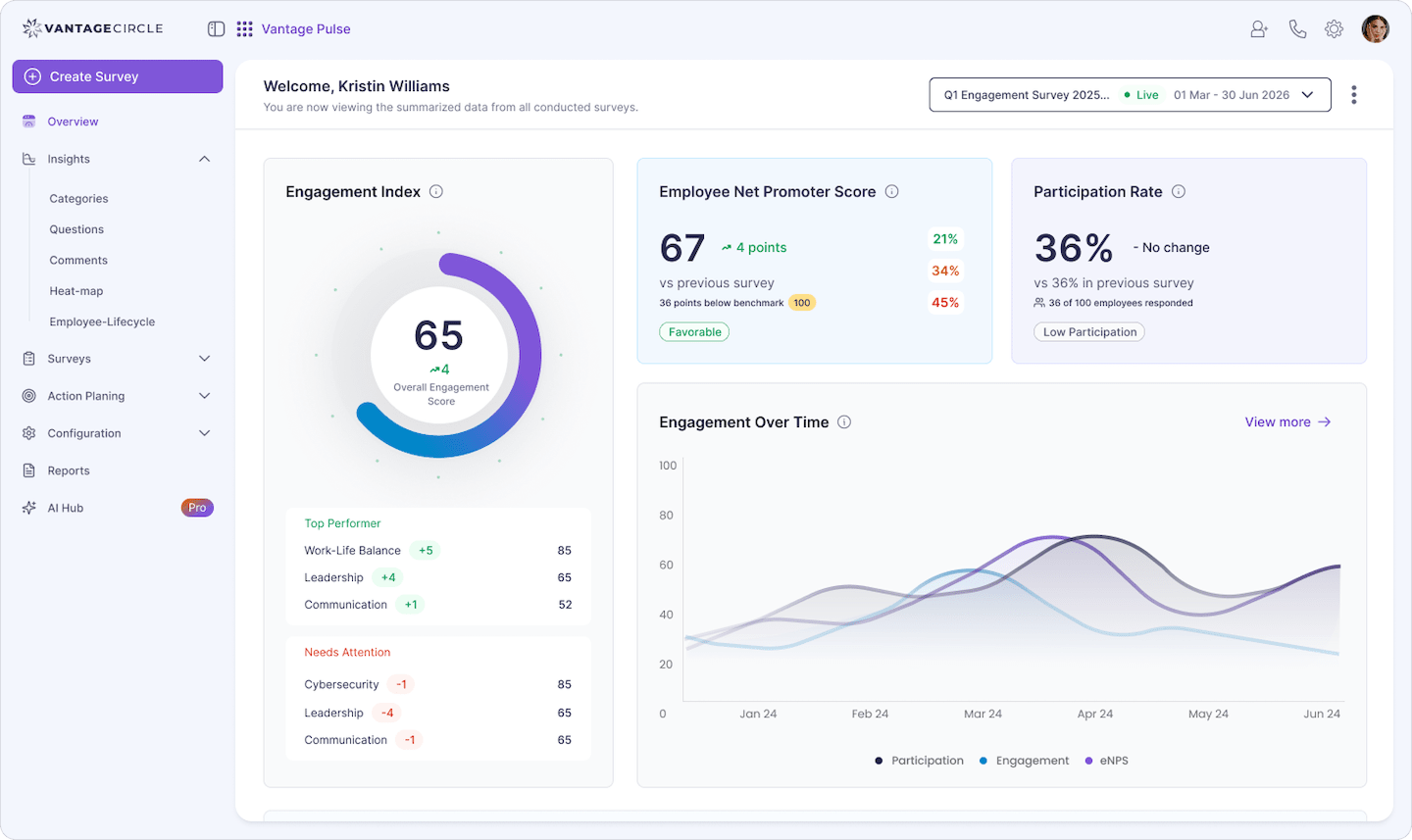
Vantage Pulse's built-in sentiment analysis surfaces meeting-fatigue signals before they become attrition risks. Track engagement trends, identify overloaded teams, and make data-backed decisions about your meeting culture all in one dashboard.
Frequently Asked Questions
1. What are business meetings?
Ans: A business meeting is a structured gathering, in person or virtual where professionals come together with a defined objective, real-time interaction, and an expected outcome.
2. What are the 4 types of business meetings?
Ans: The four core types are decision-making meetings, problem-solving meetings, status update meetings, and brainstorming meetings. Each serves a distinct purpose and requires a different facilitation approach.
3. What are the 7 categories of meetings?
Ans: The seven categories are: informational, decision-making, problem-solving, brainstorming, planning, relationship-building, and one-on-one meetings.
4. What are the 5 P's of meetings?
Ans: The 5 P's are Purpose, Participants, Preparation, Process, and Payoff. It's a five-point checklist that ensures every meeting is focused, efficient, and actionable.
5. What are five types of meetings?
Ans: The five most common types are decision-making meetings, status updates, problem-solving meetings, brainstorming sessions, and one-on-ones.
6. How long should a business meeting be?
Ans:** Only as long as the objective requires.
- Standups: 15–30 minutes.
- Decision meetings: 30–60 minutes.
- Strategy sessions: up to 90 minutes.
Default to shorter. You can always use the time saved.
Final Thoughts
A meeting is a tool, not a default. Every slot on the calendar costs real time, real energy, and real money. And most organizations are overspending without knowing it.
The teams that run the best meetings aren't the ones with the most meetings. They're the ones who are deliberate about when to meet, who to include, and what they need to walk away with. They use frameworks like the 5 P's, they send agendas in advance, they document decisions, and they measure whether any of it is actually working.
If your meeting culture is draining your team rather than driving it, the problem is rarely the people. It's the design. Fix the design, and the results follow.
Start with one meeting this week. Apply the 5 P's. See what changes.

This article is written by Sanjeevani Saikia. Sanjeevani Saikia is a Senior Content Strategist at Vantage Circle, where she leads end-to-end content strategy across SEO, thought leadership, brand storytelling, podcasts, and video. She is also the host of the Vantage Influencers Podcast, where she brings conversations with HR and business leaders from top global organisations, including Fortune 500 companies.
Connect with Sanjeevani on LinkedIn.


