Most teams do not have too many meetings. They have the wrong ones. Workplace meetings fall into five groups by purpose: status and alignment, problem-solving and innovation, planning and decision-making, people and development, and governance. Each group needs different attendees, a different cadence and a different agenda. Picking the right type is the fastest way to cut meetings that waste time.
According to Harvard Business Review, 71% of senior managers say meetings are unproductive and inefficient. A separate analysis from Bain, published in HBR, found that meetings can consume a third or more of senior leaders' time once recurring meetings and their follow-ups are added up.
That does not mean organizations should hold fewer meetings. It means they should run the right meeting for the job, with the right people, on the right cadence. This guide covers 12 meeting types managers run most often, when to use each one, and the small people moment that makes each meeting worth attending.
How do the types of meetings differ?
Meetings differ by purpose, who attends, how often they run and how long they last. Grouped by purpose, the 12 types break down like this:
Status & Alignment
- Daily stand-up: Immediate team, daily, 10-15 min. Surfaces status and blockers.
- Weekly team meeting: Team + manager, weekly, 30-45 min. Reviews progress and recognizes wins.
- All-hands (town hall): Whole company or department, monthly or quarterly, 45-60 min. Shares strategy and takes questions.
Problem-Solving & Innovation
- Brainstorming: Small cross-functional group, as needed, 30-60 min. Generates options.
- Problem-solving meeting: People closest to the problem, as needed, 30-45 min. Fixes a specific issue.
- Retrospective: Project or sprint team, end of project or sprint, 30-60 min. Reviews what worked and what to change.
Planning & Decision-Making
- Project kickoff: Project team + sponsor, once per project, 45-60 min. Aligns scope, owners and timeline.
- Decision-making meeting: Decision-maker + key input-givers, as needed, 30-45 min. Commits to a choice.
People & Development
- One-on-one: Manager + direct report, weekly or biweekly, 20-30 min. Coaches, gives feedback, and recognizes.
- Skip-level meeting: Senior leader + employee, quarterly, 20-30 min. Hears unfiltered feedback.
- Performance review: Manager + direct report, quarterly or annually, 45-60 min. Formal progress and goal review.
Governance
- Board meeting: Board members and executives, quarterly, 60-120 min. Oversight, compliance and major decisions.
Status and alignment meetings
Status and alignment meetings keep people informed and working on the same priorities. They are the most frequent meetings on any calendar, which is exactly why getting their length and attendee list right matters most.
1. Daily stand-up (status update) meeting
- Purpose: Surface what each person is working on and what is blocking them.
- Who attends: The immediate team, nobody outside it.
- Cadence & length: Daily, 10 to 15 minutes, same time every day.
- Agenda: What I did yesterday. What I am doing today. What is blocking me. Nothing else; park longer discussions for after.
- People moment: Close with a 30-second shout-out round. One line, one name, one specific thing done well. It costs nothing and it is the easiest recognition habit to build into a team's day. If the team needs a quick warm-up before status updates, a rotating icebreaker question works well here too.
2. Weekly team meeting
- Purpose: Review the week's progress against goals and recognize what moved the needle.
- Who attends: The full team and their manager.
- Cadence & length: Weekly, 30 to 45 minutes.
- Agenda: Wins and misses against the week's goals, blockers that stand-ups could not resolve, priorities for next week.
- People moment: Recognize the team result and the individuals who drove it, not just one or the other. 79% of high-effectiveness recognition programs recognize both the team and standout individuals when celebrating collective achievements, compared with 37% of other programs, according to The State of Recognition & Rewards 2025 (Vantage Circle). A weekly meeting that only praises the team, or only singles out one person, misses half of what makes recognition land.
Peer recognition can extend this past the meeting itself. A two-minute recognition round works best when it continues after the meeting ends, so teammates can thank each other the moment the work happens instead of waiting for the next Monday. See how peer-to-peer recognition keeps that going, or browse more employee recognition ideas for the weekly meeting itself.
For the structure, cadence and icebreakers that make a weekly meeting worth attending, see our guide to team meeting ideas.
3. All-hands (town hall) meeting
An all-hands meeting, often called a town hall at work, is a company-wide meeting where leaders share strategy and take open questions.
- Purpose: Communicate direction, celebrate wins publicly, and let employees ask leadership questions directly.
- Who attends: The whole company, or a whole department for larger organizations.
- Cadence & length: Monthly or quarterly, 45 to 60 minutes.
- Agenda: Business update, department or team spotlights, values-based recognition, open Q&A.
- People moment: Values-based awards and public shout-outs on stage carry further than almost any other recognition moment, because the whole company sees them at once. This public, visible style of appreciation is often called social recognition, and it is the kind that spreads fastest through a team.
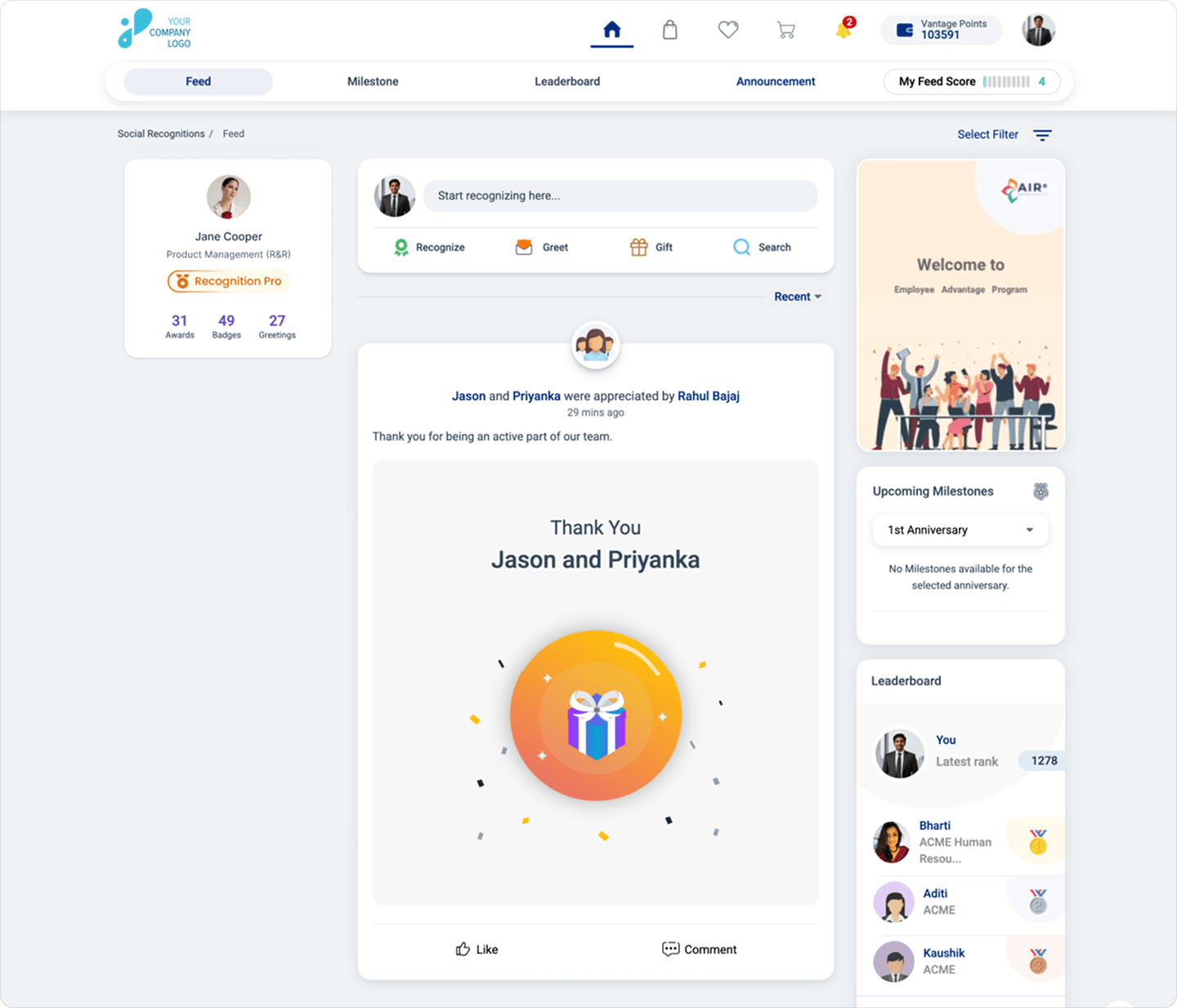
A shout-out on stage reaches only the people in the room, for about thirty seconds. Posting the same recognition to a company-wide social recognition feed lets remote and absent colleagues see it, comment, and add their own, so the moment outlasts the meeting.
A UK recognition benchmark offers a clue to what belongs on stage at a town hall. What drives the value of UK Recognition awards: financial incentive 61%, social recognition 52%, company-wide awards events 47%, team/department awards events 46%, special status/privileges for awardees 33%, involving family members of awardees 11%, according to AIRe Benchmarking Report UK 2023-24 (Vantage Circle). Social recognition and company-wide award events are both bigger value drivers than most leaders assume, which is a case for making public recognition a standing agenda item at every all-hands, not an occasional add-on.
Deepshikha Bhowmick, Assistant General Manager of Talent Management & Organisation Development at Suraksha Diagnostics, makes the same point from a different angle: regular town halls help cascade company values "down to the last employee," so that even the most junior person on the team understands what the organization is prioritizing and why (Vantage Influencers Podcast episode).
The best town hall questions are often the ones nobody wants to ask with their name attached. Collecting questions anonymously a few days beforehand gives leaders time to prepare honest answers instead of improvising on the spot. Collect anonymous questions before your next town hall instead of relying on who is brave enough to unmute.
A hybrid or remote team adds one more wrinkle: anyone dialing in needs the same chance to be seen and heard as the people in the room. Our guide to transparency in the workplace covers how to keep a town hall honest when not everyone is in the same building.
Problem-solving and innovation meetings
These meetings exist to generate options or fix a specific issue, so attendance stays small on purpose. Inviting people who are not close to the problem slows the meeting down without adding useful input.
4. Brainstorming meeting
- Purpose: Generate new ideas or approaches before committing to one.
- Who attends: A small group with relevant expertise or fresh perspective, not the whole department.
- Cadence & length: As needed, 30 to 60 minutes.
- Agenda: Frame the problem in one sentence, generate ideas without judging them, narrow to 2-3 worth developing, assign an owner to each.
- People moment: Credit idea owners by name in the follow-up notes. Ideas that get implemented without naming who proposed them quietly discourage people from speaking up next time.
5. Problem-solving meeting
- Purpose: Fix a specific, already-identified problem.
- Who attends: Only the people directly facing the problem; extra attendees add noise, not insight.
- Cadence & length: As needed, 30 to 45 minutes.
- Agenda: State the problem and its impact, find the root cause, agree on an action and an owner, set a follow-up date.
- People moment: Thank the person who raised the problem in the first place, even when the fix is still in progress. Problems that get raised and then ignored train people to stop raising them.
For a structured way to walk a team through root-cause analysis and action planning, see our guide to problem-solving skills.
6. Retrospective (post-project review)
- Purpose: Review what worked and what to change before starting the next project or sprint.
- Who attends: The project or sprint team.
- Cadence & length: At the end of each project or sprint, 30 to 60 minutes.
- People moment: Run the "what went well" round first and name contributors before moving to "what to change." Starting with what to change first turns the whole meeting into a complaint session.
Planning and decision-making meetings
Planning and decision meetings turn options into a committed plan with owners. The biggest failure mode here is leaving a meeting with general agreement but no named owner for any next step.
7. Project kickoff meeting
- Purpose: Align the team on scope, timeline, roles and success criteria before work starts.
- Who attends: The project team and its sponsor.
- Cadence & length: Once per project, 45 to 60 minutes.
- Agenda: Goal and success criteria, scope and what is explicitly out of scope, timeline and milestones, roles and decision rights.
- People moment: Acknowledge what each person brings to the project by name, not just by role. "Priya, we need your client relationship here" lands differently than "the account team will handle client-side."
8. Decision-making meeting
- Purpose: Turn a set of options into one committed decision.
- Who attends: The named decider and the people whose input the decision actually needs, not everyone it might interest.
- Cadence & length: As needed, 30 to 45 minutes.
- Agenda: State the decision to be made and the deadline, present options with trade-offs, name who makes the final call (a RAPID or DACI model works well here: who Recommends, who Agrees, who Performs, who gives Input, who Decides), decide and document.
When one person makes decisions without input, it often leads to disagreement later and weaker buy-in. Involving the right people in the decision, with someone clearly accountable for making the final call, tends to produce decisions people actually follow through on. For more on running this well, see our guide to decision-making.
People and development meetings
People meetings are where managers coach, give feedback and recognize individuals, and they are the meetings employees remember.
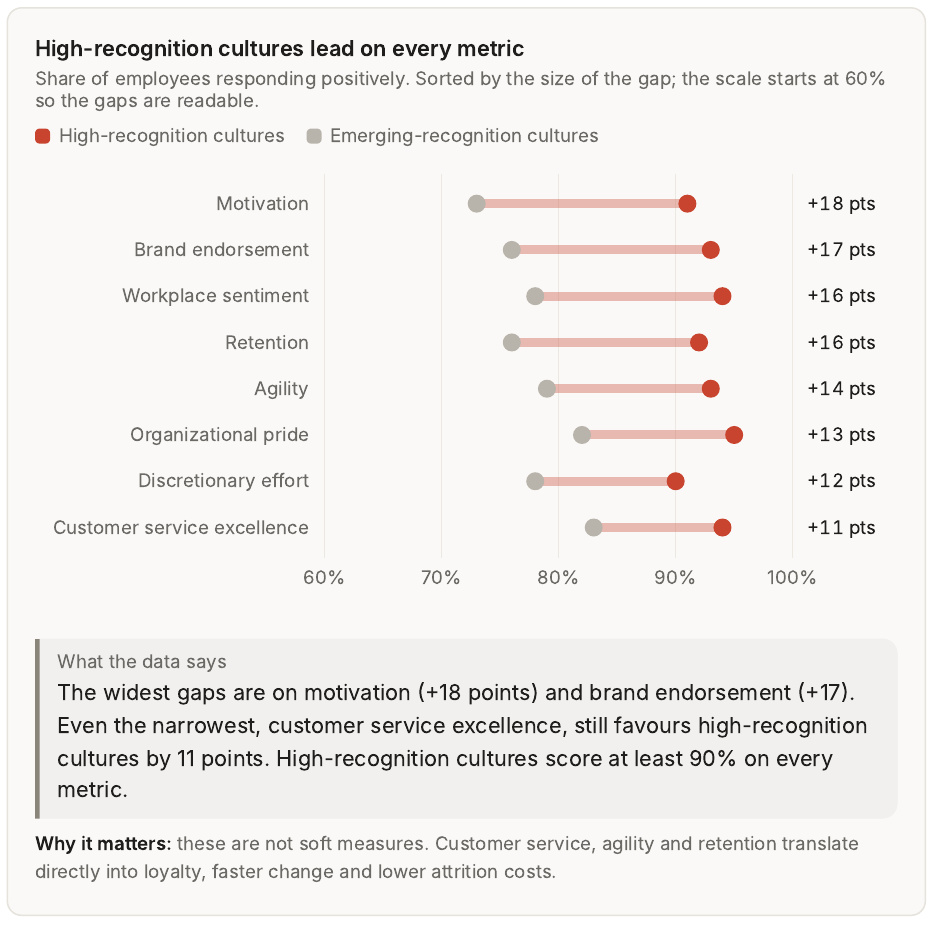
Recognition does not land evenly across an organization. Hierarchy effect: recognition rises with rank, 78% for senior leaders versus 66% for non-supervisory employees, according to The Recognition Effect (Great Place To Work® India × Vantage Circle, 2025). Frontline and individual-contributor employees feel this gap the most, which is exactly why their one-on-ones and skip-levels matter more than any town hall ever will.
9. One-on-one meeting
- Purpose: Coach, give feedback, and check in on the employee's wellbeing and career, not just their task list.
- Who attends: The manager and one direct report.
- Cadence & length: Weekly or biweekly, 20 to 30 minutes.
- Agenda: The employee's agenda first, manager items second, career or growth check-in, including how the employee feels about the company culture and whether the working environment suits them.
- People moment: Open with one specific piece of appreciation before the employee's agenda, not a generic "good job." Before the meeting, a manager can check when the employee was last recognized and for what, so the opening comment is concrete instead of invented on the spot.
Specific, documented recognition going into a one-on-one works better than a compliment pulled from memory. For the research on why specific feedback outperforms generic praise, see our guide to effective feedback.
10. Skip-level meeting
- Purpose: Give a senior leader unfiltered feedback from someone outside their direct chain, and give the employee a channel beyond their own manager.
- Who attends: A senior leader and an employee who does not report to them directly.
- Cadence & length: Quarterly, 20 to 30 minutes.
- Agenda: Open-ended questions about what is working, what is not, and what the employee does not feel comfortable raising with their direct manager.
- People moment: Treat it as a listening meeting first. The value is in what the employee says, not in what the leader presents.
Pandi Alagu Raja Mahamuni, HR Business Leader, has encouraged skip-level meetings at every organization he has worked with, on the principle that there is nothing wrong with an employee going past their direct manager to meet their manager's manager when they need to (Vantage Influencers Podcast episode).
Skip-levels are most useful when the senior leader already knows where the friction points are. Department-level pulse results can show which teams to prioritize and what to ask about before the meeting starts.
11. Performance review meeting
- Purpose: Formally review progress against goals over a set period and agree on what comes next.
- Who attends: The manager and the direct report.
- Cadence & length: Quarterly or annually, 45 to 60 minutes.
- Agenda: Review goals and outcomes, discuss strengths and growth areas, agree on goals for the next period.
- People moment: Nothing in a performance review should be a surprise. If recognition and feedback happened consistently in one-on-ones all period, the review becomes a summary, not a confrontation.
For how to structure the conversation itself, see our guide to performance reviews.
Governance meetings
12. Board meeting
- Purpose: Oversight, compliance and decisions that affect the whole organization.
- Who attends: Board members and relevant executives.
- Cadence & length: Quarterly, 60 to 120 minutes.
Board meeting requirements, including quorum and what counts as valid, vary by jurisdiction and by company bylaws. Check your local regulations and governing documents rather than relying on general guidance for anything legally binding.
Hybrid and virtual meetings: format, not type
A hybrid meeting has some attendees in the room and others joining remotely. Any of the 12 types above can run in hybrid format; hybrid describes how people attend, not what the meeting is for.
The main risk in a hybrid meeting is a two-tier conversation, where people in the room talk to each other and remote attendees watch. Open with a round that includes remote attendees first, not last, and use virtual icebreakers designed for mixed-attendance groups rather than ones built for an in-person room.
Should this be a meeting? A 4-question check
Many status meetings exist only because there is no other place to share wins and updates. Before scheduling one, run through four questions:
Should this be a meeting?
- Does this require a live decision from more than one person? If no, send an async update.
- Does this need real-time discussion or disagreement to work through? If no, a recorded video or written doc covers it.
- Is this a relationship or trust-building moment (a one-on-one, a skip-level)? If yes, it is worth the meeting regardless of the other answers.
- Could this be answered by checking a shared dashboard instead? If yes, fix the dashboard, not the calendar.
A shared recognition and announcement space can replace a standing update meeting without losing visibility. If your team's weekly meeting is mostly people reading out wins that could have been posted, see how a shared platform handles that instead.
Conclusion
Meetings are not the problem. The wrong meeting, with the wrong people, on the wrong cadence, is. Twelve types, grouped by purpose, cover nearly everything a manager needs to run: status and alignment keep people informed, problem-solving and innovation generate and fix, planning and decision-making commit to a path, people and development meetings are where employees feel seen, and governance keeps the organization accountable. Build a small, specific people moment into each one, and meetings stop being something people merely survive. For the broader habits that make all of this work day to day, see our guide to workplace communication.
Frequently Asked Questions
What are the different types of meetings and how do they differ from each other?
Workplace meetings differ by purpose, attendees, cadence and length. They generally fall into five groups: status and alignment (stand-ups, team meetings, all-hands), problem-solving and innovation (brainstorming, problem-solving, retrospectives), planning and decision-making (kickoffs, decision meetings), people and development (one-on-ones, skip-levels, performance reviews), and governance (board meetings).
What is a hybrid meeting?
A hybrid meeting has some attendees in the room and others joining remotely at the same time. It is a format, not a separate meeting type: a stand-up, a one-on-one or an all-hands can all run as a hybrid meeting.
What are the five roles in a meeting?
Most well-run meetings assign five roles: a facilitator who keeps the discussion on track, a decision-maker who has final say, a note-taker who documents outcomes and owners, a timekeeper who watches the clock, and participants who contribute input.
What are 5 things you would include in a meeting agenda?
A solid meeting agenda includes the meeting's goal, the specific topics to cover, how much time is allotted to each topic, who is responsible for each topic, and the decision or outcome expected by the end.
What are the requirements for a valid company meeting?
Requirements for a valid company meeting, such as quorum and notice periods, vary by jurisdiction and by a company's own bylaws or articles of association. Check local company law and your organization's governing documents rather than relying on general guidance.

Shaoni Gupta is a content marketing specialist at Vantage Circle, with expertise in scriptwriting and copywriting in the field of employee rewards and recognition.
Connect with Shaoni on LinkedIn.