
Team meeting ideas sort by how much time they take. Icebreakers fill the first 3-5 minutes. Collaborative activities need 10-15 and build trust between people. Structure tips shape the whole meeting so it stays productive. Which mix you need comes down to one thing: are you warming the team up, or trying to get real work done?
Most weekly team meetings I sit through open with someone sharing a screen and saying "let's give people a minute to join." Then the first five minutes go to waiting.
Five minutes doesn't sound like much. Across a year of weekly meetings it comes to more than four hours of a team watching each other's cameras load.
I've grouped the ideas below by how much time they take, because time is usually the real constraint. A two-minute warm-up and a fifteen-minute activity solve different problems. Not sure yet what kind of meeting you're running? Read our guide to the types of meetings first, then come back.
The Ideas We'll Cover Below
Icebreakers and Quick Warm-Ups (3-5 Minutes)
Keep icebreakers under five minutes and keep the ask small. A one-word answer. A photo. The goal is to get every voice into the room once before the agenda starts.
That matters more on hybrid and remote teams. Someone on a video call can go a full hour without speaking, and nobody notices until their camera stays off for good. Aon's 2025 Human Capital Employee Sentiment Study surveyed more than 9,000 employees across 23 geographies and found fully remote employees are 52% more likely to feel undervalued. A thirty-second check-in won't fix that on its own. It does make sure the remote person has said something before the decisions get made.
These four hold up week after week.
| Icebreaker | How It Works |
|---|---|
| One-word check-in | Everyone gives one word for how their week is going. Explanations are optional. |
| Rose and thorn | Each person shares something that went well and something that's been a pain, one sentence each. |
| Desk show-and-tell | Everyone holds up one thing within arm's reach and explains it. Someone always has a strange mug. |
| This-or-that poll | The laziest option. Coffee or tea, asked in chat. Read the results out loud and move on. |
Rotate them. The same icebreaker every Monday turns into a chore by week four. If the team wants more variety, our list of icebreaker questions has enough to last a quarter.
One honest caveat. Some people dislike icebreakers, and pushing a reluctant engineer to "share a fun fact" burns goodwill fast. Let people pass. Most of them stop passing once they see nobody is putting on a show.
Collaborative and Bonding Activities (10-15 Minutes)
Bonding activities need a real slice of the agenda, usually ten to fifteen minutes. That puts them in weekly or monthly meetings. Squeezing one into a daily standup just makes the standup longer.
The ones that work tend to involve the actual work. Ten minutes on a real problem builds more trust, in my experience, than pet trivia ever has. I've gone back and forth on this, honestly. Games have their place at offsites. In a regular Tuesday meeting, though, people spot filler within about a minute.
A few formats worth trying:
Problem swap. One person brings a stuck problem. Everyone else gets five minutes to suggest a fix, and the owner picks one to try before next week.
Five-minute teach. A teammate shows the group something they know that others don't. It can be as small as a spreadsheet shortcut.
Failure of the week. Someone shares a thing that went wrong and what they'd change next time. This only works if the manager goes first, more than once, with a real mistake. Otherwise you get safe, tidy failures. Nobody learns much from those.
Then there's the one I'd put ahead of all of these.
Win of the Week
In Win of the Week, one teammate opens the meeting by crediting a colleague for something specific from the past week. Five minutes, tops. I've seen it done badly plenty of times, so the details below matter.
Here's how to run it:
- Rotate the nominator. A different person names the win each week, so it never becomes the manager's job alone.
- Name the person and the moment. "Thanks to Ria" is weak. "Ria caught the pricing error in the Henderson proposal on Thursday night" is the bar.
- Say why it mattered. One sentence.
- Tie it to a value. If your company has named values, say which one the win showed.
- Post it after the meeting. Most teams skip this step. In my experience it's the step that decides whether the habit lasts past month one.
A shoutout in the meeting reaches the six people on the call. Then the call ends. The colleague's skip-level manager never hears about it, and neither does the team two floors down that depends on her work.
Gartner's 2024 ReimagineHR findings on core performers found only 42% of them believe they're appropriately recognized for their contributions.
42% → 22%
of core performers feel appropriately recognized, but the ones who do show 22% higher engagement than those who don't. (Gartner, 2024)
These are the steady people on every team, the ones who rarely make the all-hands slide.
I'd push back slightly on reading that 22% as a case for recognizing more often. Being specific has mattered more than being frequent on the teams I've watched. A vague "great job, everyone" every week teaches people to tune it out.
I watched one team lead, Farhan, run this every Monday for a quarter. By week six, people walked in with nominations already typed out. The meeting itself looked the same. But people had started paying attention to each other's work midweek, since they knew Monday was coming.
"Start the meeting with a win" is one of the oldest meeting tips around. This very post carried it as tip #2 for four years. Most teams I've seen try it quit by the second month. The win gets said out loud, people clap on mute, and by Wednesday it's gone. Give it somewhere to live after the call and it tends to stick.
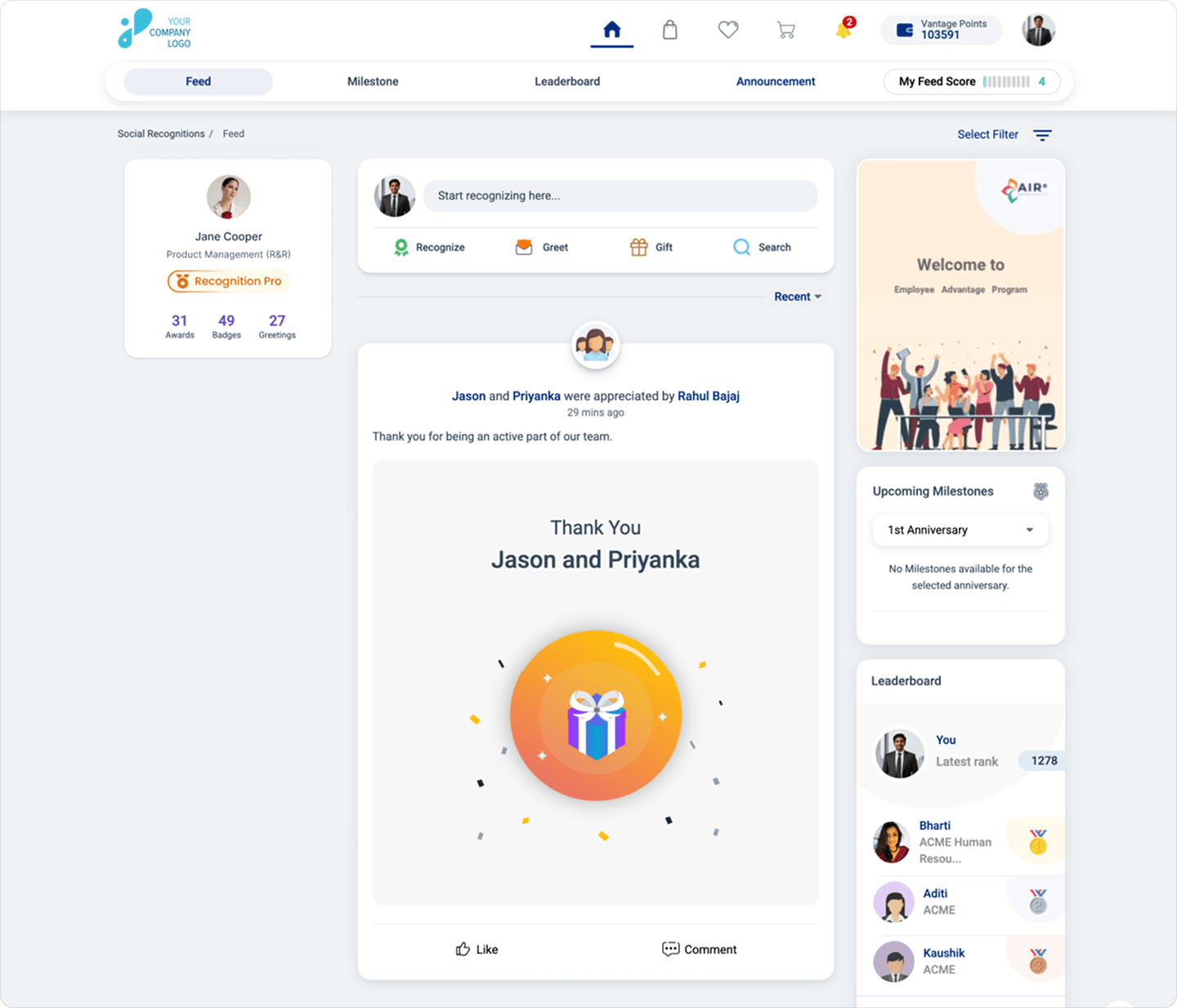
Posting the shoutout to Vantage Rewards puts it on a social recognition feed the whole company can see. The teammate who nominated can send the recognition directly. You can also tag each post to a company value. A few months in, scroll back through the feed. One or two values show up constantly. Usually a couple never appear at all, and that alone is worth raising with leadership.
Source: Vantage Rewards
Productivity and Structure Tips
A good icebreaker can't save a meeting with a vague purpose and fourteen invitees. I've tried. What fixes it is structure, and most of that is unglamorous.
McKinsey's 2023 explainer on effective meetings cites a survey where 61% of executives said at least half their decision-making time was ineffective. A lot of that time happens in meetings.
A bad 30-minute call can also eat the rest of the afternoon. A 2025 Harvard Business Review study found more than 90% of people surveyed had experienced a "meeting hangover," a stretch of lost focus after a bad meeting. The researchers put the share of meetings that left people feeling worse afterward at about 28%. So more than one meeting in four.
Four habits fix most of it. I'd add them in this order.
| Tip | Why It Works |
|---|---|
| Write the agenda as questions | "Do we launch Thursday or push a week?" tells you who has to be there and when to stop. |
| Cut the invite list | Each person gets more airtime. Anyone who only needs the outcome can read the notes. |
| End five minutes early | People get a buffer before their next call and show up less frazzled. |
| Close with owners and dates | Every action item gets one name and one deadline, read aloud before anyone leaves. |
The agenda-as-questions idea comes from meeting researcher Steven Rogelberg. If you only try one thing from this list, try that one.
Fewer meetings help too. Researchers writing in MIT Sloan Management Review in 2022 looked at 76 companies that brought in meeting-free days. Where meetings dropped by about 40%, roughly two clear days a week, productivity ratings came out 71% higher. I don't fully trust that number for a ten-person team with weekly client calls. Two clear days is a lot to ask when clients book the calendar. One protected afternoon a week is a more realistic first test.
How to Know If Your Meetings Are Actually Working
The only reliable way I know is to ask, anonymously, about once a month. A lot of managers go by complaints. No complaints, so the meeting must be fine. Usually the silence just means people stopped expecting the meeting to change.
Gartner's 2023 engagement research figure was one in three. That's the share of employees who expect their organization to act on feedback. Ask for a show of hands at 4:58 on a Friday and you'll get thumbs up from people already leaving the call.
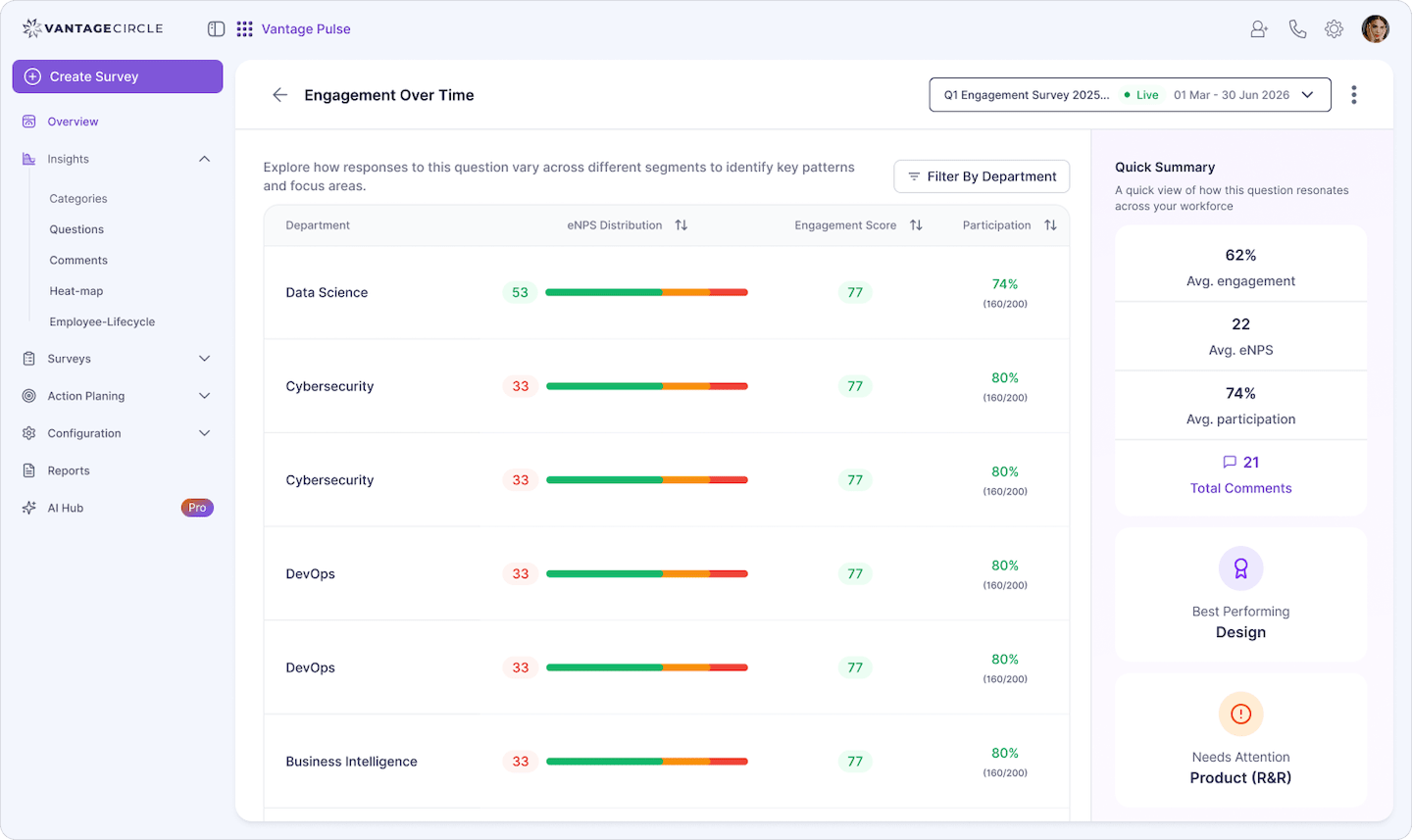
One anonymous question works better. I'd ask "Was this week's team meeting a good use of your time?" on a 1 to 5 scale. Add a comment box. Keep it optional. Through Vantage Pulse the answers stay anonymous, which is what gets the quieter people to admit the format isn't working.
Source: Vantage Pulse
After that, change one small thing and say so out loud. Scores say it runs long? Cut ten minutes and mention it the next Monday. That visible change does more for trust than the survey itself.
Watch the trend over any single score. If a meeting drifts from 4.2 down to 3.1 across two months, something's off there, even if the room has been quiet.
Conclusion
Most of the meetings I've seen go sideways had two problems. Nobody had decided what the meeting was for. And whatever good news came up stayed in the room.
If you want somewhere to start, Win of the Week is the one I'd pick. It costs five minutes, and nobody needs approval to try it.
FAQ
Q1. What are some fun things to do at a team meeting?
A: My go-to is the one-word check-in, about ninety seconds start to finish. If there's ten minutes spare, do a five-minute teach. Somebody shows the group a trick they use, like a keyboard shortcut or how they sort their inbox. Win of the Week works too, and it's covered in detail above.
Q2. How to make a team meeting more interesting?
A: Let somebody other than the manager run the first five minutes, and change who it is every week. Small change. It means the manager isn't the only voice for the first ten minutes. Status updates can mostly go in a shared doc the day before, which leaves room for one real problem.
Q3. What are some good topics for a team meeting?
A: Anything that needs two or more people to decide goes first. After that, anything someone is stuck on and can't clear alone. Wins worth recognizing belong on the list too. Status updates are usually the weakest use of meeting time, since most of them can be read in advance.
Q4. What are the 5 P's of meetings?
A: Depends who you ask. The version I see most often starts with purpose, which is just why you're meeting at all. Then product, the thing you want to walk out with. Usually a decision. People is the guest list. Keep it short. The process part is just the order you'll take the agenda in. And pitfalls? Whatever usually derails you, like the colleague who reopens last week's decision every single time. Some lists use practicalities like time and room for that slot.

He has worked in the human resources environment and has elevated recognition and rewards through his insightful and detailed writing. He aims to enhance the practice of Recognition in the workplace with new ideas and innovation that will help shape the work culture. For any related queries, contact editor@vantagecircle.com