Picture the average performance review. A manager scrolls back through six months of Slack messages the night before, trying to remember what actually happened in March. The employee walks in already guessing what the rating will be. Twenty minutes later, both people leave with a number neither one fully trusts.
That's what happens when assessment gets treated as a once-a-year event instead of a system. Six distinct types exist to fix exactly that problem, and most organizations only ever use one of them.
Key Takeaways
- Employee assessment isn't one activity, it's six distinct types (performance reviews, skills, behavioral, 360-degree, self, and potential assessments), each answering a different question about how someone is doing.
- 63%. That's the share of employers naming skills gaps as the single biggest barrier to business transformation, per the World Economic Forum's Future of Jobs Report 2025.
- Formal assessment measurably beats gut-feel rating: 16% higher accuracy and 41% higher perceived fairness in pay decisions, per The Talent Strategy Group's 2026 Performance Management Report.
- Self-ratings quietly anchor the final number more than most managers admit, per a 2025 Harvard Kennedy School study on performance-review bias.
- Most organizations skip calibration, the one practice that keeps one manager's "meets expectations" from meaning something different than another's.
What Is Employee Assessment?
Employee assessment is the structured, ongoing process organizations use to evaluate a current employee's performance, skills, and behavior against defined criteria. It measures people already on the team, not candidates being screened before hire, and it works as a system of six distinct types rather than a single annual event.
Most of the confusion around this term traces back to a search-engine collision. A candidate googling "will I pass the Walmart assessment test" and an HR manager googling "employee assessment process" land on the same results page, even though they're asking about two completely different moments in someone's employment.
This page is for the HR manager. It stays inside one lane, assessing people who are already on your team, well after they've been hired.
"Employee evaluation" shows up constantly as a stand-in for the same idea. In most HR conversations, the two terms get used without much distinction. Whichever one your team defaults to internally, both point to the same six-part practice covered below.
What actually separates a working assessment process from a box-checking one isn't the terminology. It's how many of those six types an organization uses on purpose. Most companies default to whatever process survived from the last performance-management vendor they signed with. Few ever go back and ask whether that default still fits what they're trying to measure.
The 6 Types of Employee Assessment
Employee assessment isn't one activity. It's six of them, each answering a different question about how someone is doing at work.
A performance review asks whether someone hit their goals. Simple enough on paper.
A skills assessment digs into whether they can actually do the technical parts of the job. That's a different test than a review conversation, which tends to stay at the surface. Behavioral assessment looks at how someone works with other people, which sounds soft until you realize it's usually what actually gets someone promoted or managed out. 360-degree feedback exists because a single manager's view of someone's year is incomplete no matter how good that manager is. Self-assessment flips the mic to the employee.
Potential assessment looks forward. It asks how far someone could go if the organization invested in them. That's a fundamentally different question than a quarterly review is built to answer.
The table below breaks down what each type measures and when it's the right tool. Each type gets its own section after that, some longer than others depending on how much ground still needs covering.
| Type | What It Measures | Best Used For |
|---|---|---|
| Performance Reviews | Goal achievement against set targets | Regular cycles: quarterly or annual |
| Skills Assessments | Technical and job-specific competence | Spotting training and role-fit gaps |
| Behavioral Assessments | Workplace conduct and interpersonal patterns | Team composition and culture concerns |
| 360-Degree Feedback | Performance from multiple vantage points | Leadership roles, cross-functional work |
| Self-Assessments | The employee's own view of their year | Pairing with manager input, building ownership |
| Potential Assessments | Readiness for greater responsibility | Succession planning, promotion decisions |
1. Performance Reviews
Performance reviews are the assessment type most people picture when they hear the term. A manager and employee sit down, usually quarterly or annually, and go through what got accomplished against what was planned.
The best ones cover the same ground every time. They revisit goals from the last cycle, pull in feedback gathered from supervisors and peers, and land on what the next set of objectives should look like. Skip any one of those and the review turns into either a pure scorecard or a vague chat with no record attached.
Vantage Circle has already gone deep on this specific type. For a full breakdown of review formats and cadence options, see the 7 modern performance appraisal methods.
2. Skills Assessments
Skills assessments test whether someone can actually do the job. Talking about it well in an interview is a different skill entirely, and it's the one most hiring processes already screen for.
The World Economic Forum's Future of Jobs Report 2025 found that skills gaps are now the single biggest barrier to business transformation, with nearly six in ten workers expected to need meaningful reskilling by 2030. Against numbers like that, a skills assessment stops being an HR nicety and becomes closer to a business continuity check.
A skills assessment usually takes one of three forms. Domain-knowledge tests check whether someone actually knows the material, the same logic behind a compliance quiz or a coding assessment. Simulations go further, dropping someone into something close to a real scenario, a mock customer escalation, a sample report built under a deadline. Practical exercises land in between, where someone completes an actual task under direct observation.
I've reviewed skills-assessment results that told a manager something their gut feel had completely missed. A senior analyst who'd been quietly struggling with a newer reporting tool for months, something nobody caught in casual conversation because he was too senior to admit it out loud, showed up clearly once the team ran a structured competency check. Two afternoons of targeted training fixed it. No performance improvement plan needed.
This is also where Vantage Circle's own content has genuine whitespace, since nothing on the broader performance-management cluster currently goes deep on skills or competency assessment specifically, even though it's one of the more concrete, trainable gaps HR can close once it's actually measured.
3. Behavioral Assessments
Behavioral assessment looks at how someone actually operates day to day. It covers how they handle conflict, whether they follow through on commitments, and what they're like in a room when things go sideways.
Personality assessments and structured behavioral interviews are the traditional tools here. Both work, but both are also snapshots, taken once and treated as settled fact for a year.
(Source: Vantage Pulse)
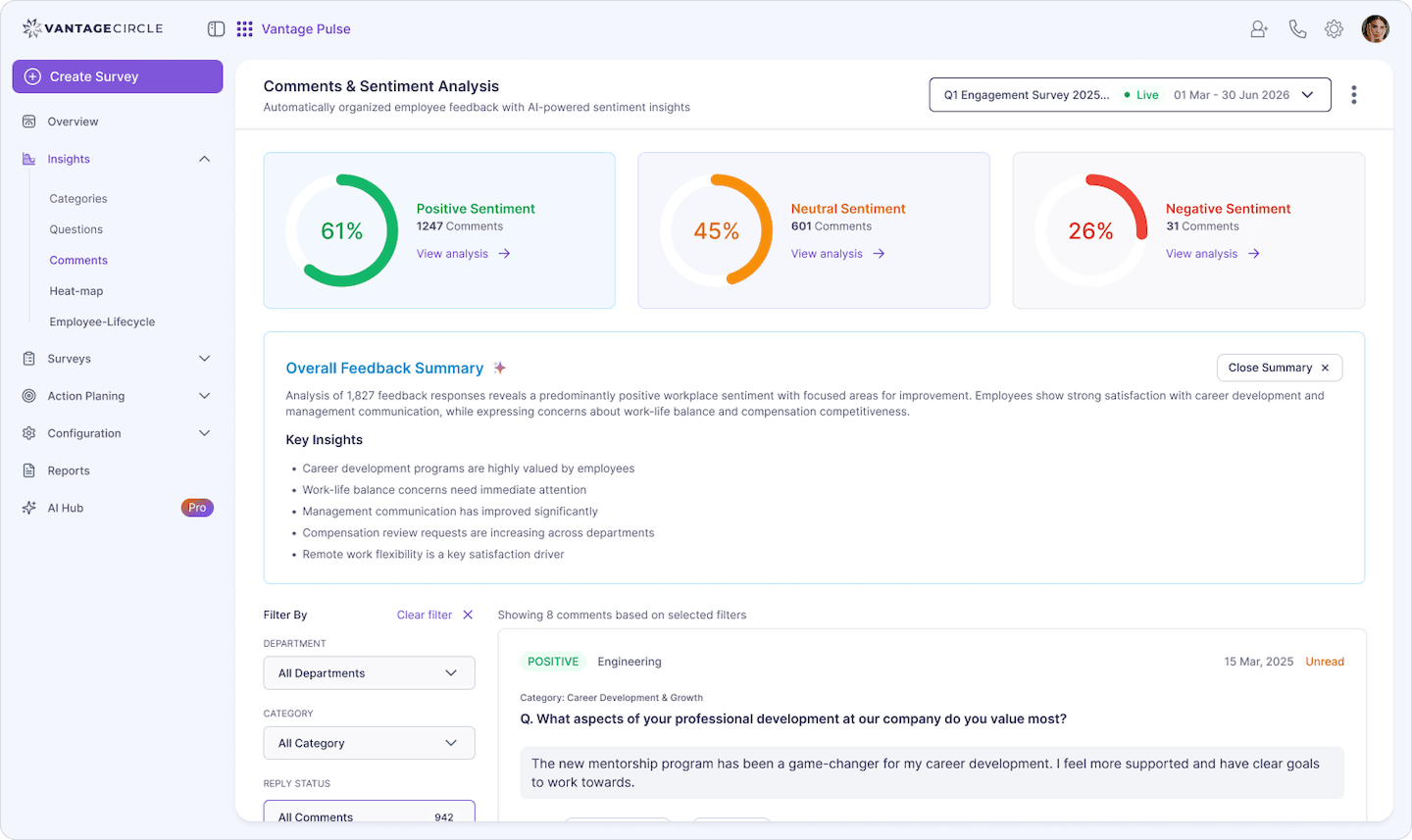
Vantage Pulse's sentiment analysis feature closes some of that gap. It scores open-text survey responses on an ongoing basis, giving a manager a running read on how someone is actually interacting with the team between formal review cycles.
Behavioral criteria get subjective fast. Something like "good attitude" means something different to every manager holding the pen. Anchoring behavioral assessment to a documented set of core values, the same ones a recognition program runs on through a feature like Vantage Rewards' Core Values Alignment, gives assessors a shared standard to point to.
4. 360-Degree Feedback
360-degree feedback pulls input from every direction around an employee. Supervisors, peers, direct reports, sometimes people outside the immediate team entirely. No single manager sees the whole picture, and this type exists specifically to fix that blind spot.
The honesty of the input is the whole game here. Peer feedback that gets softened because a colleague is worried about being identified isn't worth much more than no feedback at all.
Vantage Pulse's anonymous response setting addresses exactly that concern, giving 360 contributors a channel where honest input doesn't carry a social cost.
This type gets covered in far more depth elsewhere on the site. See a full breakdown of 360-degree feedback for formats, question banks, and rollout guidance.
5. Self-Assessments
Self-assessment asks employees to evaluate their own performance before anyone else weighs in. It sounds like a formality until you watch what it actually surfaces. Employees consistently rate themselves differently than their managers do, and the gap itself is useful information.
That gap isn't just sitting quietly next to the manager's opinion, either. A 2025 Harvard Kennedy School study led by Iris Bohnet, examining four review cycles at a multinational financial services firm, found something worth knowing. During a one-year software glitch that hid self-evaluations from managers, average ratings dropped and tracked self-scores far less closely than in any other year. Self-ratings, it turns out, quietly anchor the final number more than most managers would admit.
Someone who scores themselves far above what the data supports might be missing feedback signals earlier in the year. Someone who scores themselves low despite strong results might be dealing with impostor syndrome, which is worth a manager naming out loud.
Vantage Circle already has strong resources here, among the best-performing pages on the site. For real examples to reference, see 100+ self-appraisal comment examples and 60 self-evaluation examples.
6. Potential Assessments
Potential assessment looks forward. It asks how far someone could go if the organization invested in them, a fundamentally different question than a performance review is built to answer.
The traits under evaluation here are harder to pin down than a skills checklist. Adaptability, how someone handles ambiguity, whether they think strategically past their current role, signs of leadership even before someone holds a title.
This is the type most vulnerable to bias when it's left to gut feel. "High potential" too often ends up describing whoever reminds a senior leader of themselves at a younger age. Missing data plays a role here too. Gartner's HR research found only 8% of organizations have reliable data on the skills their workforce actually holds. Most potential calls end up resting on impression, because the evidence to do it properly was never collected in the first place. A documented, criteria-based potential assessment, tied to specific evidence, is the only version of this that actually builds a defensible succession pipeline.
Skip this type and an organization is left discovering its future leaders by accident, usually right when it needs one to step up.
Why Employee Assessment Matters
Employee assessment matters because guessing is expensive. A manager who relies on gut feel for a year-end rating is making decisions about pay, promotion, and sometimes someone's job security based on whatever stood out most in the last six weeks.
Formal assessment fixes some of that, though not by magic. The Talent Strategy Group's 2026 Performance Management Report, built from data across more than 250 organizations gathered in late 2025, found that companies with a formal review component report 16% higher effectiveness in accurately assessing performance than those without one, along with a 41% jump in perceived effectiveness for distributing compensation fairly.
Organizations running a formal assessment process report 16% higher accuracy in evaluating performance and 41% higher effectiveness in distributing pay fairly, compared to organizations without one. Source: The Talent Strategy Group, 2026 Performance Management Report.
That gap holds up because structure removes some of the noise a single conversation can't. A defined process forces the same criteria across every employee in a role, catches the manager who rates everyone a 4 out of habit, and gives HR something concrete to point to when someone asks why a raise landed where it did.
None of that happens automatically just because a form exists. The objectives of performance appraisal still have to be set deliberately, or the process becomes exactly the box-checking exercise it was supposed to replace. Done right, assessment is one of the clearest levers an organization has for keeping employee engagement tied to something real. A survey score nobody acts on doesn't move the needle the same way.
How to Measure Employee Assessment: 6 Practices
Six practices matter here, and I'll be honest, most organizations already do two or three of them without realizing it. The gap is usually in the other four.
1. Set Clear Objectives and Metrics
Vague goals produce vague assessments. Define what success looks like before the assessment starts. A target productivity number. A customer satisfaction threshold. A specific skill, demonstrated on a specific project. Specific enough that two different managers score the same evidence the same way.
2. Let Technology Do the Heavy Lifting
Spreadsheets from six different managers, cross-referenced by hand. That's how good assessment data quietly dies before anyone acts on it. One platform. Scores, comments, trend history, all in one view. A department head shouldn't need an entire afternoon to reconcile ratings a decent dashboard surfaces in ten minutes.
3. Build Regular Feedback Into the Calendar
Once a year isn't enough. Fifteen-minute check-ins, scheduled between formal reviews. Catch problems while there's still time to fix them. Cadence over format.
4. Calibrate Across Teams
This is the practice organizations skip most often, and it's probably the one that matters most. Two managers rating the same performance land on two different scores constantly, unless someone forces a conversation about what "meets expectations" actually means. Calibration sessions are that conversation. Skip them and one department's 4 out of 5 quietly becomes another department's 2, with nobody noticing until someone compares notes at a promotion committee meeting.
5. Combine Qualitative and Quantitative Data
Numbers alone flatten a person into a score. A rating of 3 out of 5 means almost nothing without a comment attached explaining why. Pair them.
6. Benchmark Against Something External
An organization's internal comparisons only say how it's doing relative to itself. Is a "strong performer" here actually strong by market standards? Industry benchmarks and salary survey data are the only way to answer that honestly. It won't change how any single assessment gets scored, but it shapes where the bar sits for everyone.
None of these six practices does much on its own. Calibration without clear metrics just standardizes confusion more efficiently. The six work as a set, and skipping even one tends to undercut the other five more than most HR teams expect.
The Employee Assessment Process: 6 Steps
1. Plan Before You Assess
Skip the planning step and the whole process feels arbitrary to the person on the receiving end. Outline what's being evaluated. Define the criteria in writing. Confirm who's involved before the first conversation happens.
2. Collect Data From More Than One Source
A manager's memory of the last few weeks is recency bias wearing a data source's clothes. Surveys. Interviews. Performance metrics. Skills tests. Each one catches something the others miss. Pull from at least two before drafting any rating.
3. Turn Data Into an Actual Conversation
Data that never gets discussed is just paperwork sitting in a folder. Sit down with the employee. Walk through specific findings. A constructive feedback approach here is the difference between someone leaving the room motivated and someone leaving defensive, and it's a bigger factor than most managers give it credit for.
4. Set Goals Together
An assessment without new goals attached is a report card, nothing more. Employees who help shape their own goals tend to actually chase them. Targets handed down from above tend to breed quiet resentment.
5. Implement and Keep Watching
Development plans fail quietly. Nobody checks on them after the meeting ends, and three months later nothing's changed. Track progress on a real schedule.
(Source: Vantage Rewards)
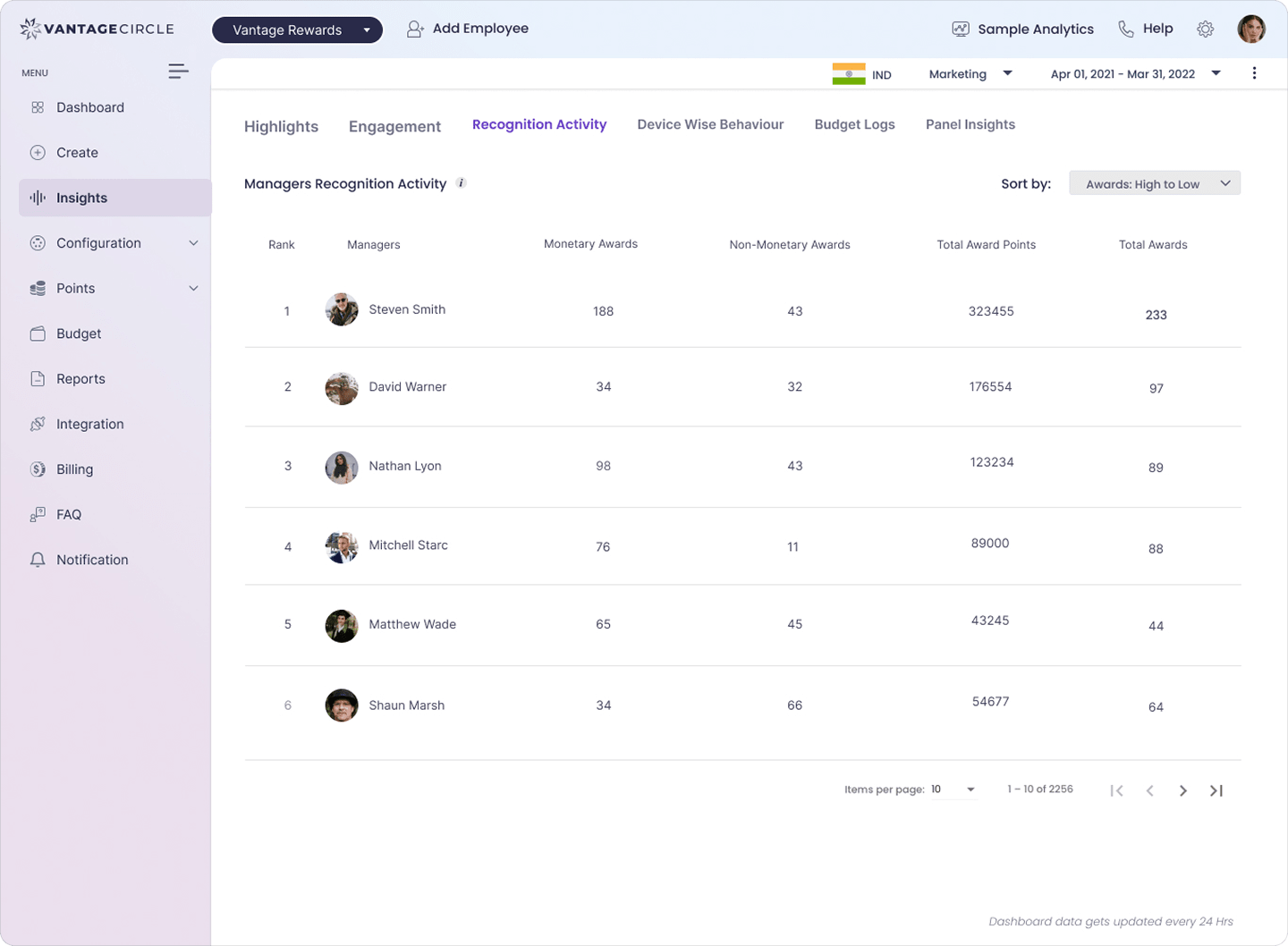
Closing the loop with recognition when someone acts on feedback keeps the change reinforced while it's still fresh. Vantage Rewards' manager recognition feature builds that acknowledgment directly into the workflow, so it doesn't depend on someone remembering to do it weeks later.
6. Close the Loop on the Process
Most organizations review the employee and call it done. Almost nobody goes back and asks whether the process itself held up. Did the criteria actually apply consistently across managers?
Vantage Pulse's department-wise insights answer that by breaking outcomes down by team. The pattern it surfaces, one department quietly rating everyone a notch higher than another, is nearly invisible without the data laid side by side.
I'll admit the six-step version above reads cleaner than it actually runs in most organizations. Step five is where things usually stall. Everyone nails the planning and the conversation, then the follow-through quietly disappears once the next quarter's priorities show up.
5 Best Practices for Conducting an Employee Assessment Session
1. Prepare a Real Agenda
A checklist beforehand. Shared with the employee ahead of time so nothing lands as a surprise. That's most of it.
2. Set Goals the Employee Actually Understands
Break the organization's expectations into specific, sequenced pieces. Attach a realistic timeline to each one. Confidence follows clarity. It rarely follows encouragement alone.
3. Be Honest About the Purpose
Employees can tell when a session is performative. They check out the moment they sense it. Say plainly why the session is happening. Name the outcome both sides are actually working toward.
4. Keep the Cadence Predictable
Quarterly or annual works equally well. Holding to whichever one gets chosen is what actually matters. A cycle that gets skipped or shows up late starts reading like a warning sign, whether or not it was meant that way.
5. Make It a Two-Way Conversation
Ask what the organization could be doing better. Ask what's missing. The best sessions end with both people having talked in roughly equal measure.
Conclusion
Six distinct tools. Six different decisions. Performance reviews, skills checks, behavioral assessment, 360-degree feedback, self-assessment, potential assessment, each one answers something different. Most organizations lean on one or two and let the rest sit unused.
Running all six on everyone, all the time, isn't practical for most HR teams, and it isn't necessary either. The type has to match the decision at hand: a raise, a training budget, a leadership track, whatever's actually on the table. Run it consistently enough that the data means something by the third or fourth cycle.
Assessment done well doesn't stop at a rating. It ends with a plan, a recognized win, and a reason to show up for the next cycle and do it again.
FAQ
Q1. What is an employee assessment?
A. The structured, ongoing process organizations use to evaluate a current employee's performance, skills, and behavior. Not pre-employment candidate testing, which happens at the hiring stage, before anyone's on payroll.
Q2. What are 5 examples of performance assessment?
A. Annual or quarterly performance reviews. 360-degree feedback. Self-assessment. Skills or competency testing. Potential assessment for succession planning. Five types, and a sixth, behavioral assessment, that a growing number of organizations now run alongside them.
Q3. What is an employee evaluation?
A. Same practice, different word. Some organizations reserve "evaluation" for the performance-review type specifically and use "assessment" as the umbrella term, but that split isn't consistent industry-wide, so both usually mean the same six-type framework.
Q4. What's the difference between a skills assessment and a competency assessment?
A. Skills assessment measures something specific and teachable, proficiency in a software tool, say. Competency assessment is broader: judgment under pressure, cross-functional collaboration, capabilities that combine several skills at once. Most smaller organizations use the two terms interchangeably anyway, and never notice the difference matters.
Q5. How often should employee assessments happen?
A. Annually or quarterly for the formal cycle, but that shouldn't be the only point of contact. A sales role changing month to month needs tighter check-ins than a stable back-office function does. Role volatility, more than any universal best practice, is what should set the cadence.

He has worked in the human resources environment and has elevated recognition and rewards through his insightful and detailed writing. He aims to enhance the practice of Recognition in the workplace with new ideas and innovation that will help shape the work culture. For any related queries, contact editor@vantagecircle.com