

Employee performance tracking is the practice of monitoring, measuring, and evaluating how well employees do their work against clear goals. Done right, it aligns individual effort with business priorities, surfaces your strongest performers, and shows exactly where people need support. Done poorly, it becomes surveillance that erodes trust.
Most companies sit somewhere in between. They have a performance management process on paper. But the day-to-day tracking is inconsistent, gut-feel driven, and concentrated around one annual review.
That gap is expensive. 77% of employees are not engaged or are actively disengaged at work, according to Gallup. You cannot fix what you do not measure. And you cannot measure engagement or output without a real tracking system underneath it.
This guide breaks down what to track, how to track it, the tools that help, and how to do it without crossing the line into micromanagement. There is a free template at the end.
Key Insights
- What employee performance tracking is and why it matters
- The performance metrics and KPIs worth tracking
- A 6-step method to track performance consistently
- How to track performance ethically, not as surveillance
- The best performance tracking tools and a free template
What is Employee Performance Tracking?
Employee performance tracking is the ongoing process of monitoring, measuring, and evaluating an employee's output, behaviors, and progress against defined goals. It turns subjective impressions into evidence you can act on.
It is not the same as a performance review. A review is a moment. Tracking is the continuous record that makes that moment fair and accurate.
Three things separate good tracking from a spreadsheet that collects dust:
- It is goal-anchored. Every metric ties back to a role expectation or business objective.
- It is continuous. Data is captured in the flow of work, not reconstructed from memory once a year.
- It is two-way. Employees see the same data their manager sees, so there are no surprises.
When those three hold, tracking stops being a control mechanism. It becomes a coaching system.
Why Tracking Employee Performance Matters
Performance tracking is not an administrative chore. It is one of the clearest predictors of whether a team improves or stalls. Here is what consistent tracking actually drives.
It separates high-performing programs from the rest
Tracking discipline is a marker of organizations that get results. As per The State of Recognition & Rewards 2025 Report, the most effective programs stood out on one habit above all: nine in ten of them monitor participation, frequency, and behavioral trends, and nearly all measure return on investment. The weaker programs tracked almost nothing. The pattern is hard to miss. What gets measured gets managed.
It improves productivity, not just paperwork
Measurement changes behavior. Among companies that rated their programs highly effective on engagement and behavior, 86% also reported high effectiveness on productivity (The State of Recognition & Rewards 2025). When people know how their work is assessed, and when they get feedback against it often, output rises.
It catches problems while they are still small
A once-a-year review tells you about a problem months after it started. Continuous tracking flags a dip in week three. That early signal is the difference between a quick coaching conversation and a drawn-out case of poor employee performance that drags down a whole team.
It makes development specific
Tracking shows you exactly where someone is strong and where they are stuck. That lets you build targeted employee development plans instead of generic training nobody needs. It also makes it obvious who is ready for more responsibility.
It builds accountability and fairness
When expectations and progress are visible to everyone, decisions about promotions, raises, and roles stop feeling political. They become evidence-based. That fairness is a retention lever in itself. Recognition-rich, well-tracked cultures show 92% retention compared with 76% in low-recognition cultures, per the AIRe benchmarking report.
Vantage Influencers Podcast
"Clarity is the rocket fuel of performance. When you're not seeing the kind of performance you want in your team or your organization, it always starts with clarity."
— Jason Lauritsen, Employee Engagement Author & Speaker
Listen to the EpisodeWhat to Track: Employee Performance Metrics and KPIs
This is where most tracking systems fall apart. Teams either track everything and drown in data, or track nothing meaningful and call attendance a performance metric.
The fix is to pick a small set of key performance indicators (KPIs) across four categories. Two or three metrics per category is plenty for most roles.
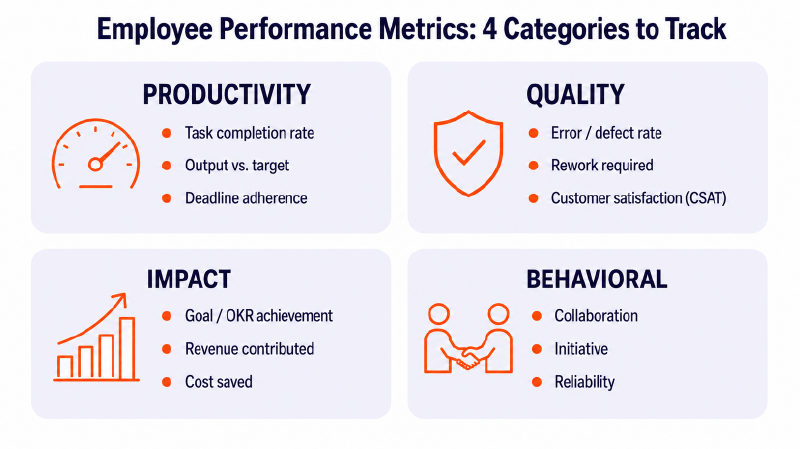
1. Productivity metrics
These measure output and efficiency: how much work gets done and how quickly.
- Task or project completion rate
- Output volume against a target (units, tickets, calls, deals)
- Time to complete key deliverables
- Adherence to deadlines
2. Quality metrics
Speed means nothing if the work is wrong. Quality metrics keep productivity honest.
- Error or defect rate
- Rework required
- Customer satisfaction (CSAT) scores
- Adherence to standard operating procedures
3. Impact metrics
These connect individual effort to business outcomes. They answer the "so what" question.
- Goal or OKR achievement
- Revenue generated or pipeline contributed
- Cost saved or efficiency gained
- Strategic project milestones hit
4. Behavioral metrics
The hardest to quantify and the easiest to ignore. But how someone delivers matters as much as what they deliver.
- Collaboration and peer feedback
- Initiative and problem-solving
- Reliability and follow-through
- Alignment with company values
A quick note on balance. Leading programs increasingly track behaviors, not just outcomes. In The State of Recognition & Rewards 2025, 77% of high-effectiveness programs determined recognition based primarily on observed behaviors, compared with just 27% of weaker ones. Behaviors are repeatable and teachable. Outcomes alone are not.
The metrics test: If a metric does not change a decision you make about coaching, development, or recognition, stop tracking it. It is noise.
How to Track Employee Performance: A 6-Step Method
A good tracking system is a repeatable loop, not a one-off project. Here is a six-step method you can run on any cadence.
Step 1: Set clear, measurable goals
Start with expectations. Use the SMART framework so every goal is specific, measurable, achievable, relevant, and time-bound. Vague goals produce vague tracking. Tie each goal to a business priority through solid performance planning so people understand why the work matters.
Step 2: Define the KPIs for each role
Translate each goal into one or two of the metrics above. Agree on them with the employee. When people help choose how they are measured, they trust the result and own it.
Step 3: Monitor in the flow of work
Capture data continuously, not from memory at review time. Use your project tools, CRM, and one-on-one notes. The goal is a running record, so a quarterly conversation reflects the whole quarter, not the last loud week.
Step 4: Give feedback early and often
Tracking without feedback is just spreadsheets. Short, regular check-ins beat the annual surprise every time. Use them to course-correct while it still matters, and to recognize wins as they happen.
Step 5: Run structured reviews
Bring the continuous data into a formal review on a set cadence. This is where modern methods of performance appraisal like 360-degree feedback add the perspective a single manager cannot see alone.
Step 6: Analyze trends and act
One data point is a moment. A trend line tells a story. Look across review cycles to spot trajectories, then act: coach, develop, reassign, or recognize. This is the step that turns tracking into improvement.
Tracking vs. Surveillance: How to Monitor Performance Ethically
There is a real difference between tracking performance and monitoring people. Cross it, and you trade short-term visibility for long-term trust.
Surveillance watches activity: keystrokes, screen time, every minute online. Performance tracking watches outcomes: did the work get done well, on time, to standard. The first treats employees as suspects. The second treats them as professionals.
Keep tracking on the right side of that line with a few rules:
- Track outcomes, not activity. Hours logged is not performance. Results are.
- Be transparent. Tell people exactly what you measure and why. No hidden monitoring.
- Make it two-way. Employees should see their own data, not just be subjects of it.
- Tie it to growth. Frame tracking as a tool for their development, because it is.
Get this right and tracking builds morale instead of draining it. Get it wrong and your best people leave for somewhere that trusts them.
How to Track Remote and Hybrid Team Performance
Tracking gets harder when you cannot see people at their desks. The instinct is to track presence: who is online, who replied fast, who is green on the status light. That is the surveillance trap in a new outfit.
For distributed teams, the answer is to lean even harder on outcomes. When you cannot watch the work happen, you measure whether the work got done well. A few adjustments help.
- Track deliverables, not availability. Clear output targets matter more than hours when time zones differ.
- Make goals and progress visible. Shared dashboards and written goals replace the hallway check-in.
- Schedule async-friendly feedback. Regular written check-ins keep tracking continuous without forcing everyone onto a call.
- Watch for the quiet drift. Remote underperformance hides longer. Trend data, not vibes, is how you catch it early.
Done this way, remote tracking is often fairer than office tracking. It rewards results over visibility, which is exactly what good tracking should do anyway.
The 5 C's of Performance and the 5 Levels of Performance Rating
Two questions come up constantly when HR teams design a tracking system. Here are clear answers.
The 5 C's of performance are a simple framework for what sustained performance management needs:
- Clarity: People know what is expected and how it is measured.
- Continuous: Feedback happens year-round, not once.
- Coaching: Managers develop, not just judge.
- Contribution: Effort is tied to team and business impact.
- Culture: Performance is reinforced by shared values and recognition.
The 5 levels of performance rating are the standard five-point scale most structured reviews use to summarize results:
- Unsatisfactory: Consistently falls short of expectations.
- Needs improvement: Meets some expectations, misses others.
- Meets expectations: Delivers the role reliably.
- Exceeds expectations: Regularly goes beyond the role.
- Outstanding: Sets the standard others follow.
A rating scale is only as good as the tracking behind it. Without continuous data, a five-point scale is just a manager's mood on review day.
Employee Performance Tracking Software and Tools (2026)
The right tool depends on what you need to track and how your team works. Rather than chase a single "best" platform, match the category to your goal. Most organizations end up combining two or three.
| Category | What it tracks | Examples |
|---|---|---|
| All-in-one performance management | Reviews, goals, 360 feedback, continuous check-ins | BambooHR, Lattice, 15Five |
| Continuous feedback and growth | Ongoing feedback, engagement, development | Culture Amp, Leapsome |
| Project and task tracking | Day-to-day output and deadlines | Asana, ClickUp, Jira |
| Goals and OKRs | Objective setting and progress | Betterworks, Workday |
| Employee listening and feedback | Sentiment, eNPS, manager effectiveness | Vantage Pulse |
A tracking stack works best when output data and people data live close together. That is why many HR teams pair a performance platform with an employee listening tool. Vantage Pulse, Vantage Circle's employee engagement and pulse survey tool, captures the sentiment side of performance: how supported people feel, where friction is building, and which managers need help. Hard metrics tell you what is happening. Listening tells you why.
When you evaluate a tool, weigh it against your needs: ease of admin, integration with your HRIS, reporting depth, and whether it reinforces a coaching culture or just a monitoring one.
Common Performance Tracking Mistakes to Avoid
Even well-intentioned tracking systems fail in predictable ways. Watch for these five.
- Tracking too much. Twenty metrics per person is not rigor, it is noise. You drown the signal and exhaust your managers. Pick the few metrics that change decisions.
- Measuring activity instead of outcomes. Hours logged, emails sent, and screen time feel like data. They are not performance. They reward looking busy over being effective.
- Saving it all for the annual review. Reconstructing a year from memory produces recency bias and unfair ratings. Continuous capture is the fix.
- One-way tracking. When employees never see their own data, tracking feels like a trap. Shared visibility turns it into a development tool.
- Tracking without acting. Data that never leads to coaching, development, or recognition is wasted effort. The point of measuring is to do something with what you find.
The thread connecting all five is purpose. Track to help people improve, not to build a case against them. Disengagement already costs employers an estimated $84 billion a year in lost productivity (Gallup). Tracking that demoralizes people only widens that hole.
Free Employee Performance Tracking Template
You do not need to buy software to start. A solid template gets you tracking this week. Download our free Excel workbook below. It has two ready-to-use tabs you can fill in right away.
1. Annual Performance Evaluation Template
A structured sheet to record goals, ratings across your chosen metrics, and review notes for each employee over the year.

2. Self-Evaluation Template
A companion sheet for employees to assess their own performance before reviews, making the conversation two-way from the start.

Download: Free Employee Performance Tracking Templates (Excel). Both tabs, ready to use.
From Tracking to Recognition
Tracking that ends at a rating wastes its best output. The whole point of finding your high performers is to do something with that knowledge.
The two highest-value moves are development and recognition. Development closes gaps. Recognition reinforces the behaviors you want repeated. And the data shows recognition is where most programs leave value on the table.
This is where tracking and recognition close the loop. Vantage Recognition, Vantage Circle's employee recognition and rewards platform, lets managers act on what tracking reveals by recognizing the specific behaviors and results that move the business. When recognition is tied to tracked performance, it feels earned and fair. That is the difference between a program people trust and one they tune out.
The proof is in the numbers. At Wipro, whose Winners' Circle program is powered by Vantage Circle, recognition reached 57% employee coverage in a single fiscal year. At L&T Technology Services, 93% of employees participate in the recognition program. Tracking tells you who to recognize. A recognition culture makes sure you actually do.
See it in action: Book a demo to see how recognition reinforces the performance you track.
Summing It Up
Employee performance tracking is not about watching people. It is about giving them, and yourself, a clear, honest record of how the work is going.
Get three things right and the rest follows. Track a small set of metrics that actually change decisions. Run a continuous loop, not a once-a-year scramble. And keep it transparent, so tracking builds trust instead of breaking it.
Start with the free template above. Pick your metrics. Set your cadence. Then turn what you learn into coaching, development, and recognition. That is how tracking stops being a chore and becomes the engine of a high-performing team.
Frequently Asked Questions
What is the best way to track employee performance?
The best way is a continuous loop, not a single annual review. Set clear SMART goals, choose two or three measurable KPIs per role across productivity, quality, impact, and behavior, capture data in the flow of work, give regular feedback, and review trends over time. Consistency and transparency matter more than the specific tool you use.
What are the 5 C's of performance?
The 5 C's are Clarity, Continuous, Coaching, Contribution, and Culture. Together they describe what sustained performance management needs: clear expectations, year-round feedback, managers who coach rather than only judge, effort tied to business impact, and a culture that reinforces it through values and recognition.
What are 5 examples of metrics to measure performance?
Five common examples are goal or OKR achievement, task or project completion rate, quality or error rate, customer satisfaction (CSAT) score, and revenue or output contributed. The strongest tracking systems balance these outcome metrics with behavioral ones like collaboration and reliability.
What are the 5 levels of performance rating?
The standard five-point scale runs from level 1 to level 5: Unsatisfactory, Needs Improvement, Meets Expectations, Exceeds Expectations, and Outstanding. The scale is only reliable when it is backed by continuous tracking data rather than a single end-of-year impression.
Written by