Most employee leaderboards fail for one dumb reason. They rank the wrong thing. A board that tracks who's busiest instead of who's doing genuinely good work turns into a popularity contest by week two, and everyone quietly stops looking at it.
The leaderboards that work are one part of a real recognition culture, not a gimmick to pressure people into working harder. People act differently the moment they can see where they stand and who around them is being recognized.
Here's what an employee leaderboard actually is, the six types worth knowing, and how to design one that creates healthy competition instead of quiet resentment. We pulled the proof points from companies actually running these programs, not just theory.
What Is an Employee Leaderboard?

An employee leaderboard is a ranking system that shows employee or team performance and achievements across your organization, updated close to real time. It borrows a familiar mechanic from sports: a scoreboard everyone can see, showing who's ahead and by how much.
Employee leaderboards help people set specific goals, track their own progress, and see how their contribution compares with their team's. Some organizations run a leaderboard as a physical board in the office. Others run it inside an HR or recognition platform, visible to every team and manager, updating the moment someone gets recognized instead of once a week in a spreadsheet.
Either way, a leaderboard's job is the same. Turn scattered performance or recognition data into one signal people can check without asking their manager for an update.
Why Employee Leaderboards Actually Work
Self-Determination Theory holds that people feel fulfilled at work when three needs are met: competence, autonomy, and social connection. A leaderboard touches all three. It shows people they're capable, lets them choose how to climb it, and puts their effort in front of their peers.
That matters more than it sounds. 77% of employees are not engaged or actively disengaged at work, according to Gallup's workplace report. A leaderboard won't fix disengagement on its own, but it does one thing well: it makes effort visible in a workplace where most people's work otherwise goes unseen.
"Companies are creating leaderboards that assign points to different tasks or achievements and rank employees based on their points. The idea is to encourage healthy competition amongst employees." Harshit Upadhyay, Senior Manager, People Strategy at Publicis Sapient, on the Role Of Gamification In HR episode of the Vantage HR Influencers Podcast
For HR leaders, the useful question isn't whether a leaderboard is fun. It's whether it moves a metric you're already accountable for, like participation, peer-to-peer recognition frequency, or retention. Track it the way you'd track any other engagement input, not as a novelty on the side.
A few specific ways a well-run leaderboard supports that:
- Sense of progress. Employees see, in real time, whether their effort is translating into results, which sparks internal motivation rather than waiting for a quarterly review to find out.
- Accountability. Visible, real-time metrics give people ownership over their own numbers instead of relying on a manager to flag a problem.
- Team collaboration. When a leaderboard rolls up individual scores into a team ranking, people have a reason to help a struggling teammate instead of only looking out for their own rank.
- Social recognition. A public leaderboard gives peers a reason to congratulate each other, which reinforces the behaviors your recognition program is already trying to encourage.
- Engagement you can actually see. Instead of guessing at engagement from an annual survey, a leaderboard gives you a live, week-to-week read on who's participating and who's gone quiet, well before it shows up as an attrition number.
See how a structured recognition program tracks participation, not just points.
Book a free demo.Types of Employee Leaderboards
Not every leaderboard should look the same. The right format depends on what you're trying to measure, who's watching it, and what "winning" should actually reward.
| Type | Best For | Typical Metrics |
|---|---|---|
| Performance Leaderboard | Tracking progress against organizational goals across departments | Goals hit, projects completed, learning and development milestones |
| Sales Leaderboard | Sales teams specifically, given how widely this format is already used | Revenue, deals closed, demo calls completed, customer retention |
| Time Tracking Leaderboard | Agencies and service teams that bill by the hour | Hours logged, billable utilization, task turnaround time |
| Wellness Leaderboard | Health and activity challenges across teams | Step counts, activity minutes, challenge participation |
| Recognition Leaderboard | Making peer-to-peer and manager recognition visible | Recognitions given, recognitions received, values most cited |
| Project Management Leaderboard | Teams delivering multiple concurrent projects | Success rate, budget adherence, on-time delivery |
Performance Leaderboards
Performance leaderboards measure progress against pre-established criteria, like organizational goals, team priorities, and individual objectives. Most are built from a handful of components: rank, goals completed, learning and development progress, and number of projects delivered.
Run well, this gives you a clear view of consistent top performers and, just as importantly, the people who need more support before they fall further behind.
The risk is rewarding what's easiest to count instead of what's most valuable. A leaderboard built only around output volume can quietly push mentoring, cross-team support, or hard-to-measure quality work off employees' radar, since none of it moves their rank. Balance it with at least one qualitative input, like peer or manager feedback, so the ranking reflects the whole job, not just the part that's easy to score.
Sales Leaderboards
A sales leaderboard is a performance leaderboard built specifically for revenue teams, tracking metrics like deals closed, monthly revenue, demo calls, and customer retention. It's common enough across industries to warrant its own category.
Leaderboards can backfire for sales teams if the metric is too narrow. If the leaderboard only rewards deals closed, reps can start optimizing for volume over ethical sales practices or long-term customer relationships. Pair any sales leaderboard with a metric that reflects deal quality, not just deal count.
Time Tracking Leaderboards
A time tracking leaderboard ranks employees or teams by hours logged, billable utilization, or how fast assigned tasks get turned around. Agencies, consultancies, and any team that bills clients by the hour lean on this format, because time is the actual unit of revenue.
The risk here is bigger than with most leaderboard types. Rank people purely by hours logged, and you reward whoever's best at padding a timesheet, not whoever's doing the best work. If you run a time tracking leaderboard, pair it with a quality or output metric, like client satisfaction score or tasks actually closed, so the ranking reflects real productivity instead of hours parked at a desk.
Wellness Leaderboards
Wellness leaderboards track team habits like step counts, activity minutes, or challenge participation. Most adults fall short of recommended activity levels, which is exactly why a well-designed wellness leaderboard can be a meaningful nudge. Keep this on a separate platform from your recognition leaderboard. The two measure different things, and combining them muddies both.
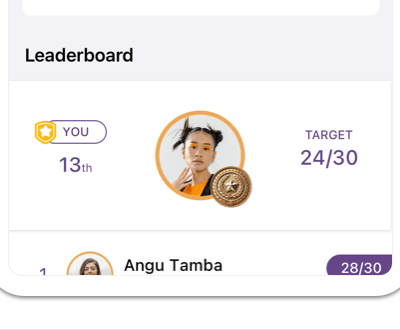
Vantage Fit, Vantage Circle's wellness platform, runs on this exact model: step and activity challenges with team rankings built in, so HR doesn't have to bolt a wellness leaderboard onto a recognition tool it was never designed for. Organizations already running recognition on Vantage Circle can add wellness challenges without switching vendors or juggling a second platform relationship.
Recognition Leaderboards
A recognition leaderboard tracks how consistently your people are giving and receiving appreciation, not just how much work they've closed out.
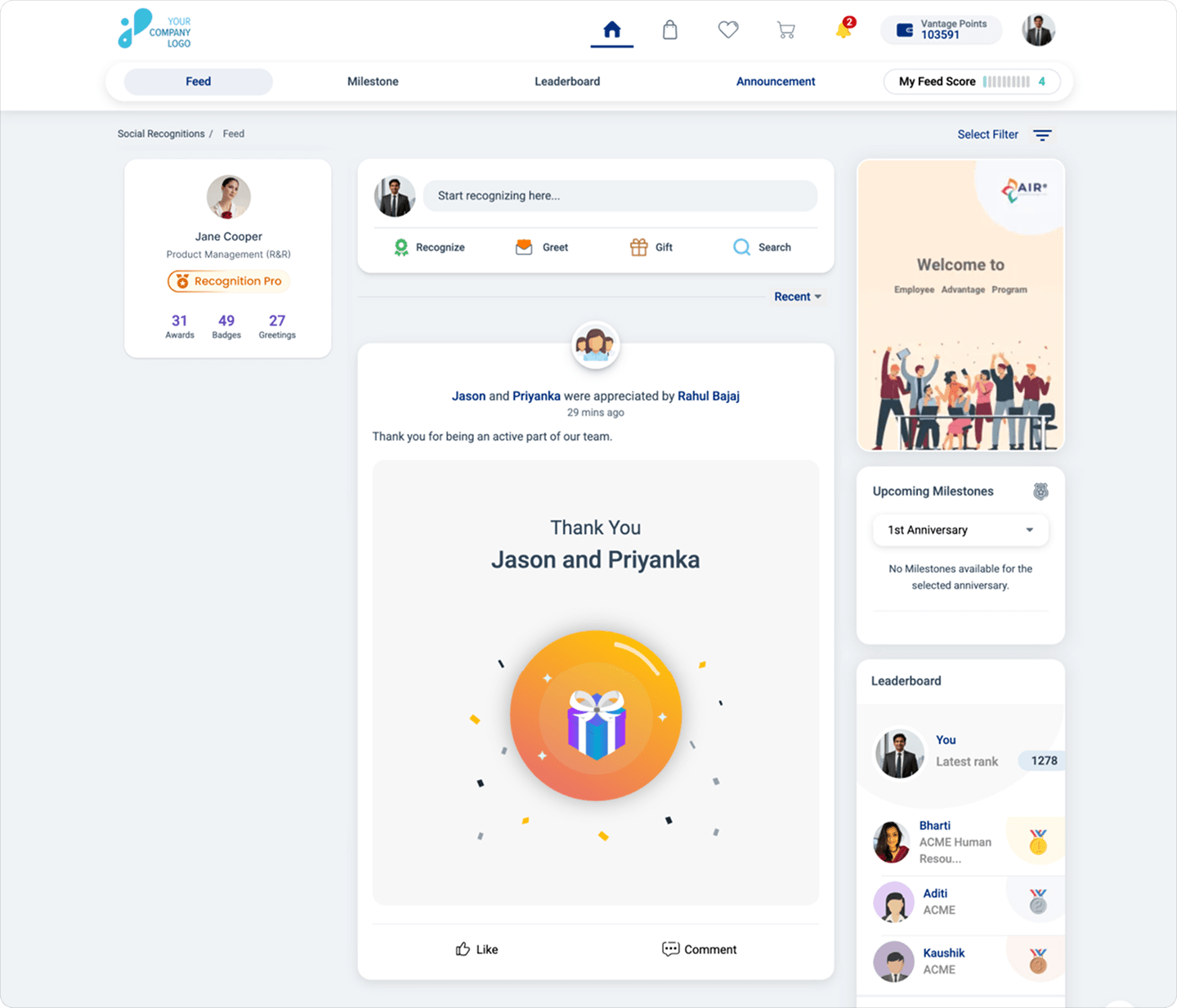
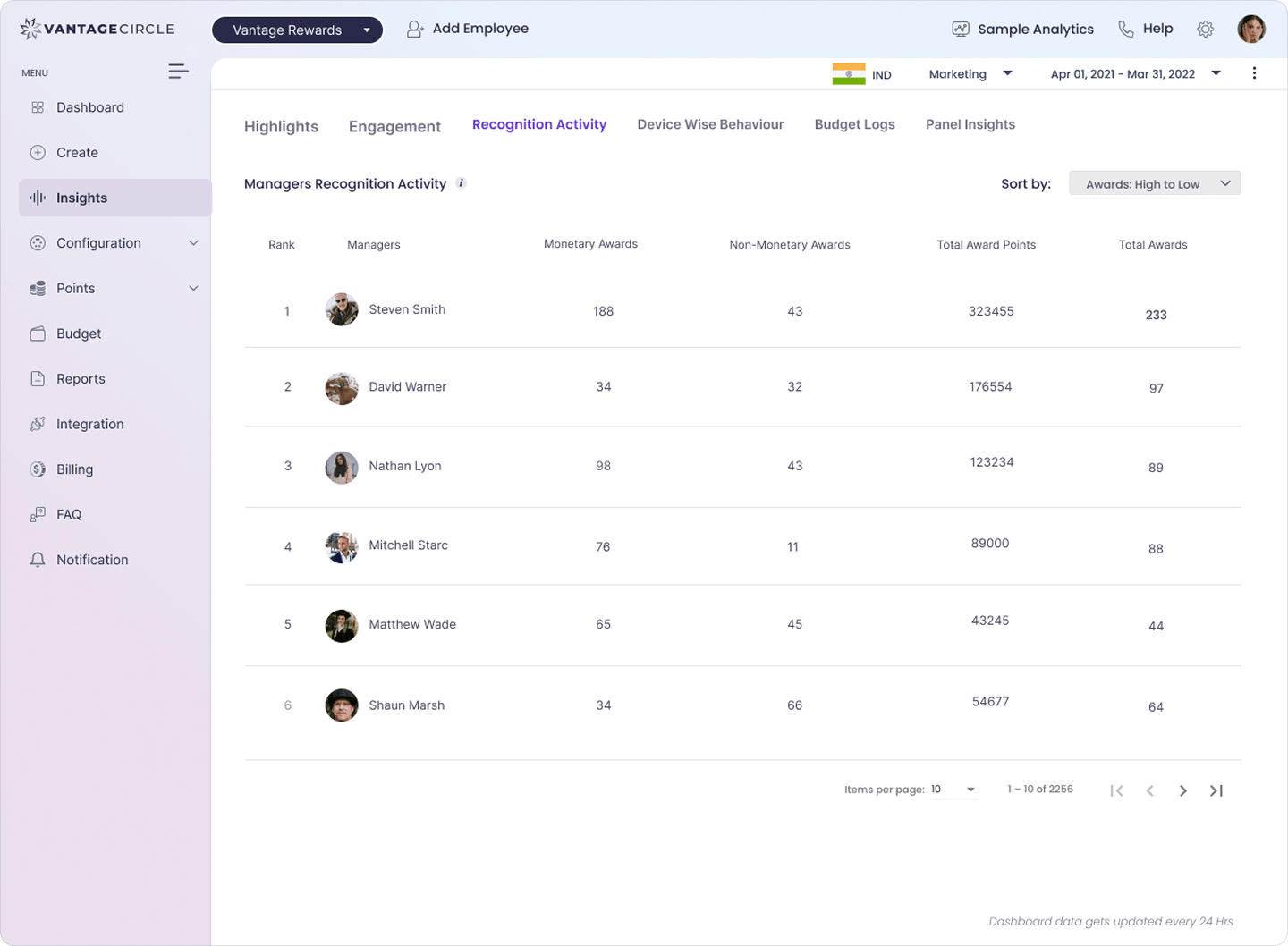
Most organizations already have some kind of appreciation happening informally. Without a way to track it, understanding the health of that culture is guesswork. Modern recognition leaderboards close that gap by updating in real time instead of on a weekly batch, so the moment someone gets recognized, their rank moves. Platforms like Vantage Circle's Social Leaderboard also split rankings by department as well as company-wide, so a small team isn't stuck permanently below a much larger one just because of the math. A well-built one adds an opt-out for anyone who'd rather their score stay private, which matters more than it sounds in regions with stricter workplace privacy expectations.
At Wipro, recognition happens once every 1.2 minutes, and peer-to-peer recognition rose 97.5% over two years (Wipro case study). At Tata Realty, the standout feature has been badges. As HR lead Nikita Kamtekar put it: "The most popular feature here is the badges, people are really enjoying giving each other badges" (Tata Realty case study).
That kind of transparency also lets HR spot recognition gaps by team or manager before they show up as attrition.
Project Management Leaderboards
A project management leaderboard displays project performance metrics, such as success rate, budget adherence, and on-time delivery, in one clear, shared view. It's most useful for organizations running multiple concurrent projects where leadership needs a quick way to compare team or individual performance without digging through separate reports.
The same trap as sales applies here. Rank teams purely on hitting deadlines, and some will quietly cut scope or quality to protect their spot. Pair delivery metrics with a customer or stakeholder satisfaction score, so "on time" doesn't become code for "rushed."
How to Build an Employee Leaderboard That Doesn't Backfire
An unfair or biased leaderboard isn't fun for anyone. When people are ranked against arbitrary or opaque criteria, it produces demotivation and resentment rather than healthy competition, and a toxic competitive environment can spread well beyond the leaderboard itself.
A few practices reduce that risk:
Set clear, achievable targets. As researcher Richard N. Landers puts it, "the principles of goal-setting theory should be used to maximize the impact of leaderboards." Targets that are realistic build confidence and drive more effort. Targets that are borderline impossible just produce frustration.
Choose metrics that match business objectives. The right criteria tell employees exactly what to focus on to help their team succeed. The wrong criteria (like raw activity volume) reward busywork instead of outcomes.
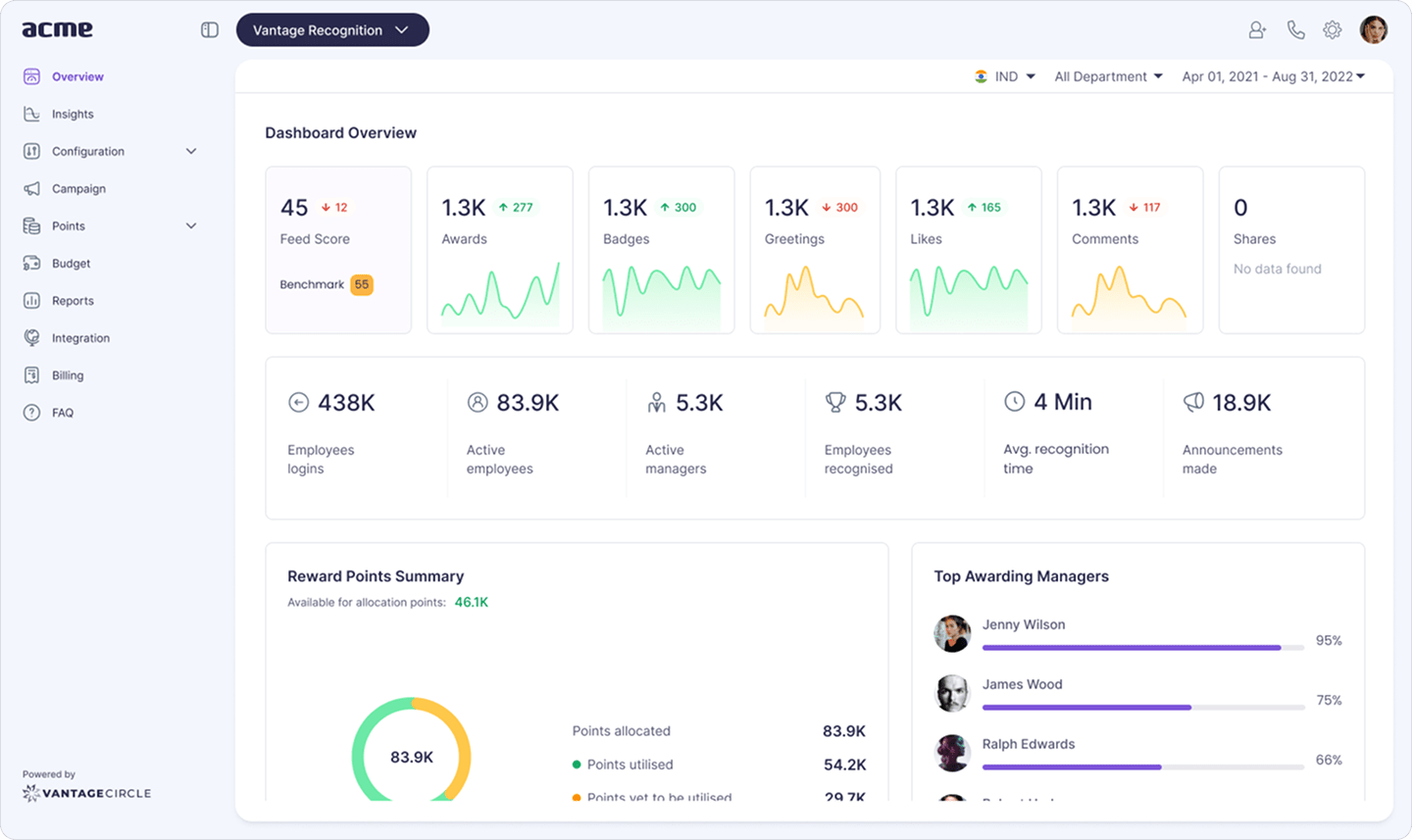
Make it visible to everyone, not just leadership. A leaderboard only leaders can see creates suspicion instead of transparency. Make the scoring criteria as transparent as the rankings themselves. That means giving every employee, not just managers, a dashboard view of scores, badges, and who's actively participating, like the one below, instead of an internal report only HR sees.
Pair rankings with recognition, not just numbers. A leaderboard with only scores motivates people for a few weeks at most. Incentivizing milestones with recognition, badges, or rewards sustains engagement well past the initial novelty.
Segment by team size. A 12-person team competing against a 300-person department isn't competition, it's math working against the smaller group before anyone's even tried. Split rankings by department or team so people are only measured against others in a comparable position.
Update it in real time. A leaderboard that refreshes once a week feels like a report. One that moves the moment someone's recognized feels alive, and alive is what keeps people checking it.
Let people opt out. Not everyone wants their name and photo on a public ranking, and in some regions that's a compliance question, not just a preference. Build in a way to opt out without losing accrued points.
Change up the cadence. A leaderboard that never resets goes stale fast. Dr. Ujjal Sengupta, Deputy General Manager HR at Reliance Jio Infocomm, made this point on the Unlocking Productivity in Large Workforces Through Gamified Learning episode of the Vantage HR Influencers Podcast. Leaderboards need to be tied to real rewards and refreshed on a cadence, "flashing who is at what point, time to time, like in IPL," or the momentum needed to chase a goal never builds.
Frequently Asked Questions
1. What is an employee leaderboard used for?
An employee leaderboard is used to surface performance or recognition data across a team or organization in real time. Instead of employees waiting for a manager to share updates, a leaderboard shows current standing, progress toward goals, and how individual or team contributions compare.
2. Do employee leaderboards actually improve performance?
Leaderboards can improve performance when they're built around clear, fair metrics and paired with genuine recognition, not just rankings. On their own, a leaderboard mainly puts existing effort on display. It doesn't create motivation from nothing, and a poorly designed one can demotivate people who consistently rank low.
3. Are employee leaderboards fair to remote or frontline employees?
Only if they're designed with those employees in mind. A leaderboard that only tracks desk-based, digital activity will systematically under-represent frontline, field, and remote employees. Vantage Circle's phygital recognition approach, bridging physical recognition cards with the digital platform, is built for exactly this gap: employees who don't sit at a computer all day. Include metrics and recognition channels that capture contributions from every employee type, not just the ones at a desk.
4. Should leaderboard rankings ever be anonymized?
Sometimes. For sales or performance leaderboards, public ranking is usually the point, since visibility is what drives the behavior. For more sensitive metrics, like time tracking or wellness data, an anonymized or opt-in view protects privacy while still giving people a sense of where they stand. The right call depends on what's being measured and how comfortable your workforce is with public ranking.
5. How is a recognition leaderboard different from a performance leaderboard?
A performance leaderboard ranks output, like sales closed or projects delivered. A recognition leaderboard tracks how consistently employees give and receive appreciation. Many organizations run both, since strong performance and strong recognition don't always show up in the same people.
6. How often should you refresh or reset an employee leaderboard?
Most organizations reset the public ranking monthly or quarterly instead of leaving it running indefinitely. A leaderboard that never resets can start to feel unbeatable for anyone who isn't already near the top, while a predictable reset cadence gives everyone a fresh shot and keeps the competition from going stale.
7. Should leaderboard points be redeemable for real rewards?
In most cases, yes. A leaderboard built purely on bragging rights tends to lose steam faster than one where points convert into something an employee can actually redeem, whether that's a gift card, merchandise, or another option from a rewards catalog. Ranking without a tangible payoff works for a while, then quietly stops mattering to people.
To Conclude
Every type of leaderboard on this list can backfire the same way: rank the wrong thing, and people start optimizing for the number instead of the work. Rank the right thing, and pair it with real recognition instead of a score alone, and it does what it's supposed to: make consistently good work visible to people who'd otherwise never see it.
Start with one leaderboard, use criteria your lowest performer would still call fair, and check participation before you stack a second one on top.

Susmita Sarma is a Digital Marketer at Vantage Circle, making employee recognition less of a checkbox and more meaningful - helping organizations say we value our people and truly mean it.
Connect with Susmita on LinkedIn.