One employee consistently exceeds expectations. Another quietly slips behind. At year-end, both get roughly the same rating.
Months later, the high performer resigns, the struggling employee is blindsided by their review, and everyone asks what went wrong. The problem usually isn't effort. It's that most organizations still treat employee performance as something they evaluate once or twice a year, rather than something they shape every day.
Performance is not the same as output, and managing it like output is why so many programs fail. What looks like a performance problem on a year-end form is often a clarity problem, a recognition gap, or a feedback loop that stopped working months earlier. The half that actually decides whether results last, the collaboration, initiative, and judgment people bring to the work, rarely shows up on a dashboard. And it moves in lockstep with employee engagement: organizations cannot sustainably improve one without the other.
And the old way of measuring it is running out of road. In 2026, AI is reshaping how work gets done, and managers are running more distributed teams than ever. Annual ratings can't keep pace with either.
This guide defines employee performance, shows the ten metrics that actually track it, and walks through eight strategies that measurably improve it.
What Is Employee Performance?
Employee performance is how well an individual fulfills their role responsibilities, measured across the quality, quantity, and efficiency of their output, their ability to meet goals, and their contribution to team and organizational outcomes.
Measured by:
- Quality of work output (accuracy, error rate, customer satisfaction)
- Quantity and speed of output (task completion rate, throughput)
- Goal and KPI (key performance indicator) attainment
- Collaboration and teamwork
- Alignment with organizational values
Modern performance has two dimensions that must be tracked together:
The Output: Tangible results such as projects completed, revenue generated, and deadlines met.
The Behaviors: How employees achieve those results, including collaboration, initiative, resilience, and alignment with company values.
The organizations that consistently outperform their peers don't just measure what employees deliver — they also track how. A top salesperson who hits every revenue target but undermines team morale is not a true high performer. The best organizations recognize that performance is cultural and relational, not just transactional.
Recognition reinforces the behaviors organizations want repeated, making it one of the earliest indicators of a healthy performance culture.
How Experts Define Employee Performance
Three definitions worth keeping in your back pocket:
- Campbell et al. (1993): "Job performance is behavior, not outcome. It is what an employee does, not what the employee produces."
- Visier (2025): "Employee performance is a measure of how well a worker contributes to the organization's goals, evaluated across quality, quantity, and efficiency."
- U.S. Office of Personnel Management: "Performance is the accomplishment of work in a manner that is consistent with position requirements and organizational expectations, measured against established standards."
The 5 C's of Performance
If output is the "what" of performance and behavior is the "how," the 5 C's are simply how you make that behavioral half concrete enough to discuss in a review:
- Competence — technical skill and job knowledge
- Commitment — motivation, initiative, sustained engagement
- Contribution — tangible value added to the team
- Communication — ideas, feedback, collaboration
- Culture-fit — alignment with values and team norms
In practice, the 5 C's give managers a shared vocabulary for the harder half of the performance conversation — the part that doesn't show up in a task completion rate. For how those conversations translate into formal assessments, see our guide to performance appraisal.
Why Employee Performance Matters in 2026
High employee performance directly drives business outcomes: top-quartile engagement organizations show 23% higher median profitability than peers with low engagement (Gallup Q12 meta-analysis, 11th edition, 2024).
Performance is not just an HR concern. It determines whether products ship on time, whether customers renew, and whether top talent stays. According to Gallup's 2026 State of the Global Workplace report, disengaged employees cost the global economy more than $10 trillion annually. That cost is not evenly distributed: low-performance clusters create drag on team output, erode manager bandwidth, and accelerate the attrition of the high performers who absorb the slack.
Three business outcomes tied directly to sustained high performance:
Retention: Engaged employees show 21% lower turnover in high-turnover organizations and up to 51% lower in low-turnover organizations compared to disengaged peers (Gallup Q12 meta-analysis, 11th edition, 2024). Retention is not primarily a compensation problem. It is a performance culture problem.
Innovation: Teams with high psychological safety consistently outperform those without it in innovation and problem-solving, a pattern first documented by Amy Edmondson (Harvard Business School, 1999) and confirmed at scale in Google's Project Aristotle (2016). Clarity enables risk-taking; ambiguity kills it.
Customer trust: Forrester (2024) notes that a 1-point gain in the Customer Experience Index can generate more than $1 billion in revenue for large enterprises. Employee performance is the upstream driver of every customer outcome.
What Causes Poor Employee Performance?
Poor employee performance most commonly stems from 5 systemic root causes: unclear goals, low engagement, skills gaps, inadequate recognition, and burnout — not from a lack of ability or effort.
Leaders who attribute performance issues purely to the individual miss the organizational conditions that produce them. Here are the 5 most common root causes and their downstream effects:
1. Unclear goals and expectations: Ambiguous KPIs or undefined success criteria leave employees unable to prioritize effectively. Productivity losses multiply when people are uncertain what "good" looks like in their role.
2. Low engagement and absent recognition: Among employees who receive feedback and recognition from their managers at least once a week, 61% are actively engaged (Gallup and Workhuman, 2022). When recognition is absent, effort goes unacknowledged and motivation erodes, often silently.
3. Skills gaps and inadequate support: Lack of training, mentorship, or current tools causes employees to plateau. Employees who feel their organization supports their growth are 47% less likely to actively look for other jobs (Gallup).
4. Outdated processes and tools: Friction in workflows, disconnected systems, or siloed communication slows execution. High-value tasks take longer and frustration compounds across teams.
5. Burnout: Persistent overload and blurred work-life boundaries erode sustained output. "Quiet quitting" is the behavioral signature of burnout in modern workplaces, and it shows up in engagement and absenteeism data before managers notice it in output.
What the data doesn't show: these causes almost never appear one at a time. An employee with unclear goals who is also unrecognized is already two-thirds of the way to resignation. By the time the performance problem surfaces in a review, the compounding has been happening for months. Effective feedback is the mechanism that catches it earlier.
Key Metrics for Measuring Employee Performance
The most effective organizations track employee performance across 3 dimensions: work quality, work quantity and efficiency, and organizational outcomes — using a balanced combination of quantitative metrics and behavioral indicators.
Relying on a single metric produces an incomplete picture. A sales representative can hit quota while burning out the team. A support agent can close tickets quickly while customer satisfaction falls. The table below covers 10 actionable employee performance metrics, organized by dimension.
| Metric | What It Measures | Example / Benchmark |
|---|---|---|
| Goal attainment rate | Percentage of OKRs (Objectives and Key Results) or KPIs completed on time | Target: 70-80% completion per quarter |
| Output quality score | Error rate, rework rate, or quality-review pass rate | Less than 2% defect rate in manufacturing; customer satisfaction score of 4 or above out of 5 in service roles |
| 360-degree feedback score | Peer, manager, and direct-report ratings on behavior and collaboration | Scored on a 1-5 scale; trend across 2 or more cycles matters more than a single point-in-time score |
| Task completion rate | Volume of assigned work completed within deadlines | Tracked weekly via project management tools |
| Time to productivity | How quickly an employee reaches full output after onboarding or promotion | Median: 3-6 months for knowledge workers (SHRM, 2024) |
| SLA adherence | Percentage of tasks, deliverables, or tickets completed within the agreed service window | Tracked through CRM or project management systems against agreed service standards; benchmarks vary by function and industry |
| Employee Net Promoter Score (eNPS) | Engagement level — a leading indicator of sustained performance | eNPS above 30 is considered healthy; below 10 signals disengagement risk |
| Recognition frequency | How often an employee receives peer or manager recognition | High-quality recognition correlates with 45% lower likelihood of leaving within two years (Workhuman and Gallup, 2024) |
| Absenteeism rate | Unplanned absences as a proxy for disengagement or burnout | US average: 3.2% (BLS, 2024); above 5% warrants investigation |
| Collaboration effectiveness | Peer-rated contribution to team goals, knowledge sharing, and cross-functional problem-solving | Measured via 360-degree peer ratings across 2+ review cycles; score trend matters more than a single point-in-time reading |
eNPS (Employee Net Promoter Score) is calculated by asking employees "How likely are you to recommend this company as a place to work?" on a 0-10 scale. OKR (Objectives and Key Results) is a goal-setting framework that aligns individual effort to organizational priorities. KRA (Key Result Area) defines the primary responsibilities a role is measured against. For worked examples, see our goal-setting for employees guide.
The goal isn't to measure more metrics. It's to measure the handful that tell you whether performance is improving before business results move.
Work Quality Metrics
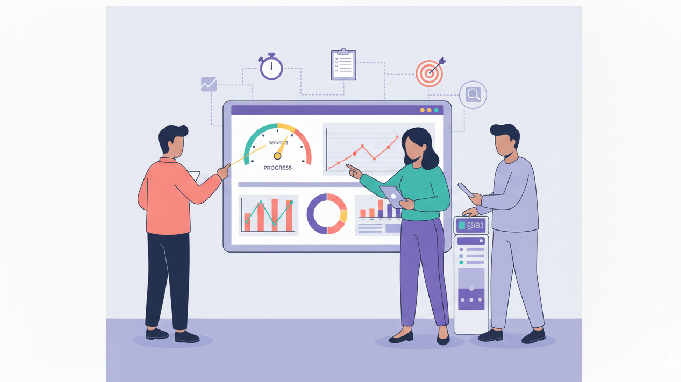
Work quality metrics measure how well work is done, not just how much gets done — capturing accuracy, customer impact, and behavioral contribution.
- 360-degree feedback: Input from peers, managers, and direct reports gives a holistic view of both output and collaboration. Tools like Vantage Pulse make continuous feedback practical, replacing the annual survey with real-time signal.
- Output quality score: Tracks error rates, rework frequency, or customer satisfaction scores tied directly to individual work.
- The 9-Box Grid: Evaluates employees on both current performance and future potential, helping leaders identify high performers and prioritize development investment.
Work Quantity and Efficiency Metrics
Quantity and efficiency metrics measure how much gets done and how well time and resources convert into meaningful outcomes.
- Task completion rate: The percentage of assigned tasks completed on time signals execution discipline and prioritization skill.
- SLA adherence: The percentage of deliverables completed within the agreed service window. In customer-facing roles, SLA adherence is one of the most direct proxies for individual performance quality.
Organizational and Outcome Metrics
Organizational metrics show the upstream impact of employee performance on business results, including retention, engagement, and workforce health.
- eNPS: Engagement as a leading indicator. Disengagement shows up in eNPS data weeks before it appears in output metrics, giving managers an early warning signal.
- Absenteeism rate: Rising unplanned absences reliably precede turnover spikes. Highly engaged teams show 78% lower absenteeism rates than disengaged peers (Gallup Q12 meta-analysis, 11th edition, 2024).
- Collaboration effectiveness: Peer-rated contribution to team goals and cross-functional problem-solving. High collaboration scores correlate with stronger collective output and lower voluntary turnover — and unlike eNPS, they point at specific behavioral patterns a manager can act on.
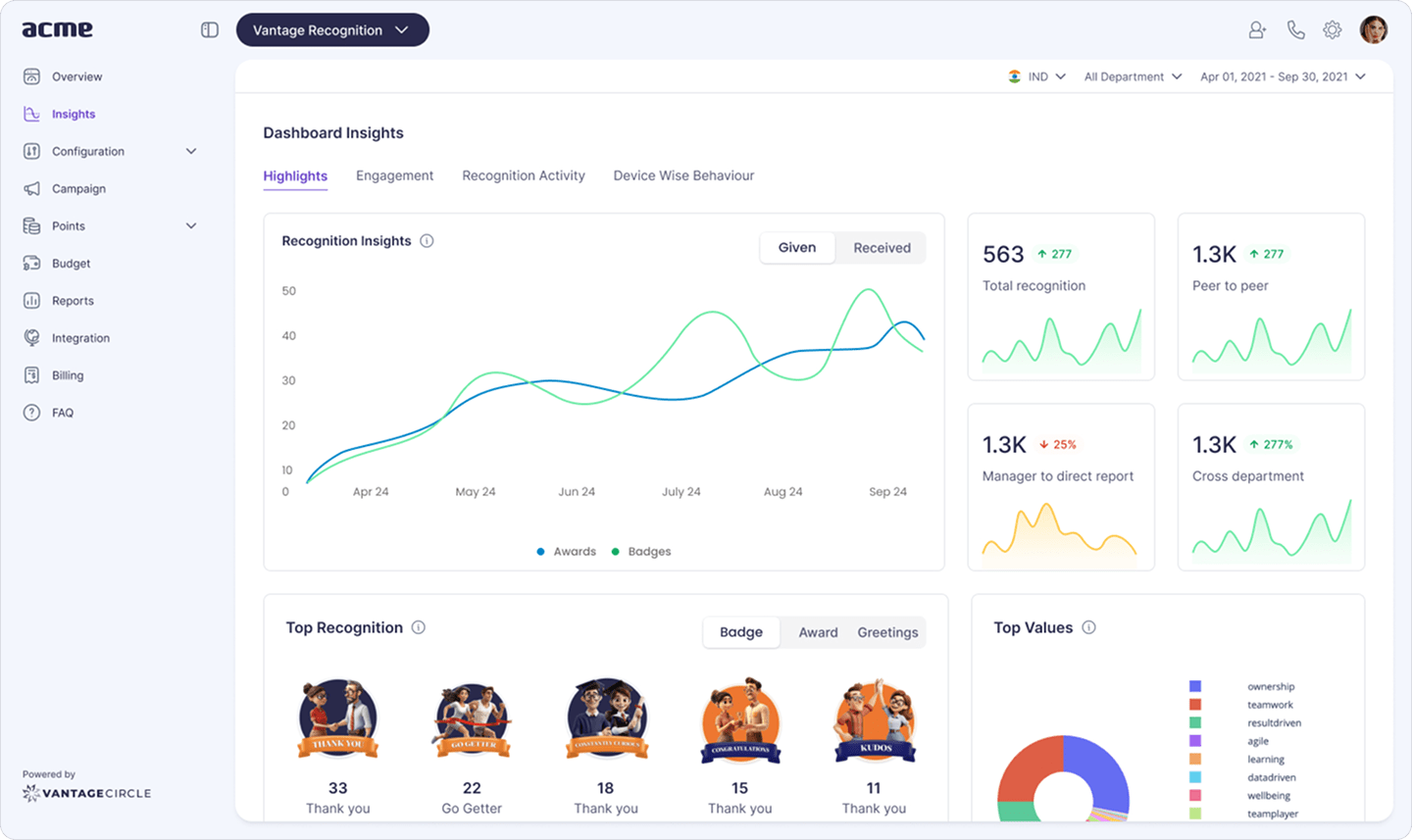
Beyond output metrics, recognition data shows whether your highest performers feel valued. Recognition Analytics from Vantage Circle links recognition frequency to retention and performance outcomes, closing the loop between culture and results.
How to Improve Employee Performance: 8 Proven Strategies
Employee performance improves most reliably when organizations combine 8 interconnected levers: clear goals, continuous feedback, recognition, engagement measurement, skill investment, autonomy, value alignment, and the right technology.
1. Set Clear, Measurable Goals
Clear, measurable goals are the single most direct driver of improved performance because employees cannot prioritize effort or self-correct without knowing what success looks like.
Use SMART criteria (Specific, Measurable, Achievable, Relevant, Time-bound) or the OKR (Objectives and Key Results) framework to connect individual goals to team and organizational priorities. Review goals quarterly and adjust when business priorities shift. Ambiguity is not a motivational problem. It is a goal-setting problem.
2. Give Continuous Feedback, Not Annual-Only Reviews
Continuous feedback closes the gap between effort and improvement because annual reviews arrive too late to course-correct on the work already done.
Feedback should be specific, timely, and behavior-focused rather than general. Telling someone their quarterly numbers are off at the end of the quarter is not feedback; it is a final score. Real feedback is the conversation that happens while the work is still in progress. Effective feedback is what keeps performance development a live process, not a calendar event.

Vantage Influencers Podcast
"In our annual performance review process, we were spending millions of hours rating people, and managers and employees were spending millions of hours defending those ratings. We eliminated annual performance reviews completely and replaced them with quarterly feedback and coaching conversations. Employees could course-correct more quickly. They felt more supported."
— Shiva Sharma, People and Culture Advisor, Superbolter
Listen to the Episode3. Recognize High-Performance Behaviors
Recognition reinforces the specific behaviors that produce high performance, because employees repeat what gets acknowledged.
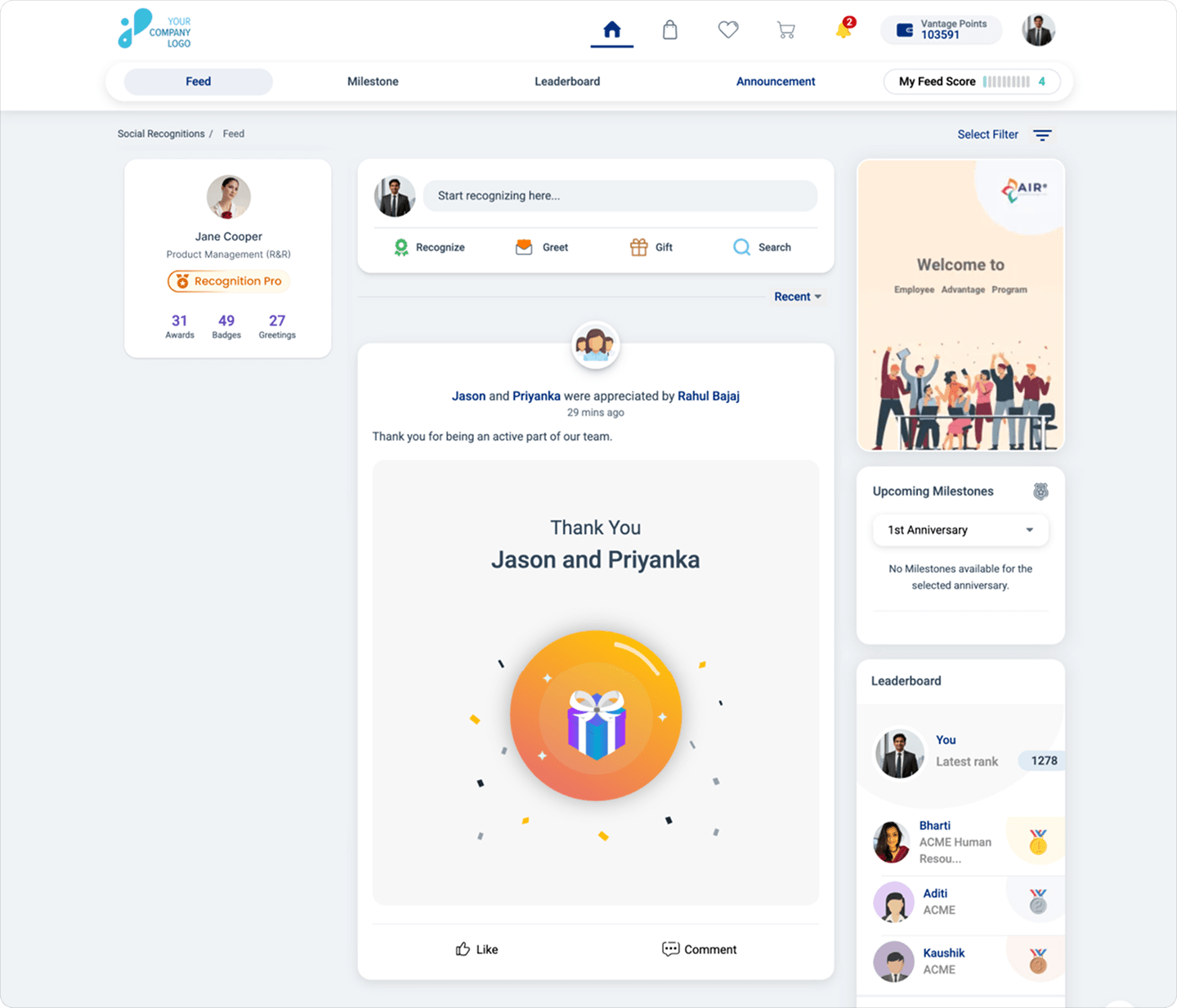
Employees who receive high-quality recognition are 45% less likely to leave within two years (Workhuman and Gallup, 2024). Real-time peer-to-peer and manager recognition tied to goals turns a single strong contribution into a repeatable habit. Vantage Rewards embeds recognition directly into daily workflows, making it timely, authentic, and scalable across global teams.
The practical failure mode: managers assume salary and promotion are doing the recognition work. They are not. Those signals arrive too infrequently and too impersonally to reinforce the specific behaviors that produced the result.
4. Build Engagement and Measure It
Engagement is a leading indicator of performance, and organizations that measure it proactively identify disengagement before it shows up in results.
eNPS (Employee Net Promoter Score) surveys and sentiment analysis surface declining engagement weeks before output metrics reflect it. Vantage Pulse provides department-level performance-sentiment trends so managers can act on early signals rather than lagging indicators.
5. Invest in Skills and Growth
Employees who feel their organization supports their growth are 47% less likely to actively look for other jobs (Gallup), making development investment a direct retention and performance strategy.
Structured learning paths, mentorship programs, and access to upskilling tools address skill gaps before they become performance gaps. Growth investment signals to employees that their long-term contribution matters, not just their current output.
6. Support Autonomy and Well-being
Empowered teams outperform micromanaged ones because autonomy creates intrinsic motivation and psychological ownership of outcomes.
When organizations extend flexibility beyond time and location to include choice over how much, who with, and what employees work on, the share of high performers rises by 40% compared with time-and-location-only flexibility (Gartner, 2023). Well-being support through financial wellness benefits and health programs reduces the burnout that quietly erodes sustained performance over time. Vantage Perks gives employees levers to manage stress before it becomes disengagement.
7. Align Performance to Company Values
When recognition maps to company values, performance and culture become the same effort, and employees see exactly which behaviors the organization rewards.
Employees who see the direct link between their work and organizational values are more committed and more engaged. Core values alignment in recognition programs makes high-performance behavior visible and explicitly reinforced. Managers do not need to say "this is what we stand for" when the recognition system already shows it.
8. Use the Right Technology
The right technology removes friction from performance management by making goals, feedback, and recognition visible in real time rather than buried in annual review forms.
Performance management platforms track goals and feedback continuously. Digital adoption platforms (DAPs) reduce skill friction during onboarding and role transitions. Recognition platforms like Vantage Rewards make appreciation effortless at scale. The critical principle: technology should amplify the human side of performance, not replace it.
Case Snapshot: Wipro's Winners' Circle
Wipro partnered with Vantage Circle to launch "Winners' Circle," a global peer-to-peer recognition program aligned with Wipro's 5 cultural values: Being Respectful, Being Responsive, Always Communicating, Demonstrating Stewardship, and Building Trust.
Results over two fiscal years:
- Over 57% of Wipro's associates received recognition in the last fiscal year
- On average, 768 awards are given per day, totaling more than 553,490 awards in two years
- A 97.5% increase in badges and appreciation tokens distributed among peers from 2021 to 2023
- More than 25,243 unique nominators contributing to peer recognition across the organization
The lesson isn't that Wipro gave more awards. It's that recognition became part of everyday work instead of an annual HR initiative. When recognition is embedded into daily routines, performance conversations become continuous rather than episodic.
Read the full Wipro case study
How to Describe Employee Performance (Manager's Language)
The most effective way to describe employee performance is to use specific, behavioral language tied to observable outcomes, not personality traits.
Performance language that references behavior and results gives employees clear, actionable information. Trait-based language ("hardworking," "motivated") does not. Here are practical words and phrases managers use to describe strong performance:
Words that describe high performance: Accountable, collaborative, consistent, dependable, detail-oriented, goal-oriented, initiative-driven, reliable, results-focused, solutions-oriented.
Example phrases:
- "Consistently meets deadlines and communicates proactively when priorities shift."
- "Brings measurable results to team projects while supporting peers through blockers."
- "Demonstrates ownership of outcomes, not just assigned tasks."
For complete structured comment templates, rating descriptors, and positive and constructive examples, see our full guide to appraisal comments. That guide covers the full vocabulary managers need for formal review cycles.
The Role of Technology in Managing Performance
Technology has shifted from supporting performance management to directly shaping it, but organizations that pair it with empathy and culture outperform those that treat it as a reporting tool.
Modern platforms give leaders real-time visibility into goals, feedback, and recognition before issues compound into performance problems. Key tools in a performance technology stack:
Performance management software: Continuous goal tracking, real-time feedback, and 360-degree review tools replace the annual cycle with always-on visibility into team and individual performance.
Digital adoption platforms (DAPs): Now standard infrastructure in enterprise software stacks, reducing skill friction during onboarding and role transitions.
Collaboration tools: Platforms like Slack, Microsoft Teams, and Zoom enable fast feedback loops and cross-functional problem-solving. They are not just communication tools; they are the infrastructure for real-time performance support.
Recognition platforms: Vantage Rewards gives managers and peers a frictionless way to recognize in the moment — across geographies, team sizes, and time zones.
AI-powered analytics: Intelligent systems now flag skill gaps, recommend personalized learning paths, and surface early disengagement signals. The critical balance is using AI to amplify human judgment in performance conversations, not to replace the relational core of feedback and recognition. The most effective organizations use AI to identify patterns and prompt conversations, not to make performance decisions on behalf of managers.
Related article: Top 10 Employee Survey Tools
Conclusion
Employee performance is the upstream driver of retention, innovation, and customer trust. Organizations that treat it as a continuous, human-centered system outperform those that treat it as an annual event.
The data is consistent: disengagement costs the global economy more than $10 trillion annually (Gallup, 2026), while top-quartile engagement organizations show 23% higher median profitability than peers (Gallup Q12 meta-analysis, 11th edition, 2024). The gap between those two numbers is where performance management lives.
Leaders who act on the 10 metrics, give recognition in real time, and align performance with organizational purpose do not just manage performance. They build the culture that sustains it.
Start with the clearest lever available: recognize the behaviors you want repeated, measure engagement as a leading indicator, and give people the goals and feedback they need to know they are on track.
Explore how Vantage Rewards helps organizations recognize and sustain high performance at scale.
Frequently Asked Questions
What is the performance of an employee?
Employee performance is how well a person does their job, measured across the quality, quantity, and efficiency of their work, and how consistently they meet goals and contribute to the team. It covers both what employees deliver (output) and how they deliver it, including behaviors like collaboration, communication, and initiative.
What are the 5 C's of performance?
The 5 C's of performance are Competence, Commitment, Contribution, Communication, and Culture-fit. Together they give managers a practical language for describing, evaluating, and developing employee performance beyond output metrics alone.
How do you describe an employee's performance?
Describe employee performance using specific, behavioral language tied to observable results, not personality traits. For example: "Consistently meets deadlines and communicates proactively when priorities shift" is more useful than "hardworking." For structured templates covering both positive and constructive language, see our appraisal comments guide.
How do you write 10 performance goals examples?
Effective performance goals are specific, time-bound, and tied to a measurable outcome. Ten examples: complete the Q3 product roadmap by August 31; reduce customer response time to under 4 hours by September 30; complete one upskilling course per quarter; achieve a 360-degree feedback score of 4 or above by year-end; increase task completion rate to 90% within 60 days; onboard 3 new accounts by end of quarter; reduce error rate on deliverables to below 2%; lead one cross-functional project by December; present one process improvement idea per month; achieve an eNPS score above 30 by Q4. Use the OKR (Objectives and Key Results) or SMART framework to structure each goal for clarity and accountability.
How often should employee performance be evaluated?
Continuous feedback is the most effective model: brief check-ins weekly or bi-weekly, supplemented by a formal structured review quarterly or annually. By the time an annual review arrives, the performance gap has already compounded. Weekly recognition and feedback conversations keep performance development active in real time, not reactive after problems have compounded.
What factors prevent your team from being as productive as members might like?
The most common factors are unclear goals, absent recognition, skill gaps without adequate support, outdated tools and processes, and burnout from sustained overload. These rarely appear one at a time. An employee with unclear goals who receives no recognition is already two-thirds of the way to disengagement before a performance problem surfaces in a review. Teams that address these factors through continuous goal-setting, real-time feedback, and recognition tied to specific behaviors consistently see measurable gains in both engagement and output.

Supriya is a Content Marketing Lead at Vantage Circle, where she writes on employee engagement, recognition, workplace communication, and culture. Her work on remote team recognition draws on primary research from Vantage Circle's platform data and customer deployments across distributed workforces. She spent the earlier part of her career in corporate communications at Burson, ESPN Star Sports, and CBRE, advising organizations on the messages employees actually hear.
Connect with Supriya on LinkedIn.