


By the time an employee submits a resignation, the decision is usually months old. The exit interview captures the ending. It misses everything that built toward it.
Employee retention in the modern workplace runs on three levers: competitive compensation, real career growth, and a culture where people feel recognized and supported. Companies that combine all three, and measure them continuously, keep more of their top talent than organizations relying on pay raises alone.
The problem is not that HR teams lack options. It is that most retention advice recycles the same generic list, pay people more, offer flexibility, build culture, without the data or the measurement to know what actually moves the number. This guide takes a different approach. It walks through six strategies with real evidence behind them, shows you how to calculate whether your retention strategy is working, and includes findings from The Recognition Effect, a 2025 joint study by Great Place To Work® India and Vantage Circle.
What Is Employee Retention, and Why Is It Getting Harder?
Employee retention is an organization's ability to keep its employees over time, and it is getting harder because employees now weigh flexibility, purpose, and recognition as heavily as pay. A role that looked secure and reasonably paid in 2015 competes against a job market where switching no longer requires relocation, and where a single visible complaint about culture can reach thousands of candidates overnight.
Three shifts explain why the old playbook stopped working:
- Work location became negotiable. Remote and hybrid options moved from perk to expectation, and employers who force a full return to office now lose people to competitors who do not.
- Purpose became a retention factor, not a poster. Employees increasingly expect their work to connect to something larger, and they leave employers who cannot articulate that connection.
- The exit path got shorter. Employee turnover used to be a months-long decision. Today it can start with one bad manager interaction and end with a signed offer inside two weeks.
| Retention pressure | Then | Now |
|---|---|---|
| Where work happens | Office by default | Flexible by role and team |
| What keeps people | Job security and tenure | Growth, purpose, and feeling valued |
| Recognition cadence | Annual review | Continuous and peer driven |
| Career paths | Fixed ladders | Skill based and self directed |
| Employee listening | Annual engagement survey | Continuous pulse and feedback |
None of these shifts shows signs of reversing. The strategies below are built for the workplace employees actually work in, not the one retention manuals were written for.
What Actually Keeps Employees From Leaving (Not Just Pay)
Compensation, growth opportunity, and workplace culture are the three documented levers behind retention, and recognition driven culture is the one most organizations still underinvest in. Pay matters, and underpaying people guarantees exits. But once compensation reaches market rate, its retention effect flattens while the other two levers keep compounding.
Here is what each lever contributes:
- Compensation sets the floor. Employees who feel underpaid leave, and employees who feel fairly paid stop leaving for money. Salary benchmarking on a regular cadence protects the floor. It rarely builds loyalty on its own.
- Growth sets the trajectory. People stay where they can see a version of themselves two years out. When the path is visible and real, setbacks inside the company feel survivable. When it is vague, every external recruiter call looks like an upgrade.
- Culture, and recognition specifically, sets the daily experience. This is the lever with the most surprising evidence behind it.
The retention gap recognition creates: The Recognition Effect, a 2025 joint study by Great Place To Work® India and Vantage Circle drawing on 5.7 million employees across 1,810+ organizations, found that organizations with high-recognition cultures retained 92% of their employees, compared to 76% in low-recognition cultures, a 16-percentage-point gap associated with recognition culture strength.
The same study found that only 55% of employees feel truly recognized at work, and that employees in high-recognition cultures showed a 21-point higher intent to stay. Recognition is not a soft benefit. It is the lever that directly moves the retention number.
Recognition is also the only one of the three levers that can move daily without additional budget or a manager's calendar. A compensation review happens once a year. A growth conversation happens a few times a year. Recognition can happen any day, from anyone, and it compounds into the day-to-day feeling that keeps people from answering a recruiter's message.
The mechanics of getting it right, peer to peer, manager led, values tagged, are covered in the guide to the types of employee recognition. The strategies section below shows where each fits into a complete retention system.
The Real Cost of Getting Retention Wrong
Replacing an employee costs between one half and two times their annual salary once hiring, onboarding, and lost productivity are counted, a range consistently cited across Gallup and SHRM turnover research. Gallup's 2019 analysis estimated that voluntary turnover costs US businesses $1 trillion every year.
The per-departure math is worse than most budgets assume because the cost hides in four places:
- Recruitment and signing, agency fees, job board spend, and interview hours.
- Onboarding and ramp, the time a replacement needs to reach full productivity, which SHRM's onboarding research places at three to six months for most roles.
- Lost institutional knowledge, processes, client relationships, and context that were never documented.
- Contagion, departures visibly increase the departure risk of the people who worked closest with the person who left.
Run the numbers on your own team. If a mid-level employee earning $80,000 resigns and replacement costs land at 1.25x salary (the midpoint of the cited range), the organization absorbs roughly $100,000 before the new hire's first full quarter. A department of 200 people running a 12% voluntary turnover rate produces 24 annual departures; at that cost assumption, that is just under $2.4 million a year in replacement spend. Both figures shift considerably with average salary and industry.
That math also explains why retention beats recruiting as a budget line. A salary adjustment that keeps a strong performer costs a fraction of the replacement figure above, arrives with zero ramp time, and never appears in a job board invoice.
This is also why listening matters before the resignation letter, not after. A well timed employee Net Promoter Score survey surfaces dissatisfaction while it is still a coaching conversation, not a bidding war over a competing offer.
6 Retention Strategies That Hold Up in a Hybrid Workplace
Six strategies consistently appear in high-retention organizations and in the retention research cited throughout this guide: flexible work design, frequent recognition, visible growth paths, disciplined compensation benchmarking, manager capability, and continuous feedback. None of them requires a reorg. All of them require consistency. Here is how to run each one.
1. Design Flexibility Around Roles, Not Blanket Policy
Retention strategies fail when flexibility is decided company-wide and applied identically to every team. A support team covering live customer hours, a finance team inside a monthly close, and a design team with sprint based output have completely different constraints. The policy that keeps one of them will frustrate the other two.
The practical approach is role based: define which parts of each job require synchronous presence, then design flexibility around everything else. Product teams might anchor two collaboration days. Accounting might flex outside close windows. Frontline roles might get schedule stability and shift swap autonomy instead of location freedom. What employees read as fairness is not identical treatment. It is a logic they can see applied to their own role.
Segmentation is what makes this workable at scale. Department level engagement and sentiment data shows exactly which teams feel the flexibility gap, rather than averaging the signal away in a company-wide score. This is also where flexibility and engagement connect directly: the evidence on hybrid work and employee engagement shows the outcome depends far more on how intentionally the model is designed than on how many office days it mandates.
2. Make Recognition Frequent and Specific, Not Annual
Recognition delivered once a year cannot change daily behavior, because the twelve months in between are exactly where retention decisions get made. McKinsey's 2021 research on attrition found that 54% of employees who quit cited not feeling valued by their organization as a top reason for leaving. That signal builds quietly, long before the resignation letter. Employees in high-recognition cultures reported a 21-point higher intent to stay, per The Recognition Effect (Great Place To Work® India and Vantage Circle, 2025). That gap is built day by day, not at year-end reviews.
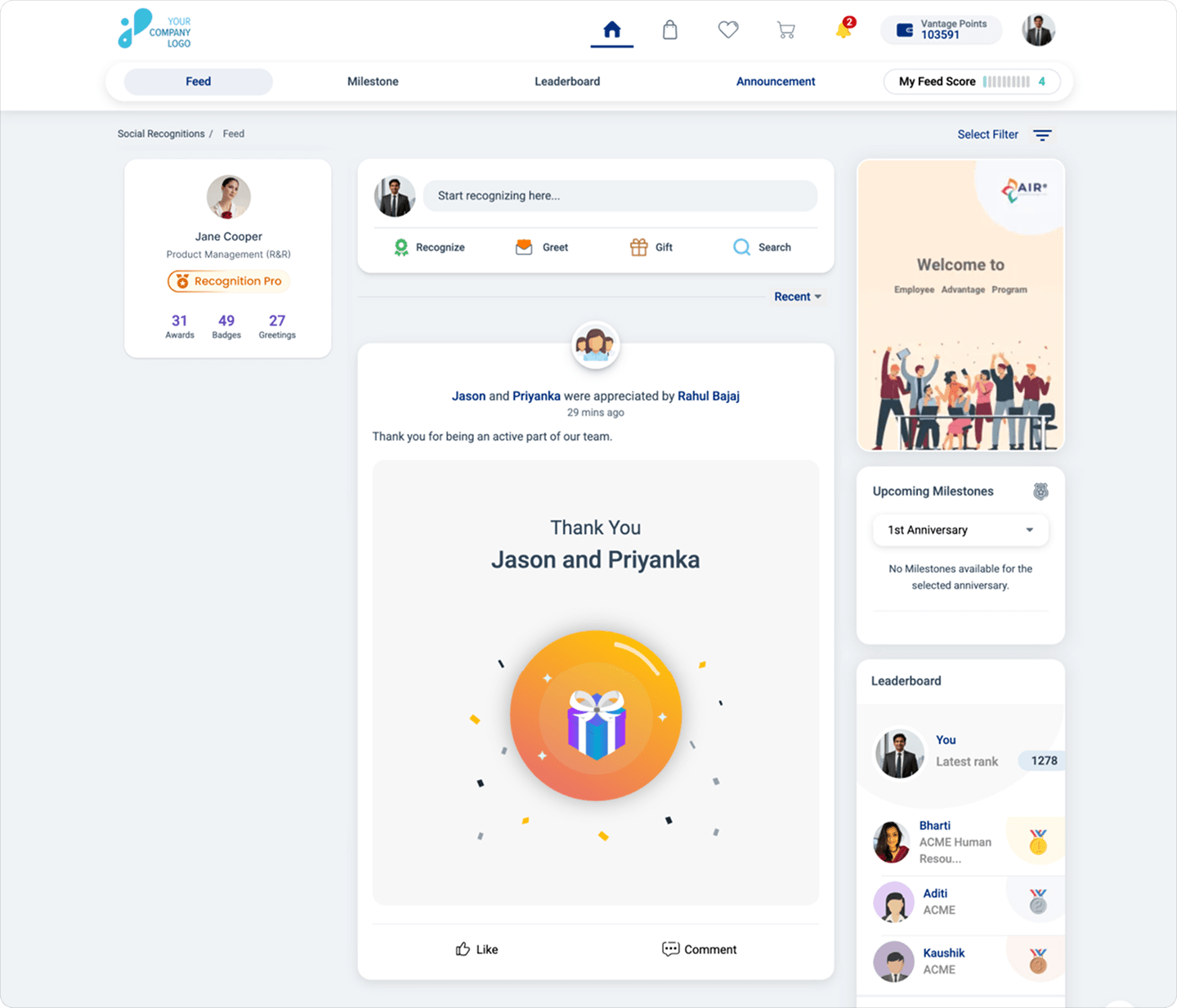
What "frequent and specific" means in practice:
- Peer to peer recognition, not just manager to report. Colleagues see the daily work managers never witness, and peer recognition keeps the "my work is seen" signal alive between reviews.
- Specificity over volume. "Great job on the launch" is noise. "Staying late to fix the billing bug before the customer's renewal call" is a behavior you just reinforced.
- Visibility in hybrid teams. A public recognition feed makes good work visible across locations, which matters most for the remote employees most at risk of feeling invisible.
Recognition that runs through a platform rather than a manager's memory also becomes measurable, which the metrics section below turns into a retention signal.
3. Show a Real Growth Path, Not a Vague Promise
Employees do not leave companies with no career paths. They leave companies where the path exists only in the org chart and only for the roles above them. A growth path is real when an employee can name the next two skills they will build, the person who will help them build them, and roughly when the next step becomes possible.
Three practices make paths concrete:
- Skills based progression, where advancement criteria are published rather than discovered through hallway conversations.
- Internal mobility, moving people toward stretch roles inside the company before a recruiter moves them outside it. Every internal move is a retained employee.
- Milestone visibility, marking tenure and career moments deliberately. Long service awards and public career milestones give employees proof the organization is tracking their journey, not just their output, and they cost almost nothing to run well.
The test is simple: ask a random sample of your team what their next role inside the company is and what stands between them and it. Where you get shrugs, you have found your next retention leak. Close the gap with a lightweight development plan per person: one page, three skills, one sponsor, reviewed twice a year.
4. Benchmark Compensation on a Real Cadence
Underpaying people is the most reliable retention strategy for your competitors, because compensation gaps surface the moment an employee interviews. The goal is not to win every salary negotiation. It is to make sure no employee discovers they are underpaid from an outside offer.
A workable cadence looks like this: benchmark salaries against market data at least annually, move on roles where the gap is material (adjust the threshold to your industry's pay bands), and be transparent about the review cycle even where the numbers are confidential.
Two mistakes to avoid: reacting to every resignation with a counteroffer (which teaches the organization that raises require an exit interview), and treating compensation as the whole retention strategy. Benchmark the floor, then invest in the levers that compound above it.
5. Train Managers, Because People Leave Managers
Managers account for roughly 70% of the variance in team engagement, according to Gallup research on team engagement across millions of US workers. A struggling employee with a strong manager usually gets a development plan. A struggling employee with a weak manager usually gets a LinkedIn profile.
The retention math follows directly. Improving manager quality is one of the few interventions that lifts every other strategy on this list at once, because managers run the recognition, hold the growth conversations, and own the feedback loops. Manager training works when it focuses on the behaviors that show up in retention data: frequency of one on ones, quality of feedback, recognition habits, and how early career conversations start.
Pair the training with measurement. Segmenting recognition and engagement data by team makes manager-level gaps visible while they are still coaching problems, not attrition problems.
6. Build Continuous Feedback Loops, Not Annual Surveys
An annual engagement survey tells you what already happened across the year it measured. By the time results are presented, employees who were quietly disengaged have usually become loudly resigned, or left. A short, recurring pulse survey catches the flight risk signal while there is still time to act on it.
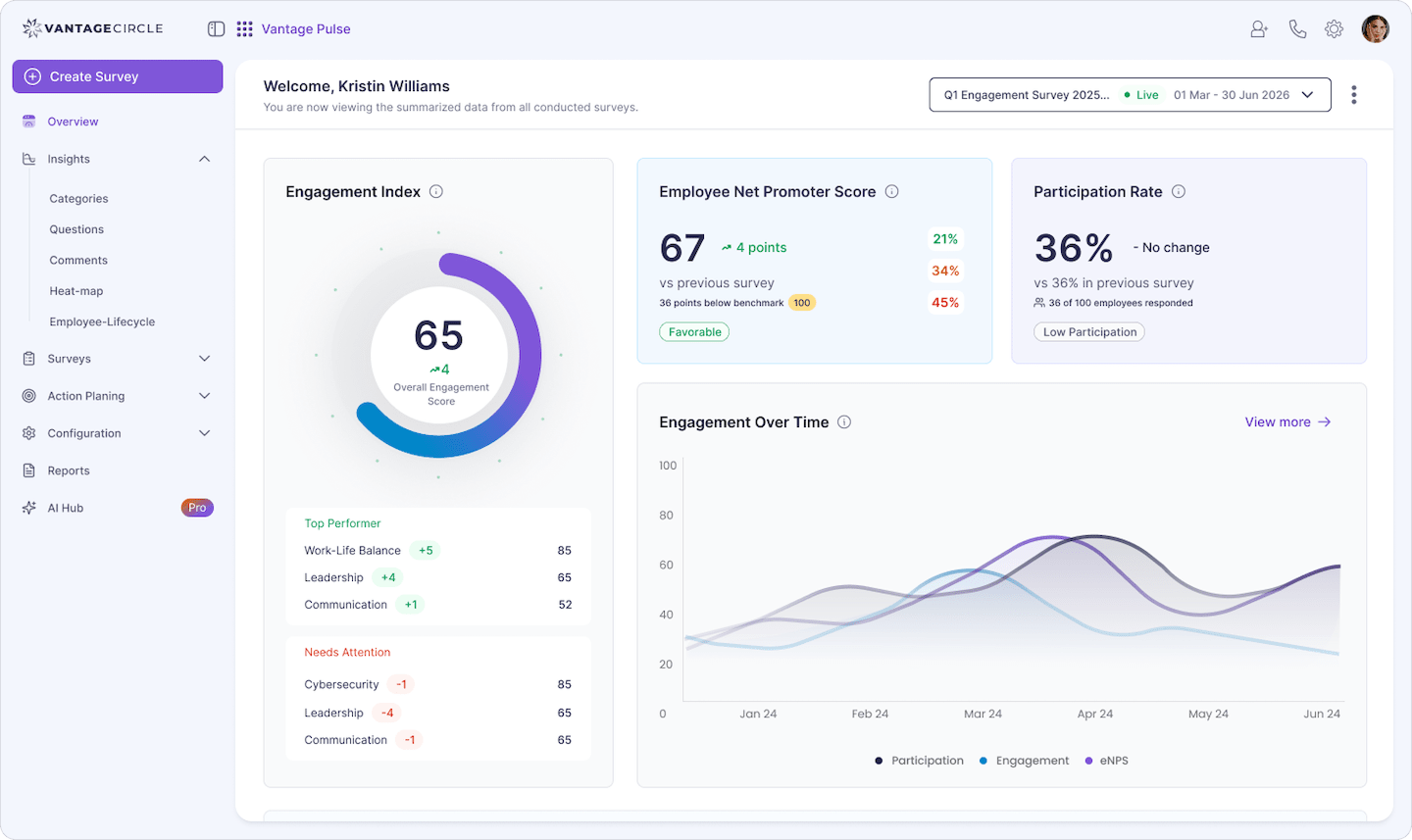
The design principles that make pulse surveys work:
- Short and recurring. Five to ten questions monthly beats forty questions annually. Shorter surveys keep participation high; higher participation keeps the trend data usable rather than self-selected.
- Anonymity that is real. Honest answers about why people are considering leaving require psychological safety, and anonymous response options are what make the flight risk signal usable.
- Closure on findings. Employees who see their survey feedback produce a visible change keep answering. Employees who see nothing stop responding within two cycles, and the loop dies.
A platform like Vantage Pulse automates the cycle, recurring eNPS and pulse surveys, anonymity, and trend tracking, so the loop survives busy quarters.
How to Measure Whether Your Retention Strategy Is Working
Retention is measured through four core metrics: retention rate, voluntary turnover rate, eNPS, and recognition participation, tracked together rather than in isolation. Each one catches a different failure mode, and none of them is useful alone. Retention rate tells you the outcome, turnover splits the causes between voluntary and structural, eNPS predicts what happens next, and participation data shows whether the programs meant to move the first three are actually being used.
| Metric | Formula | Illustrative benchmark | Where to track it |
|---|---|---|---|
| Retention rate | (Employees who stayed ÷ employees at start of period) × 100 | 85% or higher (SHRM industry average; varies substantially by sector, geography, and role type) | HRIS or exit data |
| Voluntary turnover rate | (Voluntary separations ÷ average headcount) × 100 | Below 10–15% (SHRM 2024 Benchmarking Report; treat as directional, not universal) | HRIS |
| eNPS | % promoters − % detractors | Above 0 is positive; +10 or higher is the standard "healthy" threshold on the NPS scale | Pulse surveys |
| Recognition participation | % of employees giving or receiving recognition monthly | 60% or higher monthly active (Vantage Circle recognition program benchmark; will vary by program maturity) | Recognition platform analytics |
Worked example, retention rate for a 200 person organization: The company starts the year with 200 employees. Across the year, 24 employees separate, 18 voluntarily and 6 through role eliminations, and none of the 40 new hires fall within the measured period.
Retention rate = (200 − 24) ÷ 200 × 100 = 88%. Voluntary turnover = 18 ÷ 200 × 100 = 9%. For eNPS, if 100 employees respond and 40 are promoters while 20 are detractors, eNPS = 40 − 20 = +20. Read together: stable headline retention, but the promoter gap of 40 points tells you the 88% is not evenly felt.
Two reading rules keep these numbers honest. First, watch the trend, not the snapshot, a retention rate that holds while eNPS falls is a leading indicator of next year's turnover. Second, segment before you conclude. Company level averages hide exactly the teams where the problem lives, which is why department wise insights matter more than the topline score.
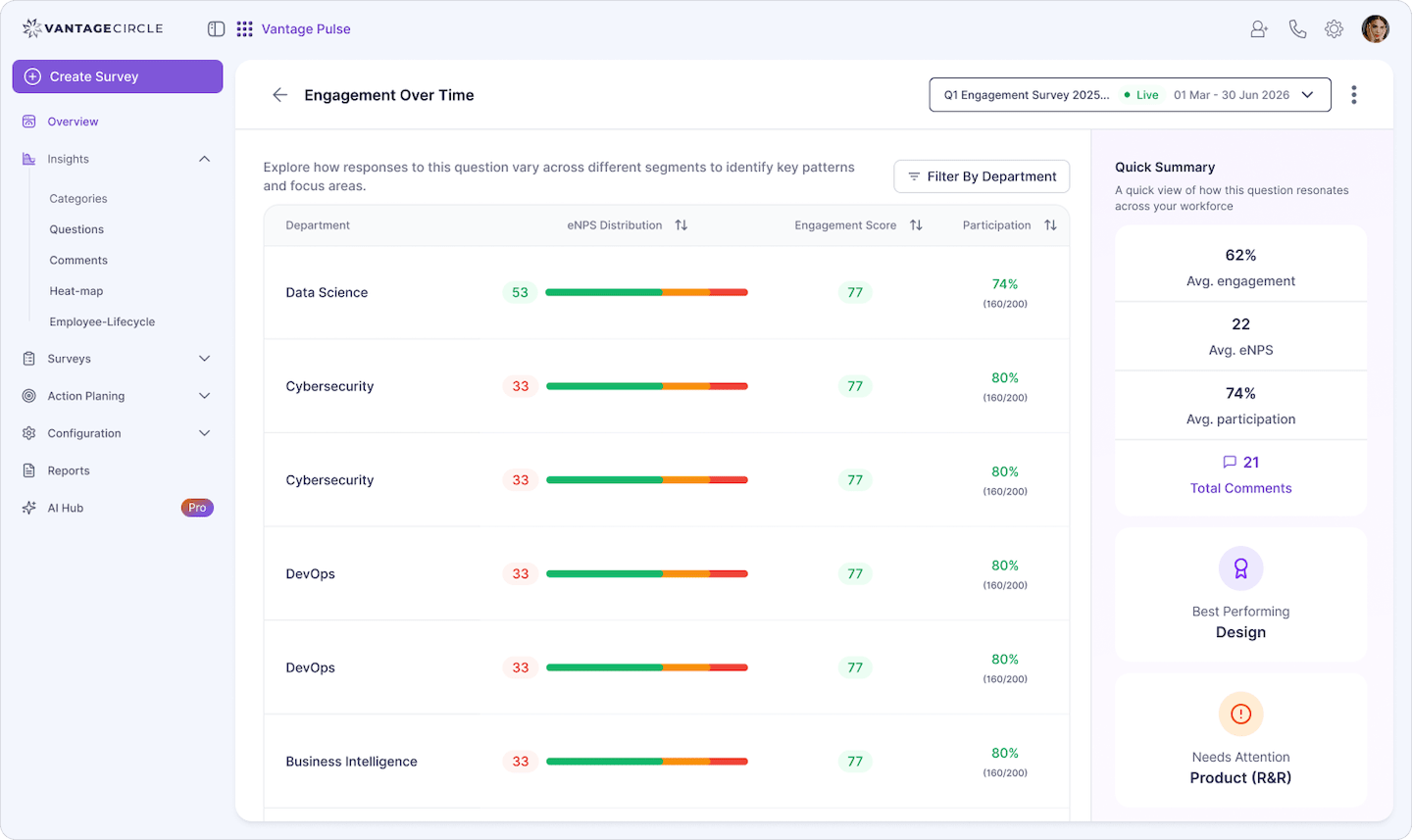
Recognition participation deserves a specific note, because it is the metric on this list most organizations do not track. Most companies can say how many people left last quarter. Few can say whether their recognition program actually moved that number. Recognition analytics ties program usage to engagement and retention trends over time, which turns recognition from a culture initiative with a vibes based business case into a measurable retention lever you can defend in a budget meeting.
Put a number on retention
Find the flight risk before it becomes a resignation.
Vantage Pulse runs short recurring eNPS and pulse surveys, segments sentiment by department, and shows you the trends while there is still time to act on them.
The Bottom Line
Retention in the modern workplace is not one lever, it is compensation, growth, and recognition working together, measured continuously rather than assumed. Pay sets the floor, growth sets the trajectory, and recognition sets the daily experience that decides whether an employee hears out the next recruiter message.
The six strategies in this guide require no reorg and no heroic budget. They require cadence. The organizations that retain best are rarely the ones with the most original ideas. They are the ones who track where people are leaving and why, segment the signal until the problem is visible at the team level, and run the same six plays consistently until the data confirms they moved the number.
Frequently Asked Questions
What are the 5 C's of employee retention?
The 5 C's are clarity, connection, culture, compensation, and career. Clarity is knowing what success looks like. Connection covers manager and peer relationships. Culture is the daily work environment. Compensation is benchmarked pay. Career is a visible growth path. Retention holds when all five are present; a gap in any one makes a competitor's offer sound reasonable.
What are the top 5 employee retention strategies?
The five most consistently cited are competitive compensation benchmarking, frequent recognition, visible career growth paths, manager capability, and flexible work design. Order matters less than combination, since each covers a different reason employees leave. Recognition and manager quality tend to be the most underinvested, which is why they show the largest gaps in retention data.
What are the three R's of employee retention?
The three R's are respect, recognition, and reward. Respect covers how people are treated day to day. Recognition is the acknowledgment of specific contributions as they happen. Reward is compensation tied to performance and tenure. The retention effect comes from running all three together: reward without recognition feels transactional, and recognition without reward eventually feels hollow.
What are some examples of employee retention strategies?
Concrete examples include monthly pulse surveys with published follow-up actions, peer-to-peer recognition with a public feed, annual salary benchmarking, structured manager training, role-based hybrid work policies, internal mobility programs, and long-service recognition. What separates working examples from decorative ones is measurement: each can be tied to retention rate, eNPS, or participation data.
What are the 5 main drivers of employee retention?
The five main drivers are compensation, career growth, recognition, manager quality, and workplace flexibility. Manager capability acts as the multiplier for the rest, determining how consistently the other four are delivered. For the research behind each driver, see the guide to the 5 main drivers of employee retention.
What are good retention strategies?
Good retention strategies are measurable, continuous, and owned by managers rather than HR alone. A recognition program HR runs in isolation is an event; a habit managers run weekly and track through participation data is a strategy. The test: does it produce a number you can trend, with someone outside HR accountable for moving it?
What are some effective staff retention strategies?
The most effective staff retention strategies start before hiring and continue past the first year: realistic job previews, structured onboarding with 30-60-90 day check-ins, frequent recognition from week one, compensation reviews on a fixed cadence, and stay conversations before a resignation appears. First-year attrition is typically the highest, so the earliest stages matter most.
What are the four pillars of employee retention?
The four pillars are compensation and benefits, growth and development, culture and recognition, and employee experience. They reinforce each other: recognition is the daily expression of culture, and growth conversations are where experience either builds trust or breaks it. For a deeper look at the fourth pillar, see the guide to employee experience.
What are some best practices for employee retention?
Consistently high-retention organizations do five things: measure retention rate, turnover, and eNPS together; segment every metric by department and manager; run recognition continuously; benchmark compensation annually; and close the loop visibly on every survey. The discipline is in running all five on a schedule, not treating exits as surprises.
Written by