
Nobody goes into HR dreaming about the day they'll have to let someone go. Yet of all the tough conversations the job throws at you, employee termination is the one that sits heaviest.
And that's because it's not just a business decision. For the person receiving the news, it's a sudden loss. One that can shake their confidence, their finances, and their sense of stability all at once.
That's a lot of weight to carry as the person delivering it. So if you're going to do it, you owe it to everyone involved to do it right.
Here's everything you need to know to handle employee termination with clarity, compassion, and confidence.
What is Employee Termination?
Employee Termination is the formal ending of an employment relationship between an employer and an employee, either initiated by the employer or the employee..
While the terms are often used interchangeably, they mean different things:
Employee termination is the umbrella term covering all of the above. Understanding these distinctions matters because each type carries different legal obligations, severance implications, and offboarding process requirements.
According to SHRM's data, the average cost of replacing an employee is 6–9 months of their salary. That makes every termination, voluntary or not, a significant financial event for the organization.
Let's have a look at a few of these types first.
The 4 Types of Employee Termination
Not every termination looks the same. Some employees leave on their own terms. Others are let go due to performance or business needs. And sometimes, both parties simply agree it's time to part ways.
Understanding which type of termination you're dealing with is the first step. It's important to understand that each one comes with its own process, legal considerations, and documentation requirements.
Here's a quick breakdown before we dive in:
| Type | Initiator | Common Reason | Notice Required | Severance Typical? |
|---|---|---|---|---|
| Voluntary | Employee | Resignation, retirement | Yes (2 weeks standard) | Rarely |
| Involuntary | Employer | Poor performance, misconduct, layoff | Varies by contract | Sometimes |
| At-Will | Either party | No reason needed | Not required | Rarely |
| Mutual | Both parties | Role misalignment, restructuring | Negotiated | Often |
Let's delve deeper into each type.
1. Voluntary Termination
In this type of termination, the worker takes the initiative to leave the company. A decision, as such, can be for many professional or personal reasons.
For example, it could be a toxic work environment, lack of growth opportunities or employee development, personal problems, etc.
If such a termination happens for professional reasons, you may be at fault. Thus, whatever reasons it may be, it is a wake-up call for you to correct the situation for other remaining workers.
2. Involuntary Termination
Involuntary termination is the type most people picture when they hear "termination." It's employer-initiated, and it falls into two buckets:
For-cause (misconduct, policy violations, consistent underperformance) and
Layoffs (role elimination, budget cuts, restructuring).
Both require thorough documentation and, in the case of layoffs, sometimes advance notice under laws like the WARN Act.
The WARN Act requires U.S. employers with 100+ employees to give 60 days' written notice before a mass layoff or plant closure. Skipping it can cost the company up to 60 days of back pay per affected employee. Several states like California and New York have even stricter versions of this law.
3. Employment at Will
This termination type dictates that an employer can fire a worker anywhere at any place without any reason. Here, an employer need not give any reason to the leaving employee.
However, employers must document the reason for themselves to fight or prohibit any discrimination case, should it arise.
4. Mutual Termination
Mutual termination is exactly what it sounds like. Both sides agree to part ways. It's common when a role is no longer a good fit, but the relationship is still respectful.
These separations are typically formalized through a separation agreement that outlines terms like severance, benefits continuation, and non-disparagement clauses.
These were a few employee termination types. A departure of such kinds can happen for many reasons or causes. Let's have a look at a few of these causes in our next topic.
Termination vs Firing vs Layoff vs RIF vs Resignation
These five terms show up constantly in HR conversations, and using them interchangeably can cause real legal and operational problems. Each one means something distinct.
The short version, termination is the umbrella. Everything else falls under it. But how it happens, who triggers it, and what it means for severance and rehire eligibility varies significantly across each type.
Here's where most HR teams get tripped up.
Here's a side-by-side breakdown of all five:
| Term | Definition | Initiator | Cause | Severance | Eligible to Re-hire? |
|---|---|---|---|---|---|
| Termination | Formal end of employment relationship | Either party | Any reason | Depends on type | Depends on type |
| Firing | Employer-initiated removal for cause | Employer | Misconduct, poor performance, policy violation | Rarely | Usually No |
| Layoff | Involuntary separation due to business needs; may be temporary | Employer | Budget cuts, restructuring, slow business | Often | Yes (if recalled) |
| RIF | Permanent elimination of a role or department | Employer | Reorganization, downsizing, role redundancy | Typically Yes | Rarely |
| Resignation | Voluntary departure initiated by the employee | Employee | Personal choice, better opportunity, burnout | No | Yes (in most cases) |
7 Common Reasons for Employee Termination
Most terminations don't come out of nowhere. There's usually a pattern, a paper trail, or a business decision that's been building. Knowing the most common reasons helps HR teams spot warning signs early and take corrective action before separation becomes the only path forward.
Here are the seven reasons that come up most often.
1. Misconduct (Theft, Harassment, Violence)
Now, this is termination for cause in its clearest form. When an employee steals, harasses a colleague, or creates a physically threatening environment, the employer has both the right and the obligation to act quickly.
These situations typically result in immediate termination and require thorough documentation to protect the organization legally. There is usually no room for progressive discipline here.
2. Performance Failure (PIP Not Met)
Consistent underperformance that survives a performance improvement plan is one of the most common grounds for involuntary termination. The PIP gives the employee a fair, structured chance to improve. When that window closes without measurable progress, termination becomes the documented next step.
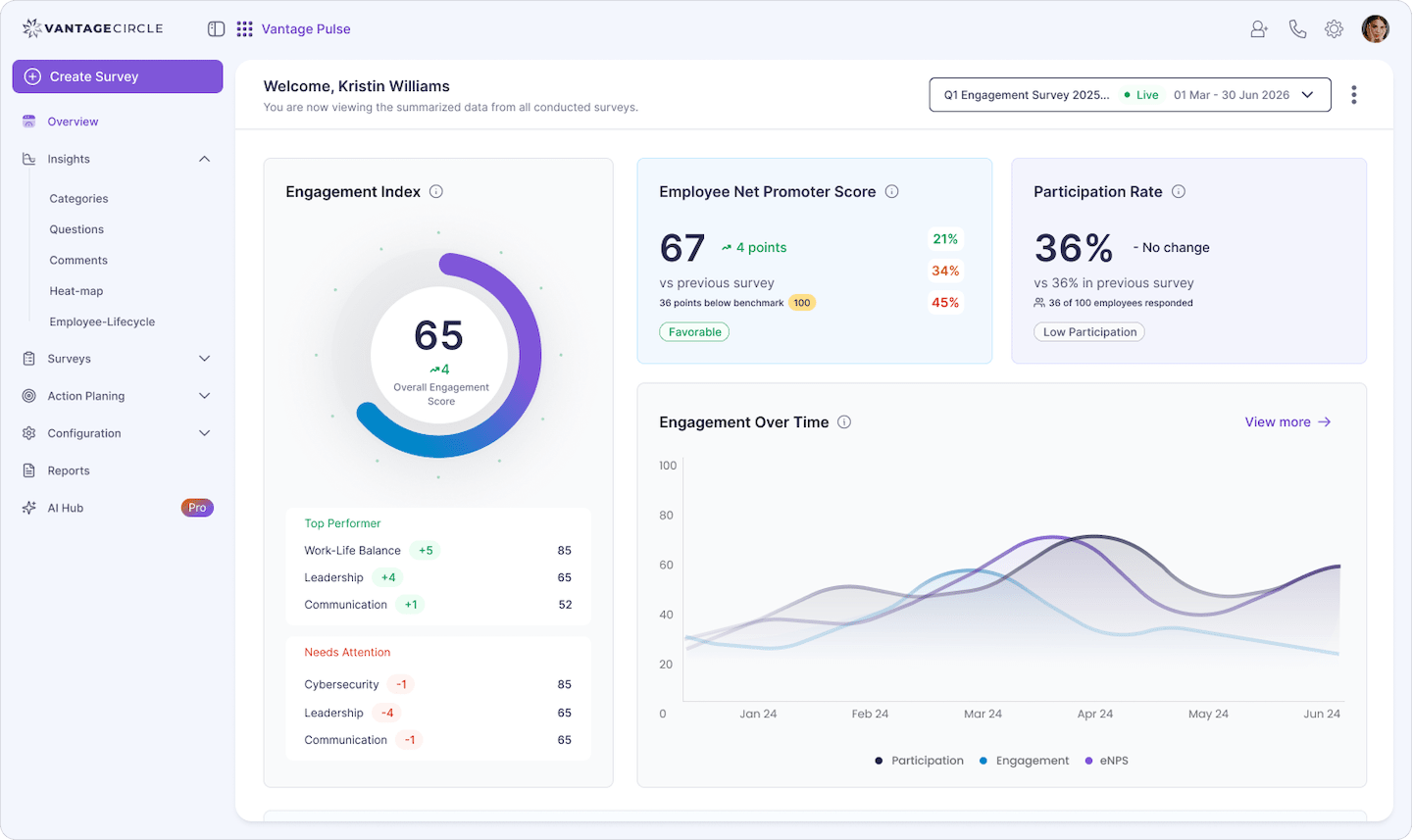
The harder truth is that most performance issues don't start at the PIP. They start much earlier, in missed check-ins, unclear expectations, or a gradual disengagement that nobody flagged in time. Tools like Vantage Pulse help managers catch those signals early through regular pulse surveys, so there's a genuine opportunity to course correct before things escalate.
3. Attendance and Tardiness
Chronic absenteeism or habitual lateness disrupts team workflows and, left unaddressed, can become grounds for termination. Most companies use a progressive approach: verbal warning, written warning, final warning, then termination.
What matters is that the attendance policy is clearly written, consistently applied, and well-documented every step of the way.
4. Insubordination and Policy Violations
Refusing to follow reasonable directives, undermining management, or repeatedly violating company policy signals a breakdown in the employment relationship. A single incident might call for a warning. A pattern, especially after documented coaching, often justifies termination.
Document every coaching conversation with dates, what was discussed, and what the employee agreed to. Verbal corrections that go unrecorded are almost impossible to rely on in a wrongful termination dispute.
5. Position Elimination (RIF, Layoff, Restructuring)
Sometimes it has nothing to do with the individual. Budget cuts, mergers, automation, or strategic pivots can make entire roles redundant. This falls under involuntary termination but carries no performance stigma. Severance, WARN Act compliance, and clear, compassionate communication all become especially important here.
6. Job Abandonment
When an employee stops showing up and stops communicating, most HR policies treat it as a voluntary resignation after a set number of days, typically three to five. Still, it requires documentation.
Never assume abandonment without making reasonable attempts to reach the employee first.
7. End of Contract or Fixed-Term Role
Project-based or contract employees have a built-in end date. When the contract expires and is not renewed, the separation is expected and straightforward. HR should still run a proper offboarding process and confirm any non-compete or confidentiality obligations that carry through.
Legal Compliance in Employee Termination: EEOC, ADA, FMLA, and WARN Act
Getting the decision to terminate right is only half the job. Getting the process right is what keeps the organization legally protected.
U.S. employment law governs nearly every stage of a termination, and a misstep at any point — from the reason you give to the timing of the final paycheck — can turn a straightforward separation into a costly legal dispute.
Here is what every HR professional needs to know.
1. At-Will Employment (and Its Exceptions)
Most U.S. employees work under at-will employment, which means either party can end the relationship at any time, for any reason, or for no reason at all. In practice, this gives employers broad discretion to terminate.
The exception is Montana, the only state with a just-cause employment statute. After a probationary period, Montana employers must have legitimate cause to terminate. They cannot rely on at-will doctrine.
Even in at-will states, termination is not truly "for any reason." Federal anti-discrimination laws, employment contracts, implied promises, and public policy protections all limit that discretion. At-will does not mean immune from wrongful termination claims.
2. EEOC Anti-Discrimination Laws
The Equal Employment Opportunity Commission enforces several federal statutes that prohibit termination based on protected characteristics:
If the timing of a termination closely follows an employee's engagement in a protected activity, filing a complaint, requesting FMLA, disclosing a disability. It can raise a retaliation claim even if the employer cites a different reason.
3. ADA and Reasonable Accommodation
Before terminating an employee for performance issues or attendance problems, HR must consider whether the underlying issue is connected to a disability. If it is, the employer is legally required to explore reasonable accommodation first.
Reasonable accommodation can include modified schedules, remote work, adjusted duties, or assistive technology. Terminating before completing this interactive process is a recognized legal risk. Document every accommodation discussion thoroughly.
4. FMLA-Protected Leave
The Family and Medical Leave Act entitles eligible employees at covered employers (50 or more employees) to up to 12 weeks of unpaid, job-protected leave per year for qualifying medical or family reasons. Terminating an employee while they are on FMLA leave, or because they took FMLA leave, is considered interference and retaliation under federal law.
HR should verify FMLA eligibility and designation before any termination decision involving a medical absence.
5. WARN Act: 60-Day Notice for Mass Layoffs
The Worker Adjustment and Retraining Notification Act requires employers with 100 or more employees to provide 60 calendar days of advance written notice before a qualifying plant closing or mass layoff. A mass layoff generally means 50 or more employees losing employment at a single site within a 30-day period.
Failure to comply can expose the employer to back pay and benefits liability for each affected employee for the number of days notice was short, up to 60 days. Several states, including California, New York, and New Jersey, have their own mini-WARN laws with lower thresholds and stricter requirements.
6. State-Specific Final Paycheck Laws
Federal law does not set a deadline for the final paycheck. That is governed by each state. Getting this wrong is one of the most common and easily avoidable compliance failures in the termination process.
| State | Final Paycheck Due (Termination) | Final Paycheck Due (Resignation) |
|---|---|---|
| California | Immediately | Within 72 hours (or immediately if 72 hrs notice given) |
| New York | Next regular payday | Next regular payday |
| Texas | Within 6 days | Next regular payday |
| Florida | Next regular payday | Next regular payday |
| Illinois | Next regular payday | Next regular payday |
| Pennsylvania | Next regular payday | Next regular payday |
| Ohio | Next regular payday | Next regular payday |
| Georgia | Next regular payday | Next regular payday |
| North Carolina | Next regular payday | Next regular payday |
| Massachusetts | Immediately (day of discharge) | Next regular payday |
Red flags that put your termination at legal risk: terminating within days of an FMLA request or return; no documented performance warnings before firing; terminating a protected-class employee while retaining a similarly situated non-protected employee; skipping the ADA interactive process; verbal-only discipline with no written record; and ignoring state mini-WARN thresholds for smaller layoffs.
Now, let's look at a basic sample letter template in the event of employee termination.
5 Employee Termination Letter Templates (Copy-Ready)
A termination letter is not just a formality. It is a legal document, a paper trail, and often the last official communication an employee receives from your organization. Every letter you send should be factual, free of emotional language, and reviewed by HR or legal before it goes out.
Below are five ready-to-edit templates covering the most common termination scenarios. Replace the bracketed variables with your specifics.
All 5 templates above are ready to copy, edit, and use. Before sending any termination letter, have it reviewed by HR or employment counsel. Ensure it does not reference protected characteristics, and confirm final pay timing meets your state's legal deadline.
After the Termination: Managing Team Impact
The moment a termination happens, HR's attention naturally shifts to the person leaving. But the people staying are watching closely too. How you handle the aftermath shapes how your team feels about their own security, their trust in leadership, and their willingness to stay.
This part of the process deserves as much care as the termination itself.
1. Communicating to the Team (What to Say, What Not to Say)
You don't owe the team details. You do owe them clarity and respect. A simple, factual statement delivered by the manager or HR is enough: "[Name] is no longer with the company as of [date]. We are working through the transition and will keep you updated on next steps."
Do not speculate, assign blame, or share reasons unless legally required. Do not let the news travel through the grapevine before leadership addresses it. The longer the silence, the louder the anxiety.
2. Watching Engagement Signals in the Next 30 Days
Terminations, especially unexpected ones or layoffs, tend to create a ripple. Some team members feel relief. Others feel unsettled, worried they are next. Both reactions are normal.
The 30 days after a termination are a meaningful window. Watch for drops in participation, missed deadlines, reduced communication, or a quietness in people who are usually vocal. These are early signals worth following up on in one-on-ones before they become something bigger.
Vantage Pulse with sentiment analysis gives HR and managers a structured way to track morale in real time after a departure, without putting individual employees on the spot. Regular pulse check-ins in this window can surface concerns early and give you something concrete to act on.
3. Replacing Institutional Knowledge
When someone leaves, they take context with them. Projects they owned, relationships they held, processes only they understood. The sooner you identify those gaps, the less disruption the team absorbs.
Ask the departing employee, where possible and appropriate, to document ongoing work, key contacts, and any pending decisions. For involuntary terminations where the exit is immediate, the manager should do a quick audit within the first 48 hours. What was in progress? Who needs to be notified externally?
4. Conducting a Post-Termination Retrospective
Not every termination calls for a retrospective, but patterns do. If the same role has turned over three times in two years, that is worth examining. If a high performer left voluntarily, the exit interview data should inform something.
A post-termination retrospective does not have to be formal. It is simply a conversation between HR and the hiring manager: what led here, what was missed early, what could be handled differently next time. The goal is not to assign blame. It is to make the next termination, or better yet the next hire, go better.
2026 Trends in Employee Termination: RTO Mandates, AI Decisions, and Federal RIFs
The rules around termination have always evolved slowly. That changed in 2024 and 2025. A combination of political decisions, technological shifts, and workplace policy reversals has reshaped how terminations are happening and what HR teams need to watch for going into 2026.
1. The 2025 Federal RIF Wave
The most significant reduction-in-force event in recent U.S. history began in early 2025, driven by the Department of Government Efficiency (DOGE) initiative. Across federal agencies, tens of thousands of employees faced termination, deferred resignation offers, or early retirement packages. Agencies including USAID, the Consumer Financial Protection Bureau, and the Department of Education saw dramatic workforce cuts.
For HR professionals outside the federal government, the practical lesson here is about process at scale. Federal RIFs of this size exposed gaps in documentation, severance administration, and communication, problems that surface in any large-scale RIF if the groundwork is not laid in advance. If your organization is planning a significant reduction, the WARN Act timeline and state mini-WARN obligations are not optional. Courts have been active in this space, and litigation around improper RIF procedures has increased.
2. AI-Assisted Termination Decisions and NYC Local Law 144
Employers are increasingly using automated tools to flag performance issues, model attrition risk, and in some cases inform termination decisions. New York City's Local Law 144, which took effect in July 2023, was the first U.S. law to regulate Automated Employment Decision Tools (AEDTs). It requires employers using such tools for hiring or promotion decisions affecting NYC employees to commission independent bias audits annually and post results publicly.
While Law 144 currently targets hiring and promotion, its framework is being watched closely by other states and cities. Illinois, Maryland, and California have introduced or passed related legislation. The direction is clear: if an algorithm touches an employment decision, documentation of how and why it was used is going to matter legally.
For HR teams today, the practical step is simple. If you use any software that scores employees, predicts flight risk, or generates termination recommendations, understand what data it uses and be ready to explain the outcome in plain language. A termination that was partly driven by a model output and cannot be explained without the model is a legal liability waiting to happen.
3. RTO Mandates, Attrition, and the Constructive Dismissal Question
Beginning in late 2024 and accelerating into 2025, major employers including Amazon, JP Morgan Chase, and several large financial institutions moved to five-day in-office requirements. Many employees who had relocated, had caregiving responsibilities, or had disability-related accommodations tied to remote work could not comply.
The legal question this raises is whether a return-to-office mandate that an employee genuinely cannot meet constitutes constructive dismissal. In constructive dismissal, the employer does not formally fire the employee but changes working conditions so significantly that resignation becomes the only reasonable option. Some employees filing for unemployment after RTO-related departures initially had claims denied because the departure looked voluntary. That is being challenged in multiple states.
HR teams handling RTO-related separations should document the accommodation review process carefully, especially where disability or medical leave intersects with the mandate. What looks like a clean voluntary resignation can become a wrongful termination claim if that process was skipped.
Frequently Asked Questions
1. What happens if an employee is terminated?
Ans: When an employee is terminated, their employment officially ends. The employer may provide a final paycheck, unused leave payouts (if applicable), and documentation explaining the reason. Access to company systems is revoked, and exit formalities like returning assets or signing paperwork are completed.
2. Can I sue for being fired without warning?
Ans: It depends on the circumstances. In many regions, employment is ”at-will,” meaning employers can terminate without notice unless a contract states otherwise. However, you may have grounds to sue if the termination violates labor laws, involves discrimination, retaliation, or breaches a contract.
3. Is termination the same as getting fired?
Ans: Not exactly. ”Termination” is a broad term that includes both voluntary (resignation) and involuntary (firing, layoffs) endings of employment. ”Fired” specifically refers to involuntary termination initiated by the employer, usually due to performance or misconduct.
4. What are the three types of termination?
Ans: The three common types are:
- Voluntary termination: when an employee resigns.
- Involuntary termination: when an employer ends employment (firing or layoffs).
- Mutual termination: when both parties agree to end the employment relationship.
5. What are 5 reasons for termination?
Ans: Common reasons include poor performance, misconduct or policy violations, absenteeism, redundancy due to restructuring, and breach of contract. Other reasons may involve ethical violations or inability to meet job requirements.
6. Can you be hired back after being terminated?
Ans: Yes, it’s possible. Rehire depends on the reason for termination, company policy, and your relationship with the employer. Employees who left on good terms or were laid off are more likely to be considered for reemployment.
Conclusion
Termination is one of the most dreadful moments in professional life. It is what a worker fears the most, so it is expected that termination will stir emotions. As an HR, your job is to ease up the process as much as possible.
To handle this process swiftly, we hope you got a better understanding of employee termination today.

Sanjeevani Saikia is a Senior Content Strategist at Vantage Circle, where she leads end-to-end content strategy across SEO, thought leadership, brand storytelling, podcasts, and video. She is also the host of the Vantage Influencers Podcast, where she brings conversations with HR and business leaders from top global organisations, including Fortune 500 companies.
Connect with Sanjeevani on LinkedIn.