
According to a 2024 SHRM report, fewer employees quit their jobs compared to the previous year, dropping from 43.3% to 38.5%. It's the first major decline since the Great Resignation. But here's the catch: what companies think keeps employees loyal often doesn't match reality.
When employees leave, 32.4% blame a toxic workplace. Only 15.3% of employers recognize it as a problem. While many companies focus on pay, 50.9% of workers say they'd accept lower salaries for better work-life balance (iHire).
This disconnect is expensive. Workplace incivility costs U.S. organizations $2.7 billion per day in lost productivity and absenteeism — a record high (SHRM Civility Index, Q4 2024), and one in five Americans have quit jobs because of poor culture. Employee recognition is another blind spot: most companies invest in recognition without measuring whether it actually works.
Behavioral science explains why reward design matters so much. Research by B.F. Skinner shows that positive reinforcement drives better results than punishment. Edward Deci and Richard Ryan's Self-Determination Theory adds that rewards work best when they nurture autonomy, competence, and connection, and backfire when they feel controlling.
37% of employees say recognition matters most for their engagement, yet only 33% of companies track whether their recognition programs actually work. (SHRM)
Despite this, most companies still treat rewards as an afterthought instead of a strategic business tool.
This guide covers what extrinsic rewards are, the five main types, 15 concrete examples, and a step-by-step framework for building a program that drives performance without backfiring.
Key Takeaways
- What Are Extrinsic Rewards
- Types of Extrinsic Rewards
- 15 Extrinsic Rewards Examples
- Intrinsic vs. Extrinsic Rewards: How to Balance Both
- Advantages and Disadvantages
- How to Design an Effective Extrinsic Rewards Program
- Extrinsic Rewards by Workforce Type
What Are Extrinsic Rewards?
Extrinsic rewards are external incentives provided to employees as compensation for completing tasks, achieving specific goals, or demonstrating desired behaviors. Unlike intrinsic motivation, which comes from internal satisfaction, extrinsic rewards are tangible or intangible benefits given by an external source, typically the employer.
The concept is grounded in two well-established psychological frameworks. B.F. Skinner's operant conditioning shows that behavior followed by a positive outcome is more likely to be repeated. Deci and Ryan's Self-Determination Theory refines this further: rewards strengthen engagement when they affirm competence and support autonomy, but undermine it when they feel controlling.
So the question isn't whether to use extrinsic rewards. It's whether you're using them in a way that builds motivation, or quietly drains it.
Types of Extrinsic Rewards
Extrinsic rewards fall into five broad categories. Understanding each helps you build a system that's both cost-effective and motivationally sound.
Monetary Rewards
Cash-based incentives are the most direct form of extrinsic motivation. They include performance bonuses, salary increases, commissions, profit-sharing, and stock options. Monetary rewards are high-impact for short-term performance goals and talent attraction, but they have a ceiling.
Research on the hedonic treadmill shows that employees adapt to each new compensation level quickly, requiring ever-larger incentives to maintain the same motivational effect. This is why monetary rewards alone are never a sustainable retention strategy.
Non-Monetary Tangible Rewards
Gift cards, merchandise, experiential rewards (travel, team outings, conference access), and employee perks all fall here. These rewards often carry higher perceived value than their cash equivalent because they feel more personal and memorable. A weekend trip awarded to a top performer carries emotional weight that a bank transfer often doesn't.
Vantage Perks gives employees access to 1,000+ brand deals and curated discounts, turning everyday spending into a tangible workplace benefit without adding significant cost to the rewards budget.
Social Recognition and Public Acknowledgment
Verbal praise, awards, certificates, shoutouts in team meetings, and peer recognition programs are powerful drivers that cost relatively little. The science is clear: a 2008 study published in *Neuron* found that receiving a compliment activates the same neural reward pathway, the striatum, as receiving cash. The brain doesn't sharply distinguish between being paid and being recognized.
Career-Based Rewards
Promotions, expanded responsibilities, title changes, and access to leadership development programs are powerful long-term motivators. They signal that the organization sees a future for the employee, and that matters far more to high performers than any one-time bonus.
Flexibility and Time-Based Rewards
Paid time off, flexible scheduling, remote work options, and sabbaticals are increasingly among the most valued non-monetary rewards. 50.9% of workers say they'd accept a lower salary for better work-life balance (iHire, 2024). Flexibility rewards signal trust, and trust is foundational to retention.

Vantage Influencers Podcast
"Companies that set themselves apart look beyond paychecks — they focus on what employees actually prefer to stay engaged."
— Vineet Kumar, HR Leader & Podcast Guest
Listen to the Episode15 Extrinsic Rewards Examples for Employees
| Category | Example | Best Used For | Cadence |
|---|---|---|---|
| Monetary | Performance bonus | Hitting quarterly or annual targets | Quarterly or annual |
| Monetary | Spot bonus | Outstanding in-the-moment contributions | Real-time / immediate |
| Monetary | Salary increase | Sustained performance, retention | Annual review cycle |
| Monetary | Commission | Sales performance | Monthly / per deal |
| Monetary | Profit-sharing | Company-wide performance alignment | Annual |
| Non-Monetary | Gift cards | Quick recognition for specific achievements | Real-time |
| Non-Monetary | Incentive trip | Top performer reward | Annual |
| Non-Monetary | Conference access | Learning milestone or development reward | As earned |
| Non-Monetary | Merchandise | Team milestones, company anniversaries | Milestone-based |
| Social | Public shoutout | Any positive behavior reinforcement | Weekly / ongoing |
| Social | Peer-to-peer recognition | Culture-building, team belonging | Continuous |
| Social | Employee of the Month award | Sustained excellence | Monthly |
| Career | Promotion | Demonstrated leadership readiness | As earned |
| Career | Stretch assignment | High-potential development | Quarterly / project-based |
| Flexibility | Extra PTO | Exceptional contributions, preventing burnout | As earned |
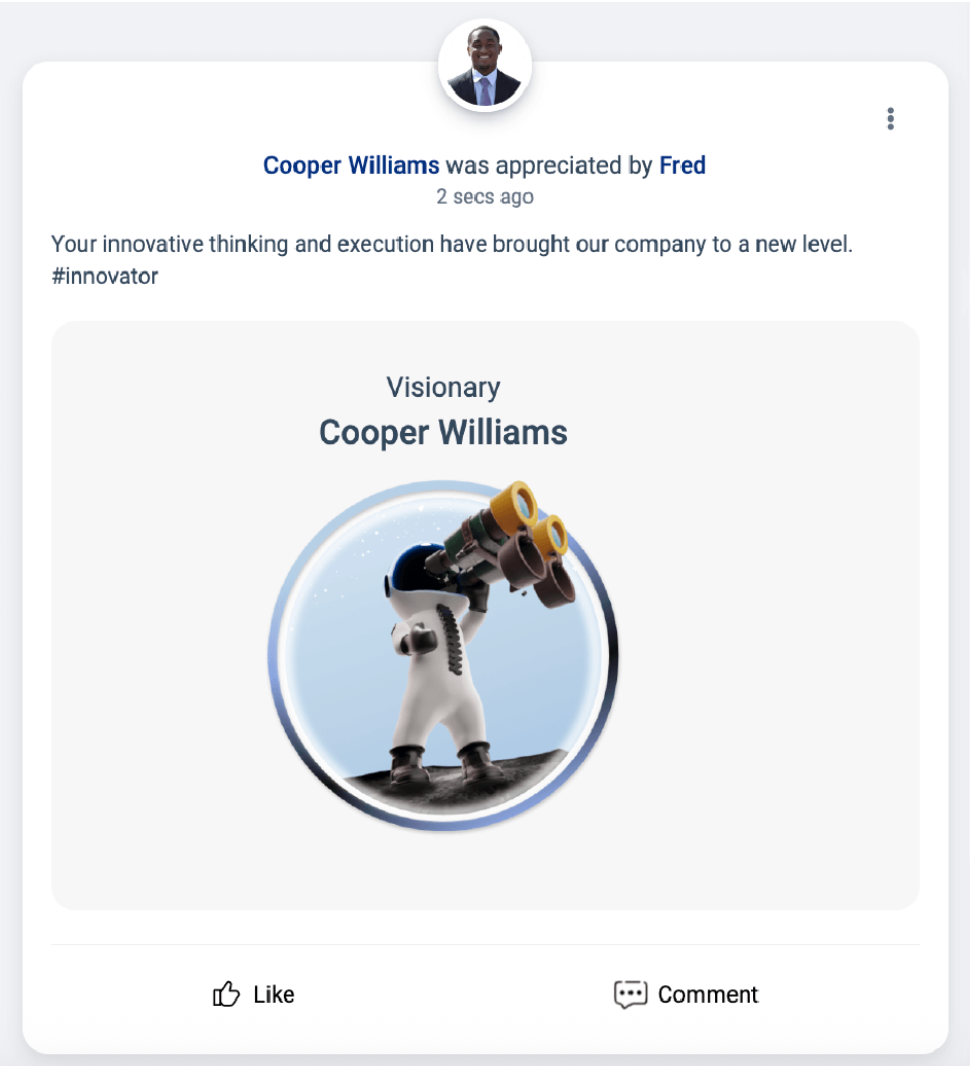
These aren't mutually exclusive. The most effective programs layer multiple reward types, frequent social recognition for ongoing reinforcement, spot bonuses for immediate wins, and career-based rewards for long-term retention.
Source: Vantage Recognition
Intrinsic vs. Extrinsic Rewards: How to Balance Both
Understanding the difference between intrinsic and extrinsic rewards is essential for designing a balanced rewards strategy. Neither works in isolation, the most effective organizations use both strategically.
| Aspect | Intrinsic Rewards | Extrinsic Rewards |
|---|---|---|
| Source | Internal (comes from within) | External (given by employer or peers) |
| Examples | Sense of accomplishment, learning, autonomy, purpose | Bonuses, promotions, awards, recognition, benefits |
| Duration of Effect | Long-lasting and self-reinforcing | Short-term boost; diminishes without repetition |
| Cost to Organization | Minimal — requires culture design, not budget | Significant — salary, bonuses, perks, gifts |
| Best Used For | Sustained engagement, creativity, loyalty | Short-term targets, milestone rewards, talent attraction |
| Sustainability | Grows stronger as employees develop mastery | May lose impact once it becomes routine or expected |
Recommended Resource: Extrinsic vs. Intrinsic Motivation — An Overview
Research published in Frontiers in Psychology shows that while external rewards effectively drive short-term behavior change and goal achievement, internal motivation fuels long-term performance. The most effective strategies use both, extrinsic rewards to recognize and reinforce desired behaviors, and intrinsic motivators like meaningful work, autonomy, and skill development to sustain them.
The key insight: external rewards work best when they don't undermine internal motivation. Poorly designed reward systems backfire when employees feel controlled rather than supported, or when rewards feel transactional rather than genuine. When recognition is authentic and fair, it amplifies, not replaces, an employee's natural drive to perform and grow.
The Overjustification Effect: When Extrinsic Rewards Backfire
There's a real risk that HR leaders need to design around: the overjustification effect.
When employees already find a task intrinsically meaningful, introducing an external reward can actually reduce their motivation. The reward shifts the perceived reason for doing the work from "I find this meaningful" to "I do this for the reward." When the reward disappears, so does the motivation, even if it was strong before.
Deci, Koestner, and Ryan's 1999 meta-analysis of 128 studies confirmed this: tangible, expected rewards consistently undermined intrinsic motivation. The fix isn't to avoid extrinsic rewards, it's to pair them with specific, genuine acknowledgment of why the contribution mattered. "You de-escalated that client situation in a way that saved the relationship" does something a $500 bonus alone cannot.
So the design rule: use extrinsic rewards to reinforce behavior, never to replace meaning.
Advantages and Disadvantages of Extrinsic Rewards
No reward system works in isolation. Here's an honest look at what extrinsic rewards do well, and where they fall short.
Advantages
- ✓Immediate behavioral impact. External incentives create clear, predictable cause-and-effect loops. Employees know what's expected and what they'll receive, that clarity drives focused effort.
- ✓Objective and trackable. Recognition programs generate data, participation rates, coverage, performance correlation, making them easier to measure and justify than culture-building initiatives.
- ✓Talent attraction and retention. Competitive compensation and a visible recognition culture influence where people choose to work and how long they stay. 44.6% of employees would accept a lower salary for a stronger company culture (iHire, 2024).
- ✓Employer brand. Companies known for fair, creative, and generous reward systems attract better talent and stand out in crowded hiring markets.
- ✓Scalable across large organizations. Technology-enabled platforms run consistent reward programs across thousands of employees in multiple geographies without relying solely on manager discretion.
Disadvantages
- ✗Hedonic adaptation. Employees adapt to each new reward level quickly. A bonus that felt meaningful in year one becomes an expectation in year two, which is why monetary rewards alone are never a long-term retention strategy.
- ✗Dependency risk. Over-relying on external incentives creates a workforce that performs only when rewards are present. The goal is to use extrinsic rewards to build intrinsic motivation, not substitute for it.
- ✗Fairness and bias. Subjective criteria, unclear promotion processes, and inconsistent recognition destroy trust faster than any reward program can rebuild it. Perceived unfairness is one of the top drivers of voluntary turnover.
- ✗Short-term focus. Reward systems tied only to immediate metrics encourage short-term thinking at the expense of long-term value creation, the design flaw at the heart of every reward scandal.
Real-World Failure: The Wells Fargo Sales Incentive Scandal
The Wells Fargo fake accounts scandal is the clearest case study in what happens when extrinsic rewards go catastrophically wrong.
Between 2002–2016, Wells Fargo's aggressive sales incentive structure pressured employees to meet unrealistic account-opening targets. The reward system created such intense pressure that thousands of employees opened millions of unauthorized accounts just to hit quotas.
The result: $3 billion in fines, massive brand damage, and executive resignations.
The failure came from three design flaws: rewards based purely on quantity without quality checks, targets that were structurally impossible to meet ethically, and a culture driven by fear rather than values.
So the lesson isn't that incentive programs are dangerous. It's that poorly designed ones are. Any reward system that prioritizes metric-hitting over behavioral quality will eventually drive the wrong behavior at scale.
How to Design an Effective Extrinsic Rewards Program

Strategic implementation is what separates reward programs that build culture from those that drain budget and produce diminishing returns.
Most reward programs are outcome-focused: hit the number, get the bonus. The more durable approach is behavior-focused: what actions consistently lead to the outcomes you want?
When you reward behaviors like cross-functional collaboration, knowledge sharing, customer empathy, you build the habits that drive sustainable results, not just the results themselves. Define these explicitly before designing any reward structure.
Ambiguity kills motivation. Employees should understand exactly what performance levels, behaviors, or achievements trigger recognition before they're in the middle of earning it.

Not every achievement deserves the same response. A tiered approach works best:
- Micro-recognition (peer shoutouts, badges) → everyday positive behaviors
- Spot awards → above-and-beyond contributions in real time
- Formal awards → sustained excellence over a defined period
- Major milestones → promotions, performance bonuses, incentive trips
When every contribution gets the same response, the signal loses meaning. Differentiation preserves it.
According to Gallup, organizations with highly engaged employees are 23% more profitable and see 81% lower absenteeism. Recognition mechanics like badges, leaderboards, milestone awards are among the most direct ways to build that engagement systematically.
Implement structured evaluation processes that minimize bias. Reward decisions should be based on objective data rather than subjective impressions, and that includes making sure the value of a reward lands the same way regardless of where someone lives.
Extrinsic rewards lose meaning fast when they feel unfair. A $50 gift card feels generous in one country and trivial in another. In global organizations, this is a structural problem, not a perception problem.
Vantage Recognition's SOLI-based (Standard of Living Index) rewarding automatically adjusts point values by geography, ensuring every employee receives an equitable reward regardless of location.
Source: Vantage Recognition
This is the most common mistake in reward program design: giving the reward without the recognition.
A bonus deposited silently into a bank account has a fraction of the motivational impact of a bonus accompanied by a specific message: "You led the migration project through three scope changes without dropping quality or losing a team member. That kind of execution is rare."
The specificity is what converts an extrinsic transaction into an intrinsic signal. It tells the employee what behavior to repeat, which is the whole point. Implement choice-based reward systems where possible too. Some employees prioritize public acknowledgment; others prefer private appreciation. Some value experiential rewards; others want cash.
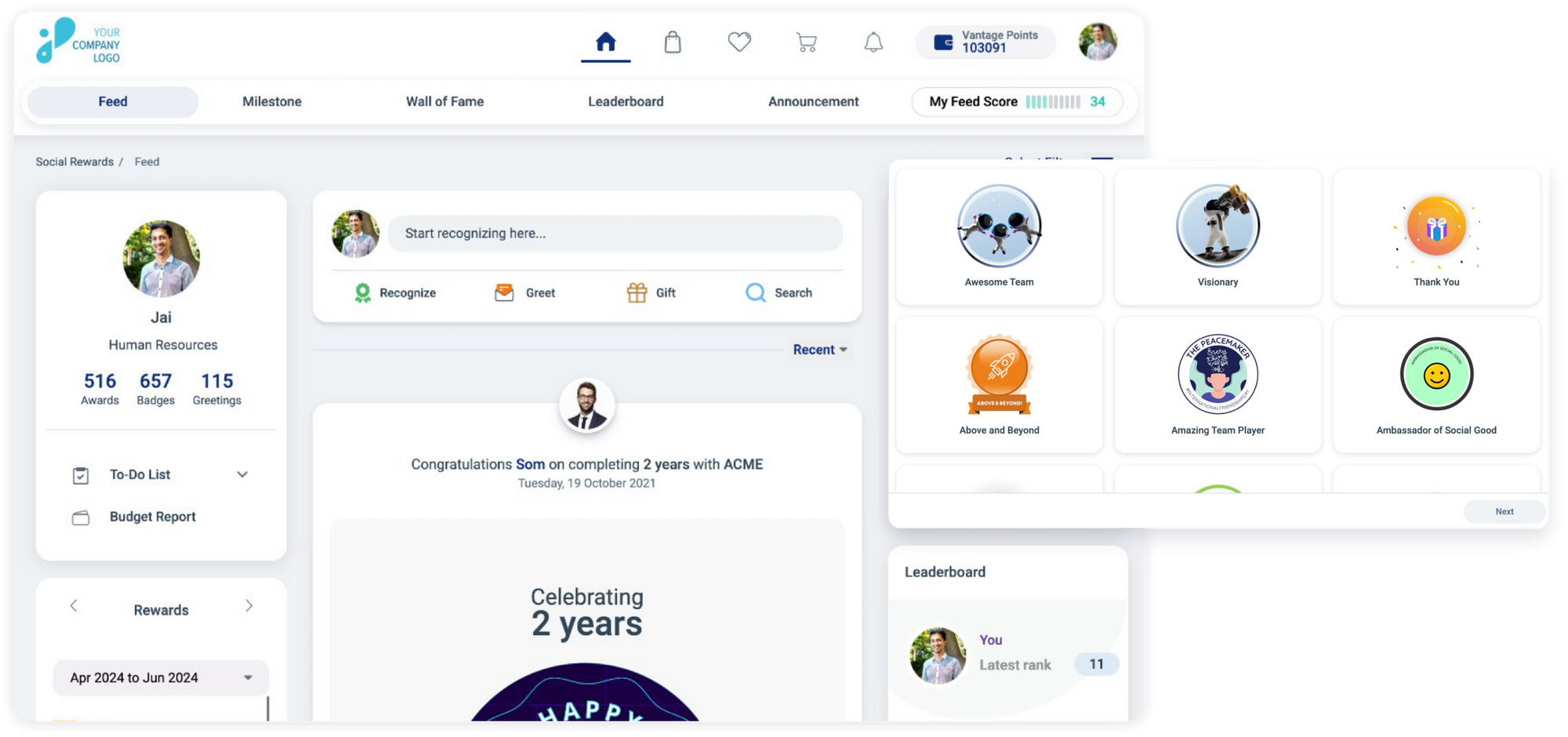
Vantage Recognition offers a global catalog spanning merchandise, experiences, gift cards, and charitable donations, enabling employees to select rewards that resonate personally rather than receiving one-size-fits-all recognition.
Source: Vantage Recognition
Most programs measure inputs, how many rewards were distributed, rather than outcomes: whether behavior and retention actually changed.
Track these instead:
- Receiver coverage: what percentage of employees received recognition this month?
- Giver coverage: what percentage of managers gave recognition?
- Average recognition time: how long between a contribution and its acknowledgment?
- Correlation to retention: are recognized employees staying longer?
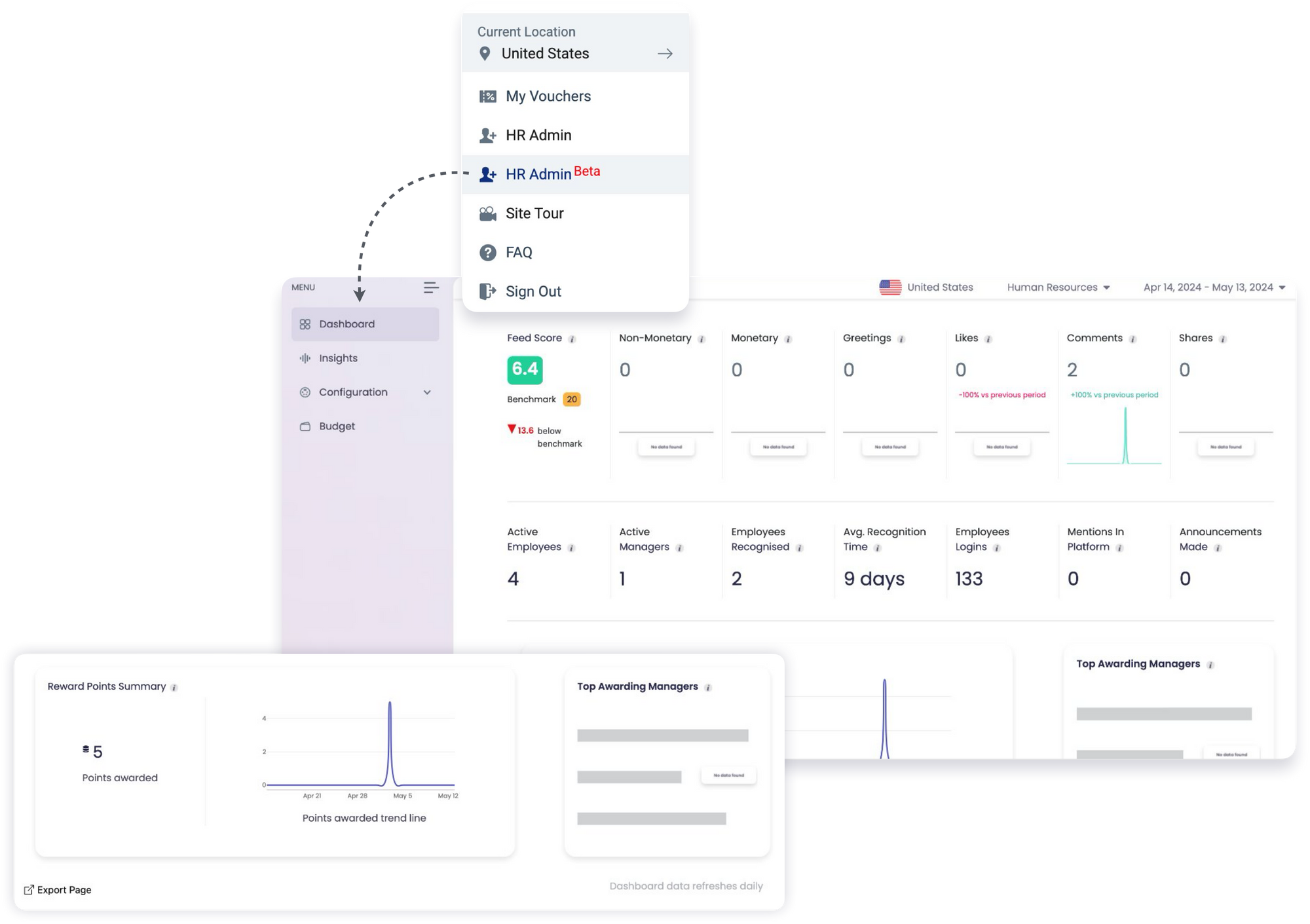
Manual reward administration is inefficient, inconsistent, and difficult to scale. Modern platforms streamline recognition while enhancing impact — and the best ones surface these metrics automatically so HR leaders can act before program decay sets in.
Vantage Edge monitors North Star Metrics monthly — Receiver Coverage, Giver Coverage, and Average Recognition Time — to maintain program momentum long after launch.
Extrinsic Rewards by Workforce Type
Reward design isn't one-size-fits-all. Different workforces have different contexts, and the same incentive can land very differently depending on how and where someone works.
Remote and Hybrid Employees
Remote employees are most at risk of missing recognition moments. Without hallway conversations and visible presence, contributions can go unnoticed — and unnoticed effort is among the fastest paths to disengagement.
The fix isn't more digital notifications. It's embedding recognition into the tools employees already use. When a manager can give a meaningful shoutout inside Microsoft Teams without switching context, recognition happens in the flow of work rather than as a separate HR task.
Frontline and Hourly Workers
Frontline workers in manufacturing, healthcare, retail, logistics often have no app access and limited screen time. Standard digital recognition platforms miss them entirely.
Effective extrinsic rewards for this workforce include spot cash bonuses, shift-end shoutouts by supervisors, tangible rewards (gift cards, merchandise), and milestone-based anniversary awards that acknowledge tenure publicly. Physical, tactile rewards matter here in a way they don't for desk-based employees.
Vantage Circle's Phygital Recognition delivers QR-coded scratch cards to frontline and field workers — a tangible reward that requires no app or screen time.
High Performers and Sales Teams
High performers often hit the ceiling on standard reward programs: they've already won every award, hit every tier, and received every shoutout. For this group, the most powerful extrinsic rewards are career-based — stretch assignments, leadership exposure, equity participation, and access to experiences that signal genuine investment in their future.
Sales teams respond well to leaderboards, commission acceleration, and incentive travel — but they're also among the most sensitive to perceived unfairness. If the top performer in one region earns dramatically more than an equivalent contributor in another due to territory differences, the extrinsic system starts eroding trust rather than building it.
Frequently Asked Questions

What are extrinsic rewards?
Extrinsic rewards are external incentives provided by employers to motivate employees and recognize performance. They include monetary compensation (bonuses, salary increases), career advancement (promotions, stretch assignments), social recognition (awards, public acknowledgment), non-monetary tangibles (gift cards, experiential rewards), and flexibility-based rewards (PTO, remote work). Unlike intrinsic rewards , which come from within the employee ,extrinsic rewards are given by an external source.
What are examples of extrinsic rewards in the workplace?
Examples include performance bonuses, spot awards, salary increases, peer recognition, awards, gift cards, incentive trips, flexible scheduling, extra PTO, stock options, and promotions. Effective programs combine multiple types for ongoing reinforcement.
What is the difference between intrinsic and extrinsic rewards?
Intrinsic rewards come from internal satisfaction like accomplishment, purpose, growth, and belonging. Extrinsic rewards are external benefits like bonuses, recognition, perks, and promotions. Best strategies use both: extrinsic for immediate impact, intrinsic for long-term motivation.
What are the 4 types of extrinsic motivation?
The four types are: external regulation (acting for reward/punishment), introjected regulation (internal pressure), identified regulation (personal value), and integrated regulation (core values). Workplace rewards should aim for identified/integrated to avoid dependency.
Are salary and bonuses intrinsic or extrinsic rewards?
Salary and bonuses are extrinsic rewards as they are external incentives. Fair compensation removes dissatisfaction, enabling intrinsic motivation to emerge.
What are non-monetary extrinsic rewards?
Non-monetary extrinsic rewards include social recognition, career advancement, flexibility perks, tangible items like gift cards, and symbolic awards. They often have higher perceived value than cash equivalents.
Conclusion
Extrinsic rewards aren't going away — and they shouldn't. When designed well, they drive behavior, reinforce culture, and signal to employees that their contributions matter.
But the design is everything.
The organizations that get this right treat reward design as a core people strategy and not an HR admin task. They define what behaviors they want to see, build systems that make those behaviors visible and valued, and measure whether recognition is actually reaching the people doing the work.
So if your current reward system is delivering diminishing returns, the question isn't "what reward should we add?" It's "are we using the rewards we have in a way that actually means something to the people receiving them?"
Published: November 30, 2022 | Updated: April 2026

Supriya is a Content Marketing Lead at Vantage Circle, where she writes on employee engagement, recognition, workplace communication, and culture. Her work on remote team recognition draws on primary research from Vantage Circle's platform data and customer deployments across distributed workforces. She spent the earlier part of her career in corporate communications at Burson, ESPN Star Sports, and CBRE, advising organizations on the messages employees actually hear.
Connect with Supriya on LinkedIn.