
Six in 10 employees are afraid to speak up at work, according to Radical Candor's 2026 "Trust Gap" workplace report.
That's the exact problem an open-door policy is supposed to solve, and the reason most of them don't.
An open-door policy is a workplace communication standard where managers stay genuinely accessible so employees can raise questions, feedback, or concerns without fear of retaliation. On paper, it sounds simple: leave the door open, people will walk in. In practice, employees don't stay away because the door is shut. They stay away because nothing changed the last time they walked through it.
This guide covers what an open-door policy actually means, where it helps, where it quietly fails, and a practical framework for making it real instead of aspirational.
What is an Open-door Policy?
An open-door policy is a workplace communication policy that gives employees direct access to managers and leadership without going through formal escalation steps. To be honest, it's a norm, not a literal instruction to leave your office door ajar.
Employee with a scheduling conflict, a concern about a teammate, or an idea for their team doesn't need to file a request or wait for their next one-on-one. They can raise it directly, at the level where it can actually get resolved.
Most companies run a hybrid version of this.
Day-to-day issues go straight to a manager. Formal matters, like harassment complaints or compensation disputes, still route through HR (human resources) for documentation and legal protection. The open door works alongside the hierarchy. It doesn't replace it.
What makes a difference is employees actually believing raising an issue will change something, not just get logged.
Now, since we understand the meaning of open-door, let's see how it distinguishes from closed-door policy.
| Dimension | Open-door Policy | Closed-door Policy |
|---|---|---|
| Access to management | Employees can approach managers or leaders directly, anytime | Access is limited to scheduled meetings or specific channels |
| Communication flow | Informal, two-way, and immediate | Formal, structured, and often one-way |
| Decision-making | Input is gathered from multiple levels before deciding | Decisions are made by leadership and passed down |
| Transparency | High, information flows freely across the hierarchy | Low, information is shared on a need-to-know basis |
| Employee trust | Builds trust through visibility and accessibility | Can create distance and a sense of hierarchy |
| Speed of resolution | Issues can be raised and addressed quickly | Issues often wait for the next formal review or meeting |
| Risk | Can consume management's time if unmanaged | Can breed rumors, confusion, and disengagement |
| Best suited for | Organizations prioritizing transparency and collaboration | Organizations with strict hierarchy or compliance needs |
The Purpose of an Open-door Policy
The ultimate goal or purpose of an open-door policy is one - i.e., transparency. Transparency at all levels in the chain of command is what it aims for.
In fact, you'll be surprised to know that Deloitte's 2024 Global Human Capital Trends report found that 86% of leaders believe greater organizational transparency builds greater workforce trust.
When every employee, irrespective of their position in an organization, can have an open discussion and share their opinions with the senior members, a culture of equality and empowerment prevails in the workplace.
Another important purpose is to cut down workplace favoritism.
Workplace favoritism is real, and it can create a very toxic environment for your employees. Even great managers can fall prey to it. Having a culture of transparency and openness allows managers to engage with every employee at the workplace. This results in an unbiased opinion of managers towards their employees.
9 in 10 employees say they've witnessed favoritism at work, and 2 in 5 have considered quitting because of it, according to a 2025 workplace survey reported by Forbes.
Modern organizations today are moving towards a more open management system.
Companies are training managers and human resources about the purpose and how to bring about a culture of equality, openness, and a great work culture altogether.
But intent doesn't always match reality. Axios HQ's 2025 State of Internal Comms report found that 74% of leaders believe employees have an easy way to share feedback, while only 46% of employees actually agree.
That's the gap an open-door policy is meant to close, not the appearance of access, but managers who actually follow through. Get that right, and the purpose serves both sides: the payoff runs both ways.
As much as the policy has its benefits, it has some drawbacks too. Here's where it delivers, and where it doesn't.
Read this Blog: Transparency in the Workplace: A Complete Implementation & Measurement Guide
4 Real Benefits of an Open-Door Policy (With Examples)
The single biggest benefit of an open-door policy is speed: problems get surfaced and solved while they're still small, instead of festering into resignations, complaints, or lawsuits. Here's how that plays out across four areas.
1. Faster Problem-Solving Before Issues Escalate
When an employee doesn't have to wait for a scheduled review to flag a problem, small friction gets resolved before it turns into a full-blown conflict.
SHRM's Q4 2024 Civility Index found that 74% of U.S. workers felt their managers and supervisors could have done more to prevent workplace incivility from escalating, an accessibility gap an open-door approach is built to close. A sales manager who hears about a client miscommunication the same day it happens can fix it before it costs the account; one who hears about it three weeks later at a review often can't.
2. Builds Measurable Trust Between Employees and Management
Access builds credibility.
Employees who don't feel trusted by senior leadership are far less likely to trust their own manager, too: just 43% say they do, according to the Edelman Trust Barometer's special report on trust at work.
A manager who blocks time every week for anyone to walk in, then visibly acts on what they hear, builds more of that trust than any line in the employee handbook. Over time, that habit compounds into broader trust in the workplace, not just between one manager and their team.
3. Reduces Harassment and Retaliation Risk
Only 51% of employees say they'd report a harassment incident if they had to put their name to it, according to Traliant's 2025 State of Workplace Harassment Report. The rest stay silent out of fear of retaliation.
An open-door culture, backed by managers who act on what they're told, gives employees a lower-friction way to raise concerns before they harden into workplace bullying or unresolved harassment claims that HR only learns about at an exit interview.
4. Strengthens Two-Way Feedback Culture
Just 1 in 4 employees strongly agree they receive valuable feedback from the people they work with, and those who do are five times more likely to be engaged at work.
An open door runs in both directions: managers get real-time signal on what's actually working, and employees get more than employee feedback examples copied from a template, they get feedback specific to their situation.
3 Real Risks of an Open-Door Policy (And How to Manage Them)
An open-door policy carries three real risks: it can eat into management's time, blur the chain of command, and create dependency instead of ownership. Each is manageable with the right guardrails.
| Risk | Why It Happens | How to Prevent It |
|---|---|---|
| Wastes management's time | Employees treat open access as unlimited access | Set expected response windows, not open-ended availability |
| Bypasses the chain of command | Employees skip their direct manager to reach senior leaders | Route issues to the right level first, escalate only when unresolved |
| Creates dependency | Employees default to asking instead of deciding | Coach employees to bring a proposed solution, not just a problem |
1. It Can Waste Management's Time
Employees might take long hours from their managers' schedules to vent about work concerns, cutting into the time managers need for their own responsibilities. UC Irvine research found it takes an average of 25 minutes to fully refocus after being interrupted, a cost that compounds fast when the door is open with no structure around it. Make it clear to employees that the policy exists to solve problems, not to fill time.
2. It Can Bypass the Chain of Command
An open door can tempt employees to skip their direct manager and go straight to senior leadership. That erodes the working relationship between employees and the managers they should be closest to, and leaves direct managers out of decisions about their own teams. Encourage employees to raise issues at the right level first, and reserve leadership access for when that channel genuinely fails.
3. It Can Create Dependency Instead of Ownership
Too much reliance on an open door can make employees afraid to make decisions on their own, running every question to a manager instead of solving it themselves. That limits the very growth an open-door policy is supposed to encourage.
You've to ask your employees what they've already tried before stepping in, so the door stays open without becoming a crutch.
These risks aren't reasons to skip an open-door policy, they're reasons to build it with structure. Implementation determines whether it works.
Coming back to the question. Have you implemented an open door culture at work?
If not. Here's how to get started.
How to Implement an Open-Door Policy: A 5-Step Framework
Ready to actually put this into practice, not just announce it? It comes down to five steps: talk to your employees first, set clear boundaries, listen without judgment, prepare for the urgent stuff, and always close the loop.
Step 1: Talk to Employees First
Don't just drop a memo announcing your new "open door" and call it done. Sit down with your employees, ask what they actually want from it, and let their answers shape how you roll it out.
Step 2: Set Clear Boundaries
To be honest, an open door isn't an unlimited door. Tell people what counts as urgent, what should go through HR instead, and how quickly they can expect to hear back, otherwise you'll spend your whole week fielding interruptions.
Step 3: Listen Without Judgment
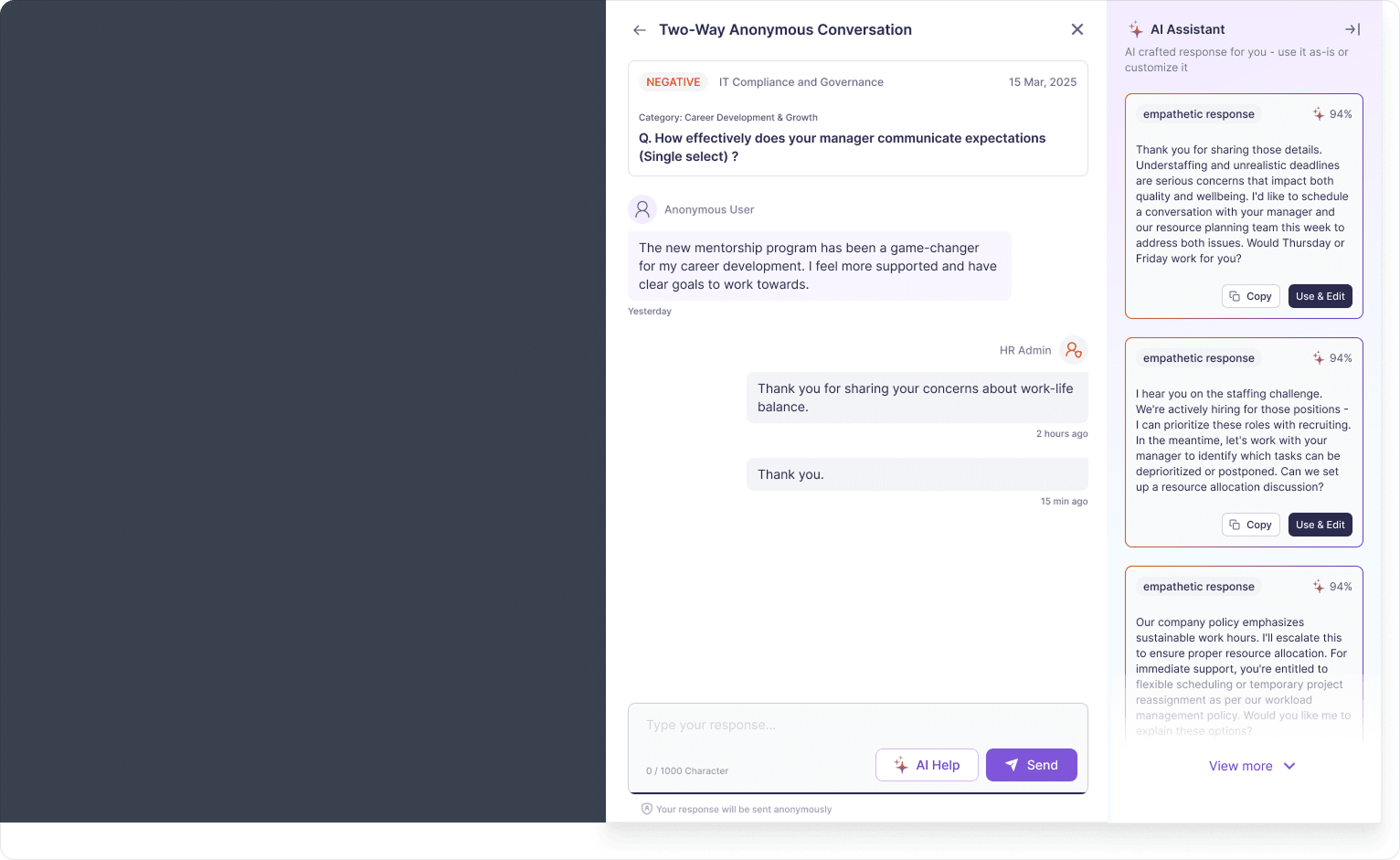
If employees sense they'll get judged, or ignored, for speaking up, they'll stop showing up at your door pretty fast. So hear them out completely before you jump in with a fix. That's honestly where most of the trust gets built. Not everything surfaces face-to-face either, some employees only open up when it's anonymous, which is why many teams pair the open door with a pulse survey tool like Vantage Pulse to catch what doesn't get said out loud.
Step 4: Prepare for Urgent Issues
Some things, like harassment or safety concerns, can't wait for your next scheduled catch-up. Know exactly how you'll escalate anything that turns into a toxic environment for your employees the second it comes up.
Step 5: Follow Up on Every Concern
Nothing kills an open-door policy faster than silence after someone speaks up. Even a quick "here's where this stands" keeps employees coming back instead of giving up on the whole thing.
| Step | What It Looks Like in Practice |
|---|---|
| Talk to employees first | Ask what employees want from the policy before rolling it out, not after |
| Set clear boundaries | Publish what counts as urgent vs. routine, and typical response times |
| Listen without judgment | Managers hear the full concern before offering a fix |
| Prepare for urgent issues | A documented escalation path for harassment or safety concerns |
| Follow up on every concern | A standing check-in, even a two-line update, after every issue raised |

VANTAGE INFLUENCERS PODCAST
"If you take feedback from people but don't do anything about it, there'll be a point when people stop giving feedback. There has to be an action, you have to close the feedback loop."
Pooja Malhotra, Head HR India at StoneX Group Inc.
Listen to the EpisodeThe Open-Door Health Check: Is Your Policy Actually Open?
The real test of an open-door is whether employees actually walk through it and something changes when they do. Most managers assume their policy works because no one has complained about it, which is usually a sign it doesn't.
That "6 in 10 employees afraid to speak up" stat from earlier isn't happening under obviously closed cultures, it's happening under policies that look open on paper. This checklist is how you find out if yours is one of them.
Manager Self-Assessment: Is Your Open Door Actually Open?
☐ At least one employee has raised a concern with you directly in the past month.
☐ Employees know what happens after they raise an issue, not just that they can raise one.
☐ You've closed the loop on every concern from the last quarter, even the ones you couldn't fully fix.
☐ An employee would come to you before HR if something felt unsafe or unfair.
☐ Employees can disagree with a decision you made without it changing how you treat them.
☐ You can name at least one change you made because an employee spoke up.
☐ You've checked whether employees skip you and go straight to your manager instead.
☐ Your team would call you approachable, not just "technically available."
If you checked fewer than six, the door might be open, but it isn't working yet. A policy only earns its name when employees feel enough respect in the workplace to actually walk through it, and enough evidence that doing so is worth it.
Frequently Asked Questions (FAQs)
1. What are some examples of an open-door policy?
Common examples include no-appointment access to a direct manager, weekly walk-in office hours, and an "ask me anything" channel with leadership. Some companies also add monthly skip-level meetings or an anonymous suggestion channel that routes straight to HR.
2. Is an open-door policy a legal requirement?
No, an open-door policy is not a legal requirement. It's a voluntary management practice, though the formal channels it often works alongside, like harassment or safety reporting, are legally required on their own.
3. What is a downside of an open-door policy?
The biggest downside is that it can eat into management's time and blur the chain of command. Without clear boundaries, managers end up fielding constant interruptions instead of handling their own responsibilities.
4. What makes an open-door policy fail?
An open-door policy fails when employees raise concerns and nothing changes. Access without follow-through teaches employees that speaking up isn't worth it, so they eventually stop using the door at all.
5. How can a manager consistently communicate an open-door policy?
Managers keep an open-door policy alive by talking about it regularly, not announcing it once. Mentioning it in team meetings, one-on-ones, and onboarding, and visibly following up on what employees raise, is what signals the door is actually open.
Q6. What is the open-door policy in HR?
In HR, an open-door policy is a communication standard that lets employees raise questions or concerns directly with managers or leadership, without going through formal escalation steps. It typically works alongside, not instead of, formal HR channels for harassment, compensation, or compliance matters.
The Bottomline
Corporate culture is changing rapidly. Companies are adopting the open door culture for all its benefits, which far outweigh the drawbacks.
The bottom line is that companies want more transparency at all levels in the chain of command.
Now, it's your turn. Weigh out the pros and cons listed above and figure out the kind of policy that works best for your organization.

Sanjeevani Saikia is a Senior Content Strategist at Vantage Circle, where she leads end-to-end content strategy across SEO, thought leadership, brand storytelling, podcasts, and video. She is also the host of the Vantage Influencers Podcast, where she brings conversations with HR and business leaders from top global organisations, including Fortune 500 companies.
Connect with Sanjeevani on LinkedIn.