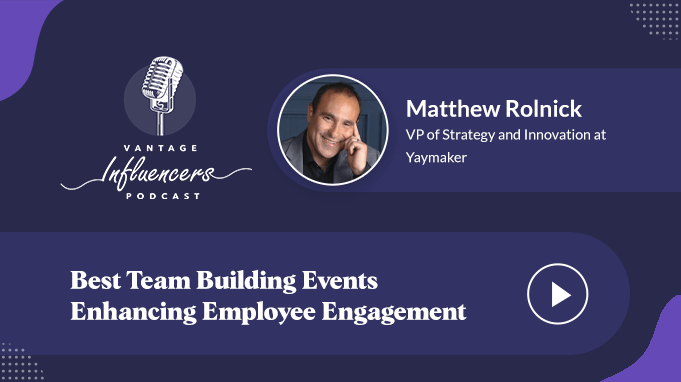
Best Team Building Events Enhancing Employee Engagement
Episode Overview
In this episode of the Vantage Influencers Podcast, host Gautam speaks with Matthew Rolnick about why team building deserves the same planning attention leaders give to any other business priority. Matthew's core argument is that team building isn't defined by any single activity: it's the practice of getting two or more people to work with a collaborative effort toward a common goal, which in turn helps individuals focus less on themselves and more on the team. Drawing on Yaymaker's work running paint nights, trivia, murder mysteries, and puzzle-style events like Code Crackers for companies navigating remote and hybrid work, he makes the case that connection, not the format of the activity, is the real outcome leaders should be optimizing for.
The sharpest, most concrete point in the conversation is Matthew's insistence that undistracted, non-work time is what actually makes team building work, whether that happens over a video call or in person. He points out that even a virtual game can get colleagues to problem-solve and put their guard down in ways a status meeting never will, and that pairing an activity with food adds another low-cost lever for connection across cultures. He extends the same logic to diversity, equity, and inclusion, arguing that sensitization workshops and speaker sessions function as team building because they help colleagues understand each other better. His closing message to HR leaders is direct: put team building on the calendar and treat it as a consistent commitment, not an occasional nice-to-have, because it pays off in happier employees and stronger retention.
Episode Highlights
- Matthew Rolnick defines team building as any group of two or more people working collaboratively toward a common goal, with the real aim being to help people focus less on themselves and more on the team.
- Virtual games, trivia, and murder mysteries can be just as effective as in-person events at helping remote employees problem-solve together and feel more connected.
- Yaymaker's most requested experiences, including paint nights and its Code Crackers puzzle format, work because they give people a shared, undistracted activity that has nothing to do with work.
- Pairing food with a team activity is a simple, low-cost way to bring people together across different cultures and interests.
- Matthew argues that DEI initiatives, from sensitization workshops to speaker sessions on Black History Month and Pride, function as team-building activities in their own right because they help colleagues understand each other better.
- His closing advice to HR leaders is blunt: schedule team building the same way you schedule any other business priority, or it will keep losing out to the next deadline.
About the Guest
Matthew Rolnick, VP of Strategy and Innovation, Yaymaker
Matthew Rolnick works closely with HR leaders and founders on team-building events and employee engagement at Yaymaker, a company known for pioneering the paint night format before expanding into trivia, murder mysteries, candle-making, chocolate tasting, and other group experiences. He has taught three courses on Udemy that have reached more than 100,000 students, has been published numerous times in Forbes, and is the author of the Amazon bestselling book Find Your Yay. Matthew considers himself an intrapreneur and is a thought leader on corporate culture, branding, employee engagement, and social selling, and is just as passionate about working with DEI, mental health, and leadership speakers as he is about team-building experiences.
Connect with Matthew on LinkedIn
Host
Gautam, Vantage Influencers Podcast Host
What You Will Learn
- How to define team building in practical terms and why it matters more than ever in a hybrid workforce.
- Why virtual games and remote-friendly formats like trivia and murder mysteries can build the same trust as in-person events.
- What actually makes a team-building activity work: undistracted time, a shared experience, and sometimes food.
- How DEI initiatives like sensitization workshops and speaker sessions double as team-building activities.
- Why leaders need to treat team building as a scheduled priority instead of an afterthought.
- How consistent team building contributes to employee retention and engagement over time.
Key Topics & Timestamps
| Timestamp | Topic |
|---|---|
| 00:00 | Podcast introduction and sponsor message |
| 00:55 | Host welcome and guest introduction |
| 02:50 | About Matthew Rolnick and Yaymaker |
| 03:35 | Defining team building |
| 04:39 | How team building drives employee engagement |
| 05:41 | Making virtual events work for remote and hybrid teams |
| 06:55 | Best team-building events and activities to implement |
| 08:45 | Using food, creativity, and innovation in team experiences |
| 09:23 | Where DEI fits into team building |
| 11:40 | Closing thoughts on prioritizing team building |
| 13:15 | How to connect with Matthew Rolnick |
Full Transcript
Click to read the full episode transcript
Welcome to the Vantage HR Influencers Podcast. This podcast is sponsored by Vantage Circle, the simple and AI-powered rewards and recognition platform for employee engagement.
Organizations around the world are constantly innovating to meet the evolving performance standards. They invest tons of money in acquiring resources and recruiting the best talents, but they often miss out on one key point. That pivotal point is teamwork and taking measures to improve it by creating team-building activities. In today's globalized world, working as a team is the only way to attain success amidst the crowd. Almost everyone is now in a rat race to grab the top spot, but achieving this is next to impossible with individual efforts.
Gautam: Hello, listeners. Welcome to Vantage Influencers Podcast. I am your host, Gautam. Just like how you and I work together as a team in making this podcast channel a success, similarly, team-building events and activities is the key to excellent teamwork and success. Today's topic of discussion is about the best team-building events and how they help enhance employee engagement. To shed light on this topic, we have a very special guest, and he is with us, Matthew Rolnick.
Matthew Rolnick is the VP of Strategy and Innovation at Yaymaker. Matthew works closely with HR leaders and founders on team-building events and employee engagement. He has three courses on Udemy that have reached over 100,000 students. He has been published numerous times in Forbes and is the author of the Amazon bestselling book, Find Your Yay. He is a thought leader when it comes to corporate culture, branding, employee engagement, and social selling. He considers himself an intrapreneur and is passionate about working with Yaymaker and helping employees feel more connected through team-building experiences, as well as working closely with DEI, mental health, and leadership speakers.
Hello, Matthew. Welcome to the show.
Matthew Rolnick: Hello, Gautam. Great to be here. Thank you so much.
Gautam: We are truly delighted to have you today, and thank you so much for joining us. I think our listeners will have a great time listening to you, considering the amount of experience that you have had. Team-building activities is a topic that's quite close to my heart as well, because I work mostly with company culture, and I think that's a big part of team-building and a big part of making up the company culture. But before we go ahead with the topic of discussion today, would you like to brief us about yourself? Something that I might have missed mentioning about you?
Matthew Rolnick: Well, sure. I appreciate it. I'm excited to talk to you. My company, Yaymaker, is based out of Boston, that's where our corporate office is. I live in the Chicagoland area, in a suburb called Downers Grove. I've been married to my wife for over 15 years, and we have a 14-year-old daughter. Yaymaker started as the original paint night, but we offer a lot of team-building experiences, whether it be candle-making, chocolate tasting, murder mysteries, or trivia. Like yourself, I'm very passionate about talking about team-building experiences and corporate culture.
Gautam: Wow, thank you, Matthew, so much. When you say that you're truly passionate about team-building and this is what you do on a day-to-day basis, what is team-building actually, if you could describe it in your own words?
Matthew Rolnick: Well, I think by definition, it's two or more people, any group working together or doing teamwork with a collaborative effort to reach a common goal. I look at team-building as more about just connecting people, helping individuals focus less about themselves and more about the team. So that's, I guess, how I would define team-building.
Gautam: So I think it all comes down to collaboration and respecting each other's boundaries when it comes to team-building?
Matthew Rolnick: Correct, sure. I think that's how we would come to agreement as well, that every leader or company would expect the same when it comes to team-building.
Gautam: Whenever we talk about team-building, we also talk about employee engagement. Currently, remote work has almost become the norm. So every leader is right now looking for ways to enhance employee engagement at their workplaces. How do team-building events or activities positively impact employee engagement, as per you?
Matthew Rolnick: Well, I like that question, so I think it does a lot. I think team-building helps employees communicate more with each other. I think it builds trust. I think you can learn more about different personalities. I really think it's just a more effective way to collaborate. I think great team-building makes a team feel closer, and hopefully they have fun along the way.
Gautam: All right. But when we talk about employee engagement, we mostly talk about rewards and recognition, and we talk about how DEI plays an important role in it. But we hardly give importance to team-building, as to how a small team lunch can also engage employees, how a small game can engage employees at the workplace. But considering that when you have remote work in place, how do you think virtual events can help enhance employee engagement at work?
Matthew Rolnick: Well, you asked how a virtual event can help with employee engagement at work. We see a lot of companies want people back in the office, but we also see a lot of remote workplaces all around the country and around the world. We do find that even a virtual game can really get people to problem-solve better, connect better, and put their guards down to work closer together. I'll use the example of what we do with trivia, or our own game show called Winning Opinions, or even a murder mystery. You get people to use their brains a little differently, collaborate a little differently, and the end result is that it helps them all feel a little more connected. So those employees all feel a little more engaged, and I think that all helps the cause of building that team-building.
Gautam: Well, thank you, Matthew, for that response. Coming back to remote working, or even working at the office, considering the workplace scenario has gone through a massive shift in the past two years, what, according to you, are the best team-building events that leaders must implement in 2022 for enhanced employee engagement at work?
Matthew Rolnick: Well, you say "must," and some of my favorite activities that I think leaders should look at... We are best known for our paint nights, and I think it's fascinating when you do a creative experience together. It's not only something people can participate in, but they also have their own painting or memento afterward. It's a constant reminder. But the whole idea of participation, engagement, and creativity in that experience gets us rave reviews. Events like Code Crackers, where a team solves a problem together, really get people to want to collaborate even more with each other. So that's another type of experience I'd point to. When you get teams to work closely together on something that's not work-related, I think that builds trust and communication. Those are just a couple of examples, but anytime it's undistracted, you're encouraging everybody to put work off the table and focus on doing something with the group activity together. That's what I'd say.
Gautam: I think that was great, Matthew, because usually what leaders do is use some boring methods to engage people in team-building events. But I think leaders must now start becoming a little more creative and get everybody involved in it. Of course, not forcefully, but active participation is required. Along with that, I think a bit of creativity and innovation can do the trick here. Am I right?
Matthew Rolnick: Oh, 100 percent. I think leaders need to think a little outside the box with activities. You talk about innovation and creativity. What's also interesting is that food, besides the experience itself, when you tie it with food, can help bring people together as well, no matter what culture or interests. So that's something we've added to experiences, and it tends to enhance the experience.
Gautam: Sure. Also, moving ahead, I see that you're also involved in DEI and mental health at the workplace. So do you think diversity, equity, and inclusion is a part of team-building? If yes, how would you justify it?
Matthew Rolnick: Well, I definitely do. I read in a Harvard Business Review article that diverse companies and teams can be more productive, more innovative, focus more on facts, and are better at problem-solving. So I do think diversity is really important. Inclusion, for example, everybody wants to feel included. So when companies invest in diversity, equity, and inclusion, it's another way for people to understand each other better and connect with each other better. I think it's an important aspect, and I see more and more businesses prioritizing it. At Yaymaker, we have diversity, equity, and inclusion, as well as mental health speakers who do speaking sessions, we call it "motivational minutes" or a workshop, and we find that employees typically feel more engaged and have a better understanding of things.
Gautam: True, I completely agree with you on that. Because we've been working towards bettering and nurturing a good company culture, but where we lack is when we think that we are a bit privileged, and maybe he's somewhat different, she's somewhat different, they are different, and maybe we don't have to mingle with them, or we don't have to really go and talk to them, they can come to us. I think we need to break those biases and prejudices at work, and I think that also becomes a team-building activity, when we invite speakers to speak on it, when we do a sensitization program, when we do a diversity training program. So I think that also helps a lot.
Matthew Rolnick: Absolutely, and it is shared. For us, we have speakers, whether it's Black History Month, Women's History Month, Pride. So we really try to have a diverse group of speakers that we work with as well, and try to help companies and teams with that.
Gautam: Sure. Thank you so much, Matthew. So we are now slowly approaching the end of this conversation, and not that I want to stop you here, or I don't want to listen to you, I think listeners are also really wanting to listen to you more and more, but time might not permit us. So at the end, how would you like to conclude your thoughts on team-building events enhancing employee engagement?
Matthew Rolnick: Well, the biggest thing I would say is for leaders to prioritize it. It's so easy to be so busy day-to-day, week-to-week, month-to-month, quarter-to-quarter, on everything business you're trying to get done. But it's very important to work hard and play hard. So if I give any advice, it's to prioritize it on the schedule, make sure you're doing some type of consistent team-building event. It's just going to help with happier, more engaged employees, and it will help with retention. So whether it's with Yaymaker or anyone else, I'd just encourage leaders to make sure they prioritize it and schedule it.
Gautam: So I think we are doing the same thing at Vantage Circle as well, just like Yaymaker, because we are a rewards and recognition platform. We are an employee engagement platform, and our sole job is to engage employees, whoever is tied with us, and our own employees as well. I think active participation from leaders can really inspire employees to take part in all the activities that are happening. I think that sense of motivation can just push you forward from that normal, monotonous routine. I had an amazing time talking with you, Matthew. Thank you so much.
Matthew Rolnick: Well, thank you. I really appreciate it.
Gautam: In the end, if you could just let our listeners know, how can they reach out to you if they have any queries or doubts?
Matthew Rolnick: Well, I would say a couple of things. My email is my first initial, last name, at Yaymaker. So if anybody wants to email me, it's mrolnick@yaymaker.com. And I'm also really active on LinkedIn, so search Matthew Rolnick at Yaymaker, I'm sure you'll find me. Just send me an invite, send me a quick note that you heard me here, and I'm happy to connect.
Gautam: Thank you. That was great, Matthew, and thank you so much for lending your time, especially on a Monday morning. I hope you have a great week ahead.
Matthew Rolnick: All right, thanks. You too.
Gautam: Listeners, you just heard Matthew Rolnick speak about team-building activities and how it enhances employee engagement. If you want to listen to more such conversations in the future, please stay tuned to Vantage Influencers Podcast. Thank you so much.
Thanks for listening to the Vantage HR Influencers Podcast. Please do subscribe to Vantage HR Influencers Podcast on Apple Podcasts, Spotify, and our YouTube channel for new episodes.
FAQ
What is team building, according to Matthew Rolnick?
Matthew defines team building as any two or more people, or any group, working together with a collaborative effort toward a common goal. He sees it as less about a specific activity and more about connecting people, helping individuals focus less on themselves and more on the team.
Can virtual team-building activities be as effective as in-person events?
Yes. Matthew explains that virtual games, trivia, and formats like murder mysteries can still get remote employees to problem-solve together, connect, and let their guard down, even without being in the same room. The goal stays the same: help people feel more connected and, in turn, more engaged.
How does DEI connect to team building?
Matthew considers diversity, equity, and inclusion part of team building. Citing Harvard Business Review research linking diverse teams to better problem-solving and innovation, he argues that initiatives such as sensitization programs, diversity training, and speaker sessions help colleagues understand and connect with each other, which is the same outcome team building aims for.
What is Matthew Rolnick's top piece of advice for HR leaders on team building?
His advice is to prioritize it and put it on the schedule. He notes that it's easy for team building to get pushed aside by day-to-day business priorities, but consistent team-building events lead to happier, more engaged employees and better retention.
Related Reading
Also listen on