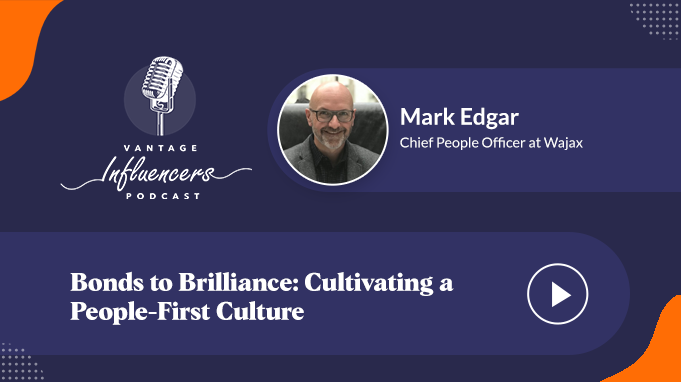
Bonds to Brilliance: Cultivating a People-First Culture
Episode Overview
Mark Edgar joins host Susmita Sarma to trace how his view of relationships changed as he moved from an HR practitioner into an organization-wide people leader. He argues that relationships are not a soft add-on to HR work but the actual mechanism through which things get done: colleagues rely on each other, work gets delivered through trust, and that trust compounds into engagement and, eventually, business results. At Wajax, that belief is written directly into a company value the organization calls "we build lasting relationships," created from stories of the company at its best rather than handed down from a slogan exercise.
The sharpest part of Mark's argument is that a people-first culture is not a single well-being program or perk. It rests on layered priorities: safety first, then well-being of the whole person (financial, mental, physical), then empathy as a learnable leadership skill built on self-awareness, not just personality. He is equally direct about where people-first efforts stall: leaders promoted for technical skill rather than people skill, vague definitions of what "people-first" actually means day to day, and organizations that lose conviction the moment business conditions get hard. His closing point is pragmatic rather than idealistic: leaders should adopt a people-first approach because it demonstrably serves their specific business, not because it sounds like the right thing to say.
Episode Highlights
- A people-first culture can be linked to up to 30% higher employee satisfaction and 20% higher productivity.
- Mark traces his belief in the importance of relationships back to his upbringing and says it deepened once he built a career in HR, where getting things done depends on trust with colleagues and leaders.
- Wajax anchors its people-first philosophy in a stated value: "we build lasting relationships," created from real stories of the company at its best.
- Employee well-being at Wajax starts with physical safety, then extends to financial, mental, and physical support delivered through programs and, more importantly, through the day-to-day environment people work in.
- Empathy is a skill leaders can build through self-awareness and practice, not just a trait some people are born with.
- Common obstacles to a people-first culture include promoting leaders for technical skill rather than people skill, lacking a clear definition of what the behavior actually looks like, and losing conviction when business conditions get difficult.
About the Guest
Mark Edgar, Chief People Officer at Wajax
Mark Edgar holds a crucial position as the Chief People Officer at Wajax. His commitment to fostering an environment where individuals are more than staff members, they are essential participants in shaping the company's heritage, is unparalleled. By prioritizing the empowerment and growth of employees, he ensures that Wajax remains a fixture of Canada's industrial sector for years to come.
Host
Susmita Sarma, Vantage Influencers Podcast Host
What You Will Learn
- Why relationships, not just processes, are often the real mechanism behind how work gets done in HR and beyond.
- How to anchor a people-first culture in a specific, story-based company value instead of a generic mission statement.
- Why well-being efforts should start with safety before expanding into financial, mental, and physical support.
- How to treat empathy as a learnable leadership skill rather than an innate trait.
- The most common obstacles that derail people-first culture initiatives, and how to navigate them.
- How to decide whether a people-first approach is genuinely right for your organization, rather than adopting it because it is trending.
Key Topics & Timestamps
| Timestamp | Topic |
|---|---|
| 01:07 | Welcome to Mark Edgar and introduction to the discussion |
| 01:30 | How Mark's view of relationships and happiness has evolved over his career |
| 04:40 | How personal relationships and values shape leaders building a people-first culture |
| 06:37 | Practical strategies for prioritizing employee well-being while driving business success |
| 10:30 | Building empathy and authenticity in leadership interactions |
| 13:50 | Common obstacles to implementing a people-first culture and how to navigate them |
| 17:12 | Closing advice for leaders looking to cultivate a people-first culture |
Full Transcript
Click to read the full episode transcript
Welcome to the Vantage HR Influencers Podcast. This podcast is sponsored by Vantage Circle, the simple and AI-powered rewards and recognition platform for employee engagement. Did you know that organizations with a strong people-first culture can see up to 30% higher employee satisfaction and 20% higher productivity? Well, in this episode of the Vantage Influencers Podcast, we'll be talking about what makes a people-first approach so impactful and how it can drive exceptional results for any workplace.
Hello listeners, welcome to the Vantage Influencers Podcast. I'm your host, Susmita Sarma, and joining me to share his insights is Mark Edgar, an expert in fostering exceptional workplace environments and a passionate advocate for putting people first. Mark's experience and innovative approach promise to bring a wealth of knowledge to our discussion. Let's begin.
Susmita Sarma: Hi Mark, welcome to the Vantage Influencers Podcast. Thank you for joining.
Mark Edgar: Thanks, it's great to be here.
Susmita Sarma: So how's the day been so far, and what's keeping you busy these days?
Mark Edgar: Day's been good. It's the start of a week here for me, so just getting back up to things. We had a busy last week with board meetings, etc.
Susmita Sarma: So you've been catching up on a few emails this morning before the main day gets going. So it's a good time to get connected. Sounds great, Mark. So I want to start with something a little personal. We often find that our perspectives on relationships evolve over time, right? So could you share how your view on relationships and their impact on happiness has transformed as you have progressed through different stages of life?
Mark Edgar: Yeah, I think that's such an interesting question. I think I'm probably somebody who's always thought that relationships are really important in the world. So maybe just starting from a more philosophical perspective, the importance of getting along with people has always been something that's been pretty close to my heart. Which I was thinking about a little bit, why that is, and probably like most things, I put it down to kind of parenting and where I was brought up, etc. Relationships were always important.
But as I entered the workforce many, many years ago now and built a career in HR, I think it's given me an even greater appreciation of how important that can be. And in a role in HR, I think that the way in which things often get done is through relationships. So you're building relationships not just with the colleagues that you're working with on a day to day basis, and you've never been in roles where you're able to do everything. You always rely on other people. So relationships are super important there, as well as obviously with the leaders and the team members in the various business areas I would have supported. So I think that certainly has helped me having that philosophy.
And then I think over time, as I've shifted into other roles, roles that hopefully can influence organizations at a broader level, I've developed more of an appreciation of some of the best practices you see. You sort of see other people succeeding, you see organizations succeeding where they have very much a relationship-based approach. And I think also maybe the last point to make is I've developed more of an appreciation of some of the research, the social psychology that goes behind why relationships are so important, and the connection, as you mentioned, between relationships driving happiness, happiness driving engagement. And we know that engagement is ultimately the thing that's going to drive business success. So I think relationships, and people enjoying the people that they're working with and connecting with on a day to day basis, is so important in the world of work and something that we need to make sure we're focusing on.
Susmita Sarma: Absolutely. When I was younger, happiness was often tied to achievements and milestones, like winning some random games and getting good grades in school. However, over the years, I have also come to realize that true happiness comes from meaningful connections with others, the support of family and friends and our colleagues, and the ability to share life's joys and challenges.
Mark Edgar: Yeah, I wonder if it is something that we realize over time, as our perspective on the world maybe shifts and we go through different situations, or, you know, maybe the optimist in me makes me think that perhaps people are starting to realize that relationships are so important. Yeah, it's an interesting evolution we're going through.
Susmita Sarma: Very true. It's a profound evolution. And now relating this to our main topic of discussion today, building a people-first culture in the workplace, how do you believe personal relationships and the values that they entail can influence the way leaders foster such a culture within their organizations?
Mark Edgar: Yeah, I think it's critically important. I mean, the concept of people-first, which is something we think a lot about at Wajax, is very much anchored in a set of values that we have as an organization, and one of those values is around, we build lasting relationships. So the word lasting, I think, is something that we spent a lot of time thinking about when we created the values. And just as a bit of backstory, the way we created our values was based on stories of when Wajax was at its best, when Wajax was having its best day. And so the lasting relationships, I think, is based on the fact that we have very long-term relationships with our customers and our clients, but I see those extending into the day to day relationships that people have with their colleagues as well. And there's lots of people, I've been at the organization for just under a couple of years, but there's lots of people who've been at the organization for 20, 30, 40, even 50 years. So it's certainly that kind of lasting word is important, but I don't think that necessarily means that it's a prolonged time. I think that could be a relationship that's just started but is expected to last a long time. And so I think that that focus on relationships is really the cornerstone that then builds that connection with people, and that connection with people, as we mentioned, is ultimately what drives the engagement and happiness. So we see relationships as being an integral part of our strategy to be people-first.
Susmita Sarma: So the key is to prioritize genuine connections and create an environment where employees truly feel valued and heard, which naturally fosters a more engaged and productive team.
Mark Edgar: Exactly.
Susmita Sarma: So drawing from your extensive experience, Mark, could you share some practical strategies or initiatives that you've observed that have effectively prioritized employee well-being and growth while still driving organizational success?
Mark Edgar: Yeah, I mean, I think well-being is another critical component that does really drive that ultimate success. And as you mentioned, it kind of allows people to really thrive and bring their full selves to work. And that's an easy thing that as HR leaders we say, but putting that into practice can often be quite challenging. But we've certainly made progress at Wajax with that ambition. And it really started by anchoring a lot of it in ensuring that our people are safe. That was the most important, it's the most important value that we have. Our commitment behind making sure that people are working in a safe environment, the idea that they can go home at the end of the day to their families and their loved ones, etc., is so important to us and everything that we do.
And over time, I think as our thinking around that has evolved, we started to take an appreciation beyond safety into thinking that other elements are also important. So it's not instead of, it's a kind of building on. I'm thinking about the whole person, both in terms of mind and soul, and ensuring that people are really thriving in their work environments, means that well-being is so important. So the success we've had around that, I think there's probably two things I'd point to. I think one is through programs. I think programs can be really important in ensuring that we're raising awareness when it comes to well-being and making sure that people have the right support available when they need it. So we have a range of programs and platforms that our team members can access as they need to, to get support around different elements of well-being, it could be financial, could be more on the mental side, as well as advice on the physical side as well.
But I think the most important thing is probably more the environment that we create. So this environment we create, again, around relationships, around connection, around people being able to kind of be themselves, I think is where people are more likely to get value from a well-being perspective, because that's what's happening to them every day. And if you are in an environment where you feel like you're thriving, where you're able to be authentic, I think that can drive so much value for people when it comes to their mental well-being in particular. So that's certainly another area that we focus on.
Susmita Sarma: The programs that you mentioned definitely encourage open communication and regular feedback, and most importantly, robust professional development opportunities that signal to employees that their well-being is valued as much as their performance metrics.
Mark Edgar: Yeah, exactly. I think it's really important, and I think the way that we think about well-being has evolved so much over the years. So many elements really do feed into well-being. So you think about things like development and people being able to build their skills, and that ultimately is going to ensure that people are feeling better about work, feeling better about themselves, and the contribution that they make. So I think there are many roads that lead to well-being as an outcome. And one thing we find is by being proactive in listening to our people, by proactively getting feedback, that allows us to make sure we're not developing any programs in isolation, we're driving programs that we think ultimately create the most value for people. And I'll be honest, we don't always get it right. Sometimes we start something that doesn't get the traction that we perhaps thought it would, and we can then quickly shift and think of something else. So that way of being quite agile and acting on feedback is also important when you think about these programs.
Susmita Sarma: Some really crucial aspects that you mentioned, Mark. So in your view, what specific actions can leaders take to cultivate empathy and authenticity in their interactions with their team members?
Mark Edgar: Yeah, I think that word empathy has certainly become front and center for us over the last few years, hasn't it? And it's really interesting, I think back to an article I remember reading a few years ago, in the midst of the pandemic, around the fact that the world needs many more CEOs, and the E in this case stood for empathy. We need more chief empathy officers. And I think to a certain extent, I may be would suggest that the burning platform that we had has maybe waned a little bit as I think about society more generally, but I think it's still such an important area for leaders to be able to ensure that they are leading with empathy.
And it's worth reminding, perhaps for listeners' benefit, that the word empathy is really around making sure that you're able to understand other people's perspective. So being able to put yourself in other people's shoes is what we're trying to get from empathy. And for me, a lot of that comes from really ensuring that people are able to build a really solid level of self-awareness, so that when they are dealing with somebody else, they're able to focus on that other person. And if you're able to be confident and really fully listen to the other person, then that does allow you, I think, to be empathetic.
I think we'll find that some people have this very naturally, and lots of people will have very strong empathy and authenticity when they're dealing with people. I would also suggest that it is a skill that you can learn as well. But again, I think that is anchored in ensuring that there's a lot of self-awareness, the opportunity for people to practice being empathetic in a safe environment, and then get feedback, because it's something that we can all get better at all the time. I think empathy is a really critical skill as we think about not just building relationships, but in terms of being a leader in the modern world, understanding the truly varied perspectives that people have and the different backgrounds and different points of view, and being able to still ensure that people are working in a very collaborative and engaging way. Having that level of empathy, I think, is critical to that.
Susmita Sarma: Mark, you mentioned a chief empathy officer, is it for real? Do organizations really have such a position?
Mark Edgar: No, I think it was more, I mean, I think I would suggest it's something that you'd imagine in time, but it was more the opportunity to ensure that that becomes part of all of our jobs, having that skill set. So I think that was the point the article was trying to make. It's so important. It's trying to really highlight it, but it's just an interesting play on words in terms of chief executive officer versus chief empathy officer. And I think we saw lots of people through Zoom and other platforms kind of being more vulnerable during that time. But again, I would maybe argue that some of that initial level of interest and people leaning into being empathetic isn't quite there to the same extent. And I'm saying that very generally. But I think when leaders do demonstrate that empathy, then they really stand out, and those are the leaders that are going to get the best from their teams.
Susmita Sarma: Brilliant, Mark. And what would you like to say about the common obstacles when trying to implement a people-first culture, and especially how can leaders effectively navigate them?
Mark Edgar: Yeah, I mean, I think being a leader is tough. I think we shouldn't forget that being a leader is a really hard job, and it's something that I think people need to really ensure that they want to do, and it's something they have to give their all to. They have the responsibility for people and for team members in very often challenging environments. So you have a set of things you need to deliver, whatever that might be in your organization, and you have a bunch of people who need to help you deliver that. I mean, it seems very simple, but it is actually very complex, as human beings are very complex things with a lot going on that needs to be supported through a leader. So I think the first thing is remembering it's a difficult job being a leader.
And therefore, I think we have to remind ourselves that many leaders are in that position because there has to be a leader, the classic situation where your top salesman was asked to be the leader of the sales team, or your top researcher was asked to be the leader of the research team. And that's not necessarily going to ensure that you've got people who want to be there, people who want to learn, and people who want to develop their skills. So a common obstacle is you could have lots of square pegs in round holes, which is something to think through.
And then the second thing for me is being really clear about what you mean by being, in our case, a people-first leader. So we've spent a lot of time being very thoughtful about defining what we mean by that, creating a set of behaviors, a set of expectations, if you like, which ensure that people have a good sense of what it means, what is it that you're working towards, and then helping people to develop those skills. So without having that clarity, that can be a huge obstacle in terms of really being clear on what being a people-first leader means.
And then I think maybe the final thing I'd mention is recognizing that when things become difficult, organizations go through lots of cycles. When things are going well, some of these conversations might be easier than when things are hard. And so I think there's also a potential obstacle around ensuring that you continue to have conviction in what it is that you're doing when it comes to being a people-first leader, or when you're implementing a people-first culture, and really thinking about this as being a long-term game that you're working towards. This is about building for the future. This isn't a quick fix, and you need to recognize you may not always get it right, and again, be ready to pivot and get back on track. So for me, certainly thinking about the challenges for leaders, recognizing that you need to be clear on what good looks like and then staying the course, would be some of the elements as I think about the potential obstacles and how best to overcome them.
Susmita Sarma: Absolutely crucial insights there for our listeners, Mark, thank you for those. Finally, for those who are business leaders aiming to cultivate a people-first culture within their organizations, what specific advice would you offer based on your experiences and insights into effective leadership and organizational development?
Mark Edgar: Well, I think if your listeners are, as I am, kind of a student when it comes to all these sorts of things, I think it's important to take on board what other practices are, listen to podcasts, read books, listen to case studies, and make sure you understand exactly what the opportunity is. But more crucially, it's important to ensure that you're doing what's right for your organization and really understanding what the business drivers are. How would being a people-first organization help your organization? I think is the crucial question to ask, why is this something that you want to invest time in over something else. In the case of Wajax, we've been a business for over 165 years. We are truly a people business. We don't manufacture our own products, it's all about the service and the proposition we give to our customers and the solutions that we give to our customers, which all come through our people. So being people-first felt like a very natural progression of our long journey and our long history. But whilst I'm fully committed to it and I believe in it to my soul, that's not necessarily going to be the right approach for every organization. So I think the advice I'd have is to avoid doing something because it seems like the right thing to do, but really doing it because it is the right thing to do, would be, I think, an important question to ask.
Susmita Sarma: Thanks so much, Mark, for your invaluable insights today. Your wisdom and passion have profoundly impacted me personally, and I appreciate the time and thoughtfulness you brought to our conversation. I'm sure it resonated with our listeners for sure. Once again, thank you for your time and energy.
Mark Edgar: Thanks, it's been a pleasure. Love to connect.
Susmita Sarma: And to all our listeners, thank you for tuning in. We hope you found this episode really insightful. Stay tuned for more enriching discussions on the Vantage Influencers Podcast.
FAQ
What does "people-first culture" mean according to Mark Edgar?
Mark Edgar describes a people-first culture as one where relationships come first, both with customers and among colleagues. At Wajax, this is captured in a company value built from real stories of the organization at its best: "we build lasting relationships." It shows up in how leaders prioritize safety, well-being, and genuine connection over treating employees purely as a means to deliver output.
Why does Mark Edgar say relationships matter so much in HR and leadership?
Mark explains that most work in HR, and in organizations generally, gets done through relationships rather than in isolation. Leaders rely on colleagues, teams, and other departments to deliver results, so the strength of those relationships directly affects how well work gets done. He also points to the connection between relationships, happiness, and engagement, noting that engagement is ultimately what drives business success.
How does Wajax approach employee well-being under Mark Edgar's leadership?
Wajax's well-being approach starts with physical safety as the top priority, then expands to financial, mental, and physical support through dedicated programs. Mark emphasizes that programs alone are not enough. The day-to-day environment, one built on connection and authenticity, is what ultimately determines whether people experience real well-being at work.
What are the biggest obstacles to building a people-first culture, according to Mark Edgar?
Mark identifies three recurring obstacles: promoting leaders based on technical skill rather than people skill, lacking a clear, shared definition of what a people-first leader actually does, and losing conviction when business conditions get difficult. He frames a people-first culture as a long-term commitment rather than a quick fix, one that requires leaders to stay the course even when it is hard.
Related Reading
Also listen on