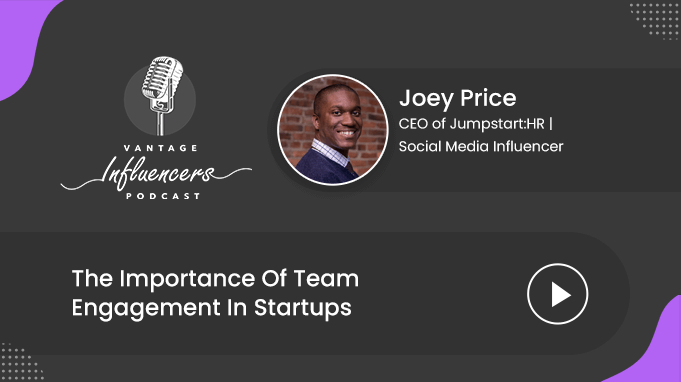
The Importance Of Team Engagement In Startups
Episode Overview
In this episode of the Vantage HR Influencers Podcast, host Susmita Sarma speaks with Joey Price, CEO of Jumpstart:HR, about what actually keeps a startup team together when there is no big budget to fall back on. Joey traces his own path from studying exercise science and training athletes to building an HR consulting firm in 2011, and argues that a founding team survives on just two traits: competency, meaning sharp, adaptable people willing to do whatever the moment requires, and commitment, meaning partners who protect both the mission and the relationship between them. He is direct about the tradeoff startups face: you cannot out-pay a bigger company, so the story you are building and the way your team treats each other becomes the actual recruiting pitch.
The sharpest, most concrete part of the conversation is how Jumpstart:HR keeps a fully remote team connected without ever having met in person. Joey describes a weekly ritual called High-Low-Buffalo, where team members share a high, a low, and a random tip, alongside a non-work Slack channel called Family Fridge for casual conversation. He frames remote management as a proactive skill, not a passive one: managers have to reach out first, because it is easy for a remote employee to quietly drown in work and disappear. He closes by turning the question around, arguing that larger, more bureaucratic companies could learn a lot from how startups stay nimble and keep repeating their mission and their "why" to hold a team's motivation together.
Episode Highlights
- A startup founding team's strength comes down to two traits: competency, meaning sharp, adaptable people willing to do whatever it takes, and commitment, meaning partners dedicated to both the mission and to each other.
- Startups cannot compete on salary, benefits, or amenities, so the real recruiting pitch becomes the story you are building, the relationships on the team, and the wins you are already earning together.
- Team engagement is not a "later" investment. Even a solo founder should start building those skills early, since a team is coming eventually and the habits are easier to build before you need them.
- Jumpstart:HR keeps its fully remote team connected through a weekly ritual called High-Low-Buffalo and a casual, non-work Slack channel called Family Fridge.
- Managing remote employees well means managers proactively reaching out rather than waiting to be asked, since it is easy for a remote worker to quietly drown in their workload.
- Startups can teach larger, more bureaucratic companies a lesson in staying nimble and in constantly repeating the mission and the "why" behind the work to keep people motivated.
About the Guest
Joey Price, CEO, Jumpstart:HR
Joey Price is the CEO of Jumpstart:HR, an HR consulting firm he founded in 2011 to help small businesses, startups, and later multinational firms with a US presence build stronger workplace cultures. With more than 15 years in the HR industry, he has earned several rewards and recognition, including being named "Top 30 HR Professional Under 30" by SHRM's HR Magazine. A serial entrepreneur, Joey also hosts his own podcast focused on Business, Life, and Coffee (BLC).
Host
Susmita Sarma, Vantage Influencers Podcast Host
What You Will Learn
- Why competency and commitment are the two traits that make or break a startup founding team.
- How to pitch talent on joining a startup when you cannot compete on salary or benefits.
- Why team engagement should start on day one, even before you have a team to manage.
- Practical remote-team rituals you can borrow, including a weekly high-low check-in and a non-work Slack channel.
- How to manage a remote or hybrid workforce without losing personal connection.
- What large, established companies can learn from startup culture around agility and mission-driven motivation.
Key Topics & Timestamps
| Timestamp | Topic |
|---|---|
| 00:55 | Joey's journey from athletic training into HR and founding Jumpstart:HR |
| 03:34 | The two traits every founding team needs: competency and commitment |
| 05:47 | Whether startups should invest in HR and team engagement from day one |
| 07:42 | The benefits of employee engagement for startup founders and employers |
| 09:23 | Team engagement ideas from inside Jumpstart:HR, including High-Low-Buffalo |
| 11:30 | Tips for managing a remote workforce in a startup |
| 13:24 | What larger, older companies can learn from startup culture |
| 14:37 | Joey's closing advice for HR professionals on AI and HR tech |
Full Transcript
Click to read the full episode transcript
Welcome to the Vantage HR Influencers Podcast. This podcast is sponsored by Vantage Circle, the simple and AI-powered rewards and recognition platform for employee engagement. The efficiency of a startup's research and development is critical to its success, and in order to do so, you will need an engaged and committed workforce.
Susmita Sarma: Hi everyone, I'm Susmita, and in this episode of the Vantage HR Influencers Podcast, you will learn about the importance of team engagement in startups from Joey Price, who has spent over 15 years in the HR industry and is currently the CEO at Jumpstart:HR. Welcome to the show, Joey.
Joey Price: Hi, thank you. I'm glad to be here.
Susmita Sarma: Welcome once again, and as I've already mentioned to our listeners, today we'll be talking about the importance of team engagement in startups. Joey, before that, I'd like to know a bit about your journey in the corporate world.
Joey Price: Yes, my journey in the corporate world started on the athletic fields, actually. In university, I studied exercise science, and I thought I was going to grow up and be an athletic trainer, travel with competitive sports teams, win trophies, and be a legendary athletic trainer helping athletes perform at their best. But somewhere along the way, I realized that this isn't the field for me, this isn't what I wanted to do. I didn't want to tape up athletes for the rest of my life. So I needed to transition to something that made more sense for who I was and the life I wanted to build.
I knew that I wanted to help people, that was always my guiding voice, to help people and be of service. But I didn't know how I wanted to do that specifically in the corporate world. I was talking to some friends and family members about what I enjoyed most at the time. I was in college, I was managing a band, and I was a temp worker in DC. So while my friends were at amusement parks making minimum wage, I was making almost triple that. I did enjoy making money, but also being in a corporate setting.
And for all the skills and background that I had, someone said, hey, you should try HR, because I was a resident assistant as well. So it was almost a natural transition, I just didn't know what the field was.
Susmita Sarma: Right, that's where I guess Jumpstart came in.
Joey Price: Yeah, yeah. So I was an HR pro for several years, got my certification in HR, got my master's degree in HR. And after a while, being in other people's businesses, I said, what if I created a company where I could help small businesses and startups all across the US, and later on, multinational firms with a US presence, and guide them towards growth and building a better culture in a way that they wouldn't do naturally by themselves. So Jumpstart was created in 2011 out of that mission, and that's been our guiding mission even to this day.
Susmita Sarma: Right. So, being the founder of an organization, Joey, what are the top things you consider important to remember while building the perfect founding team of any organization?
Joey Price: The two most important things for building a founding team are competency and commitment. With competency, you have to have really smart, sharp people who are agile and adaptable, and willing to do whatever needs to be done to make the organization a success. Because when you're just creating your founding team, that's all you have: your team, your dream, and your goal. So you have to make sure you're protecting that at all costs and doing what's necessary to see it come to fruition.
And as you grow and add more members to your team, the other part is commitment: people who are dedicated not only to seeing the organization thrive, but to seeing the relationship between the founding partners thrive. Whether that means being comfortable in the role you play and not being insecure that you're not as great in something else. For example, if there are technical founding partners and non-technical founding partners, realizing that you both play an important role. So being committed to making sure the relationship between the founders is a success is another thing that's incredibly important.
Susmita Sarma: Okay, so when you talk about competency, Joey, I believe it basically comes from experience. So would you say that for a founding team or a startup, bringing in freshers is not a good idea?
Joey Price: Well, it depends. It depends, because when I teach on how to build a team, there are many different factors and components that come into building a successful startup. Some of that could be bringing on interns as one of your first few hires. So it really just depends.
Susmita Sarma: Okay, so what do you think about engagement? Should a startup invest in HR and team engagement?
Joey Price: From day one, yes, because even if you're a founder of one, you need to invest in learning how to do team engagement, because at some point you will have a team to manage. And it's better to have those skills in place before you need them, because if you don't have that, then your team won't be better off.
You have to think about it as a startup: you don't have the fringe benefits to offer, you don't have the high salary to offer, you don't have the amenities to offer. You literally have the story of what you're trying to build, the relationships people have on staff, and the successes you're earning along the way as a marketing tool to get talent into your organization.
So invest in HR to build out infrastructure that flows and is seamless, because you may have a startup you're proud about and excited about, but others transitioning into your company are coming from organizations with more established infrastructure and systems. So there are certain expectations they may have of the place they work that you just may not be aware of. You should absolutely invest in HR to help build out the infrastructure that makes your employee experience better, and team engagement by way of learning how to be a great team leader, so you can guide people and make that one of the biggest things that keeps people around in your company.
Susmita Sarma: Yes, so there's a clear mechanism there. What about the benefits of adopting employee engagement in startups for the owners or the employers?
Joey Price: For the employers, you want to establish HR because we talk to a lot of startup founders, nonprofit executive directors, and individuals who inherited C-level positions in small teams. And maybe it's a biased conversation because we're naturally talking about HR, but they say the things that slow them down, and the reason they need our help, is because there are HR challenges they're thinking about at night, stressing about, that they don't have answers for. Maybe they hired someone for the HR role and then that person left, and they realize they can't manage the HR role by themselves.
You want to have someone who can help you do things you're not as skilled and competent about. I talked about founding partners needing competency and commitment; part of that competency is knowing what you don't know, and being smart enough to get a team around you that can fill in those gaps. So as an employer, you want to ensure you're creating a great experience for your team. You want to ensure people are excited about being at your company, and that there aren't barriers to their success by way of things like payroll mistakes, poor benefits, or a lack of a performance management solution.
Susmita Sarma: When you talk about engagement ideas, Joey, what do you all do at Jumpstart HR? Would you like to share any ideas you've tailored for your startup?
Joey Price: Yeah, we're a fully remote organization. So even prior to the pandemic, I had team members I'd never shaken hands with, never given a high five, never been in the same space. So while we were ready for the pandemic, it's still no less challenging to drive team engagement in a remote setting.
Some things we do every week: we have something called High-Low-Buffalo, where we share our high of the week, our low of the week, and then Buffalo is a random tip or a thing that happened in our week that we want to share with the team. We do team trainings where we're learning together and connecting. We have a system of frequent check-ins and meetings where half of it is business, but the other half is grab a cup of coffee, let's chat, catch up, see how things are going in your world. It's a lot of sharing and over-communicating.
We also built out our Slack channels; one of them is called Family Fridge, where we share things of interest to us and talk about things that have nothing to do with work. And I encourage the team: hey, pick up the phone, call one another, see how people are doing personally, because we can't just work in a silo. That's something we used to do in the past, just focus on the work, but it's incredibly important to invest in one another on a personal level.
Susmita Sarma: Brilliant, interesting ideas that you've taken up, Joey, at your workplace. So as you mentioned that your workplace has been a remote workforce even before the pandemic, I won't miss the chance to ask for your tips on managing a remote workforce in startups.
Joey Price: You have to make sure you have really good communicators as managers. And it's not just the art of speaking, but the art of establishing connections and proactively reaching out to say, hey, how are you doing? I thought about you, hey, let's grab a couple of minutes to talk. You want to make sure people are proactively doing that, because it's easy to drown in your work when you're remote, and not talk to people. So that's important.
It's also important to develop systems that work both in person and remote. Many companies have a hybrid workforce, so an example might be with your performance management system: being able to deploy that over Zoom or a web conference in the same way you would with a person who sits in front of your desk.
And the other thing is we sometimes underestimate people's ability to manage the tech stack we have. So ensure your teams are trained to make the most out of the tech stack they have, so there isn't friction in doing their job or in communicating with one another, whether that means training on your communication tools, Teams, Google Workspace, whatever software you have. Just make sure people can function independently, so it's not a barrier to their success when they're trying to solve a problem and there's no one around who can help.
Susmita Sarma: So do you think there's something that big or older companies can learn from startup culture?
Joey Price: Yeah, there is, there's a few things. One is just knowing that much of what we do in business culture these days is agile, and realizing that the bureaucracy within a startup is way less than in a bigger or larger organization. So finding ways to be nimble and adapt to the changing speed of business is important.
Another is the reliance on mission, vision, and team story to really drive performance and commitment from team members. I don't think we celebrate enough: here's what we do, here's why it's important, here's the impact we're making in the world, here's why your role matters, not just in your department, but in serving our customer. I think startups that are growing and thriving do that really well.
Susmita Sarma: Nice, thanks for sharing this, Joey. So finally, what are your suggestions for HR professionals, especially someone in HR at a startup right now?
Joey Price: I'd say, if you aren't already, start to understand the role that artificial intelligence and machine learning is playing in the HR function. Because whether or not it's active in your company, if you leave your current place and want to land somewhere else, you're going to want to know how to work with certain tools, and what function those tools play, so that you're not marketing skills that technology has become better at than you.
So understand the climate of HR tech and the skills you need to utilize it and be successful, as opposed to continuing to grow skills that, more and more every single day, HR tech is taking over through scale and automation.
Susmita Sarma: Lovely. So finally, Joey, how can listeners reach out to you?
Joey Price: Well, it's been a pleasure being on the show today, I've enjoyed talking with you. You can find me on LinkedIn, just search for Joey Price, or it's linkedin.com/in/joeyvprice. You can find my company, Jumpstart HR, and the things we're doing over at jumpstart-hr.com. And you can find me on social media pretty much everywhere with my handle, Joey V Price HR.
Susmita Sarma: That was a wonderful conversation with you, so thanks a lot for joining me on the Vantage HR Influencers Podcast.
Joey Price: My pleasure. Have a great day, thank you.
Thanks for listening to the Vantage HR Influencers Podcast. Please do subscribe to the Vantage HR Influencers Podcast on Apple Podcasts, Spotify, and our YouTube channel for new episodes.
FAQ
What are the two most important things for building a startup founding team, according to Joey Price?
Joey Price names competency and commitment as the two essentials. Competency means having sharp, agile people willing to do whatever it takes to make the organization succeed, while commitment means partners who stay dedicated to both the mission and to the relationship between the founders, including respecting each other's different roles, such as technical versus non-technical co-founders.
Should a startup invest in HR and team engagement from day one?
Yes. Joey argues that even a founder of one should start building team engagement skills immediately, because a team is coming eventually and it is better to have those skills in place before they are needed. He notes that startups cannot offer the salary, benefits, or amenities of larger companies, so the story being built and the relationships on staff become the real recruiting tool.
What team engagement ideas does Jumpstart:HR use for its fully remote team?
Joey describes a weekly ritual called High-Low-Buffalo, where the team shares a high of the week, a low of the week, and a random tip. The company also runs a non-work Slack channel called Family Fridge for casual conversation, holds frequent check-ins that mix business with informal catch-ups, and encourages team members to call each other directly rather than relying only on messaging.
What can larger, established companies learn from startup culture?
Joey points to two lessons: staying agile, since startups carry far less bureaucracy than bigger organizations and can adapt faster to changing business conditions, and leaning harder on mission and team story. He believes companies underuse the "why" behind the work, and that consistently reminding people of the impact of their role is something thriving startups do especially well.
Related Reading
Also listen on