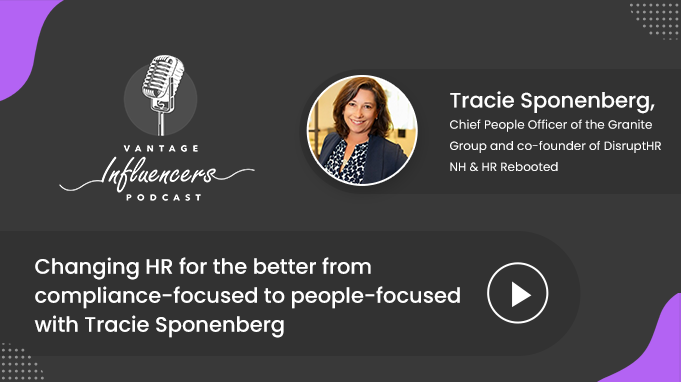
Changing HR for the better from compliance-focused to people-focused
Episode Overview
Tracie Sponenberg argues that the once-a-year performance review is effectively dead, and that most HR teams are already living through its slow replacement. In this conversation, she breaks down why traditional annual reviews fail: they bundle feedback, coaching, and compensation into a single once-a-year event, when employees (especially younger ones) expect ongoing, two-way conversations about how they are doing and what they need to succeed. She walks through how her own organization is working through that transition, separating compensation decisions from feedback conversations and pushing managers toward more frequent, less formal check-ins.
She also makes the case that HR's shift from compliance to people starts with technology and data, not culture statements. Sponenberg describes replacing paper-heavy onboarding processes with digital systems that free up HR and managers to spend time coaching rather than filing forms, and she explains how an HR analytics platform lets her benchmark pay equity, flag flight risk, and bring hard numbers into conversations with the C-suite. The discussion closes with her thoughts on measuring engagement during a sudden shift to remote work, why recognition programs have to be built around what different people actually want rather than one-size-fits-all rewards, and the advice she gives young HR professionals entering a tough job market.
Episode Highlights
- Performance reviews built around a single annual event are broken; feedback needs to be frequent, two-way, and separated from compensation decisions.
- Early in her career HR meant paperwork and policies; shifting toward serving people rather than serving forms took years to embrace personally.
- Digitizing onboarding and replacing a 51-page new-hire paperwork packet freed up time for managers and HR to focus on coaching instead of admin work.
- An HR analytics platform can flag flight risk, benchmark pay by role and geography, and check for gender pay gaps, turning HR into as data-driven a function as pricing or finance.
- During the sudden shift to remote work, daily manager check-ins mattered more than any single engagement score, though a dedicated tool still helps catch problems managers miss.
- Recognition works best when it matches the person: some employees want public praise, others prefer a private thank-you, so programs need multiple ways to say thanks.
About the Guest
Tracie Sponenberg, Chief People Officer, The Granite Group
Tracie Sponenberg is a transformational executive HR leader with experience across a wide range of industries, including deep expertise in strategic HR management within privately held, family-owned businesses. As Chief People Officer of The Granite Group, she has driven change across HR technology selection and deployment, wellness program development, employee engagement, culture building and turnaround, organizational development, performance management, coaching, legal compliance, and leadership and team development. She is a co-founder of DisruptHR NH and HR Rebooted, and serves as an SHRM special expertise panel member.
Host
Rohit, Vantage Influencers Podcast Host
What You Will Learn
- Why the once-a-year performance review model is broken and what is replacing it.
- How to separate feedback conversations from compensation decisions.
- Practical ways to reduce paperwork and free HR up for strategic work.
- How to use HR analytics to spot flight risk and benchmark pay equity.
- How to measure engagement and support teams during a sudden shift to remote work.
- How to design a recognition program that works for both public and private personalities.
Key Topics & Timestamps
| Timestamp | Topic |
|---|---|
| 00:00 | Introduction and guest background |
| 00:55 | How Tracie got into HR |
| 01:36 | Are performance reviews still relevant? |
| 04:17 | How technology has made HR more people-focused |
| 07:08 | Why HR managers need to analyze data |
| 09:39 | Recommended HR analytics platforms |
| 11:18 | Understanding employees across generations and life stages |
| 13:16 | Metrics for measuring employee engagement remotely |
| 15:43 | How leaders should take feedback from their teams |
| 18:16 | The importance of rewards and recognition |
| 20:34 | Books, articles, and HR voices worth following |
| 23:39 | Advice for young HR leaders |
| 24:43 | Where to find Tracie online |
Full Transcript
Click to read the full episode transcript
Welcome to the Vantage HR Influencers Podcast. This podcast is sponsored by Vantage Circle, the leading employee benefits and engagement platform.
Rohit: Hi everyone, this is Rohit from the Vantage HR Influencers Podcast. I'd like to say hello to our guest, Tracie Sponenberg, who's an executive leader with experience across a wide range of industries. She specializes in strategic HR management, and in privately held, family owned businesses, experience and growth. Tracie has expertise in HR technology selection and deployment, culture building and turnaround, organization development, and more. She is also an SHRM special expertise panel member, and a co-founder of DisruptHR NH and HR Rebooted. She's a speaker on technology, leadership, branding, and more, and she's currently the Chief People Officer of the Granite Group. Welcome to the show, Tracie.
Tracie Sponenberg: Thanks for having me. I appreciate being here.
Rohit: Awesome. So how did you get into HR, and what excited you about this field of human resources?
Tracie Sponenberg: I'm fairly unusual, I think, in that back in high school, probably when I was 16 or 17, I knew this was something I wanted to do. I had an aunt who worked in human resources, or personnel, it was personnel back then. I really liked psychology, I liked business, and I like people, and I think you have to love people in order to be in human resources. So very early on I developed an interest, which was sort of weird, but that really informed the trajectory of my career.
Rohit: Very interesting. You've been a transformational executive leader, and I wanted to ask: do you think performance reviews are important, or are they needless in these times?
Tracie Sponenberg: That's a loaded question. We could talk for hours on that, my feelings on it are complicated and long. But if we separate out the feedback part of the performance review from how the performance review is delivered: that feedback, knowing how someone is doing, knowing how you're performing, knowing whether you have all the tools you need to succeed, that's really critical. But the way we've been doing it traditionally, once a year, where you sit down with your manager and they tell you here's how you're doing, here's your raise, see you next year, that's completely broken.
That feedback part is really important, and as younger generations come into the workforce, and even people of my generation and older, are demanding more and more feedback, because things happen quicker. I see that performance review process changing for everyone down the road. It has to be more frequent, more like check-ins, less formal; that once a year written review is really dead.
I remember several years ago going to the HR Tech Expo in Las Vegas, looking for vendors for exactly that, for performance reviews, and I knew that was changing, probably three years ago at that point. I believe there wasn't a single vendor focused on once a year annual reviews, though there are still plenty of vendors that do them. It's changed pretty quickly: some people started creeping into the space, then more and more, because that's really what people are demanding, and it's the right way to go. We're going through that journey in our company now, looking at how exactly we transition. We already separated out the compensation piece and did that annually, so it's a process, but an important one, because feedback shouldn't be just once a year. It should be all the time, and it should go both ways: you giving feedback to your manager, and taking feedback from them, positive, negative, all kinds, and it should be a development conversation.
Rohit: Before the call, we talked about how technology has really helped HR in the last couple of years, actually helping HR become more people-focused rather than just a compliance space. How has that happened?
Tracie Sponenberg: I started my career as a very compliance-focused, paper-pushing HR professional. It took me a long time, and I've been in HR a long time, to really embrace the people side, because that's what I grew up thinking HR was: sign this form, you must have a policy for this, you have to have a policy for that, you have to create a piece of paper for that. That really wasn't serving people. The way we have to be in human resources, or the people function, is to serve people, not to serve paper.
Over the years I embraced that and changed myself, and I've made it a personal mission to help change others who were where I was, and one of the best ways to do that is to embrace technology: to take a look at absolutely everything you do in the HR department, ask first whether you need to do that at all, and second whether you need to do it in that way, because a lot of the time it doesn't work for your people. So every process, every policy, every piece of paper.
When I got to the Granite Group, I was handed a 51-page packet of new hire paperwork. I was filling in my name in 16 different places, the address over and over, the same thing again and again. I came into a small team that didn't have a background in HR, and they didn't know there was a different way. The person who had left did know, but at the time there wasn't the budget to make the changes.
So we were able to come in and make those changes, take that paperwork away, and make those processes easier and seamless, because we have 45 locations. That means our managers and our people can do that quickly and easily, and then get back to doing the things that are important. In HR, we can serve our people, we can work on strategy to make their lives better; managers can spend time with them, helping train them, instead of sitting with them for three or four hours to fill out benefits forms. There are many ways, but the biggest thing is that you can take those time-consuming tactical tasks away to focus on the things that really matter.
Rohit: In the last couple of years, we've also seen that HR managers need to analyze data. How can HR managers analyze data so that leaders know how engagement and other HR-related things are happening?
Tracie Sponenberg: Again, I was slow to embrace technology, and I was slow to embrace analytics, but it's something I've grown to love deeply. I believe data tells a story. If you have any kind of payroll system or HRIS, you have data in there, data points for everything from engagement to termination; if you have an applicant tracking system, you can tell who's applying. Those are all different data points, and you need the right system to sit on top of that, or you can pull it manually, but that's really hard.
If you have a system that will work with you, it can pull data so you can bring it to your C-suite or your boss and say: here are the 10 people at this particular location who are most likely to leave, based on factors including commute time, tenure, and maybe past job history. These are things we can do now that we couldn't do even three, four, five years ago. HR professionals have always talked about turnover, which is kind of the old metric that a lot of us knew for a long time, but now we can measure any data point, and that gives us the power to tell a story, to help our people, to influence a company.
At my company, we put in an analytics platform about a year and a half ago, and I told my CEO I wanted our department to be as analytical as our pricing department, which is super analytical. I wanted to be able to measure everything, report on it, and know where we're headed in the future. No one can really predict the future, but we can get pretty close with data and analytics.
Rohit: On analytics platforms, is there a particular product or software you'd recommend?
Tracie Sponenberg: There's a lot out there; I know Microsoft has some good products. My deepest experience is with what we use, ADP, specifically their data cloud platform. I think it's their best product. Most people across the world have at least heard of ADP, they pay a good chunk of the world, so a lot of people are familiar with it, and like any solution it has its challenges, but their data cloud is excellent, by far the best product we use.
It sits on top of the system and pulls all the data out. I can press a button and know my headcount by generation, by location, benchmark pay gaps by gender if there's any disparity, benchmark every single job against people in our industry and in our geography. It's really, really robust, and it's my favorite piece of technology we have right now.
Rohit: Especially with the mindset we have now, there's a real range of employees, from Millennials to Gen Z to other life stages. How can someone understand employees' life stage so they can deliver better productivity and performance for the company?
Tracie Sponenberg: I think it depends on the size of your company. For larger companies, surveys are really helpful, even quick pulse surveys asking people directly. For us, we actually go out and physically ask people what they need. We're close enough, even though we have a lot of locations across the Northeast, to go out and ask people what they want.
That's one of the first things I did when I started almost five years ago: I traveled around and asked what people liked and didn't like about what we were doing in HR, and that's how we ended up changing some of our technology, going right to the people using it. I think you have to.
We talk a lot about generations now, but I think there are more similarities than differences. Everybody wants the same things: a good place to work, to know their contributions are valued, to work for a company they're proud of. If we design around those things, and go out and talk to people across different generations, genders, and backgrounds, and make sure we're creating a culture that embraces technology but is also diverse and inclusive, where everybody belongs, that's really the path forward.
Rohit: Are there any metrics leaders can use to measure employee engagement, especially in a remote setup where companies across the world were forced into remote work? Do you think employee engagement has gone up during this time?
Tracie Sponenberg: That's really interesting. There are certainly a ton of tools; we don't use it yet, but eNPS is a good one for a pulse-style score. But like any data point, it relies on people responding honestly.
I think the best way, and this isn't necessarily about technology, is for managers to make sure they're communicating all the time with their people, talking regularly and asking how they're doing and what they need. My team has been remote for the past few months; our company has been working the whole time, since we provide plumbing, heating, cooling, and water supplies, so we've been in essential business. Our different locations have been working, but a lot of our office staff are remote, and we meet every day face to face over Zoom or Google Hangouts. I'm always asking them how they're doing, how they're feeling, and I think that's super important.
On top of that, you want to measure the managers who aren't doing that, so having some type of tool that measures engagement is helpful, and then you can do something about it. You can't just measure something, find out you have a problem, and let it sit there. We had a great tool we used for a number of years, but the company sunsetted it, and we're actively looking for a new tool to help supplement what we do day to day.
Rohit: You also talked about taking feedback and giving feedback. How should a leader take feedback from their team so they can improve as a leader, and how should a leader lead through that?
Tracie Sponenberg: I think taking feedback is important, but you have to ask for it: what can I do, is there anything I'm doing that you'd like to talk about, what do you need from me as your leader, what should I do differently. Be vulnerable.
I think as a leader at any time, but especially in a remote environment, you need to be willing to be empathetic, give grace, and be really patient. People working through times like these aren't necessarily working through normal times; they may be dealing with caring for ill people, or parents, or children, or pets, all sharing a home in a situation that might be unusual for them. You just have to be patient, empathetic, and listen more than you talk. It's really critical to put yourself in a vulnerable position and lead by example.
One of the things I talk about with my team is that if I'm feeling overwhelmed, or having a challenging day, I share that with them. If they see me saying that, it gives them permission to feel the same way, or to know it's okay to take time for themselves. I'll tell them I go on a few short walks a day just to clear my head. I think good leaders lead well during normal times, and they lead the same way during extraordinary times, just being much more mindful of what other people are going through. That empathy is so critical all the time, but especially now.
Rohit: Absolutely, and it's really important during this time of crisis. Coming back to rewards and recognition: how important do you think tiny, ongoing rewards and recognition are for employees, and do you think SaaS products like this are the way forward?
Tracie Sponenberg: Yes, this is actually something we're looking at too. I looked at a number of different solutions a few years ago, but I think my failing then was that I didn't ask enough people what they wanted. We ended up creating a six-part recognition program in house that works pretty well, and I think the key with any recognition program is knowing your people.
I'm an introvert, and most people don't realize that, but while everyone loves recognition, I like it privately. An email from my boss just saying thank you for your hard work means more to me than having to get up on stage, which might actually make me throw up. So everybody's different. You have to know your people, know what's meaningful to them, know what your company can afford, and design a program around that.
It should hit multiple different points: some people like to be recognized privately, some publicly, some like monetary recognition, some want a surprise gift. Something that can do a lot of different things and make a lot of different people happy is important. But we shouldn't forget the power of a simple thank you, or "hey, great job." That's the best kind of recognition there is. The other things are wonderful and important, but a meaningful thank you is the best thing you can do for someone.
Rohit: What have you been reading lately, and who do you follow and respect that you'd recommend others follow?
Tracie Sponenberg: Right now I'm reading How to Be an Anti-Racist, which is very much a business book too. I recently read The Memo by Minda Harts, and some of the old standbys, like Our Iceberg Is Melting and Good to Great. I also read Quiet by Susan Cain, which is meaningful to me as an introvert. I try to read books here and there, but one of the best ways I keep up with the news is the Harvard Business Review; I love keeping up on business articles there. And then Twitter, because I have a tiny attention span, I can scroll through and pick out the things I want to read, like speech journal articles and so on.
As for who I follow: my friend Steve Brown is probably the most connected person in HR, and he's just one of the most wonderful human beings I've ever met, so positive about the field of human resources that everyone should know him. He's on a mission to meet everybody; I'm an introvert, he's a massive extrovert. There are several HR technology voices I really love following too. One of them has a really unique view of the world, and another is a former HR professional herself who has built a really cool career in the space, and I really admire her.
There's also Tara Fioriani, who has a web show called Not the HR Lady. I've never met her in person, but I feel like I've known her my whole life. She's very straightforward, with a real no BS approach to life, I could go on and on. I also want to mention one of the coolest young professional voices I follow. I'll admit I'm not even sure I'm pronouncing her last name correctly, but she's one of the most exciting rising voices in HR right now, and I love watching what she's doing and writing. I was also a blogger myself last year, so I got to meet a lot of really cool people, and I've been very fortunate to do that.
Rohit: What's the one piece of advice you'd give to young HR leaders who are graduating this year and trying to build their careers?
Tracie Sponenberg: I always give the same advice: take a risk. That's something I wasn't good at when I was younger, and I wish I had been. Get out of your comfort zone, apply for the job you're not qualified for, take the job on the other side of the country, just go for it. That's really important before we all get settled into life, with mortgages, and people have children and pets, and get positioned in a spot for a while. Now is the time to take a risk and do something really different.
Rohit: What's the best way for people to reach out to you and learn more about your blog and HR Rebooted?
Tracie Sponenberg: You can find a list of the places I'll be speaking, and the things I've done, at TracieSponenberg.com. You can find our videos and podcasts at HRRebooted.com, which I run with my friend Michelle Strausberger. You can follow me on Twitter, or connect with me on LinkedIn.
Rohit: I'll put that in the show notes. Thank you so much for taking the time to speak with me, I totally enjoyed it.
Tracie Sponenberg: Thanks for having me, I really appreciate it.
Thanks for listening to the Vantage HR Influencers Podcast. Subscribe on Apple Podcasts and Spotify for new episodes.
FAQ
What does Tracie Sponenberg say is wrong with the traditional annual performance review?
Tracie Sponenberg argues that the once-a-year performance review, where a manager delivers a rating and a raise and then disappears until next year, is completely broken. She separates the feedback function, which she says is more critical than ever, from the delivery mechanism, arguing that the process needs to be more frequent, less formal, and built around regular manager check-ins rather than a single annual event.
How did Tracie Sponenberg move her HR team from compliance-focused to people-focused?
Tracie Sponenberg started her career as a compliance-focused, paper-pushing HR professional and spent years learning to serve people instead of paperwork. She points to replacing a 51-page new-hire paperwork packet with digital onboarding as a concrete example, arguing that removing tactical, repetitive tasks frees HR and managers to spend their time on coaching and strategy instead.
What analytics platform does Tracie Sponenberg recommend for HR teams?
Tracie Sponenberg says her team's deepest experience is with ADP's data cloud platform, which she calls the best HR analytics product she has used. She uses it to check headcount by generation and location, benchmark pay against industry and geography, and flag gender pay disparities, information she can bring directly to her CEO.
What is Tracie Sponenberg's advice for young HR leaders?
Tracie Sponenberg's advice for young HR leaders graduating into a tough job market is to take a risk: apply for the job you are not fully qualified for, or take a job on the other side of the country. She argues that early career, before mortgages and family obligations set in, is the best window to make a bold move.
Related Reading
Also listen on