
Loneliness at work is easy to miss because the people feeling it are the least likely to say so. It rarely shows up as a complaint. It shows up as someone who stops speaking up in meetings, whose messages get shorter, whose work quality slips a little without any real change in workload.
Workplace loneliness is the feeling that your social needs are not being met at work, whatever the reason. Gallup's 2024 State of the Global Workplace report found that 1 in 5 employees worldwide feel lonely at work, and the rate is nearly double among fully remote employees compared with onsite employees. It is measurable, and visible in work patterns before anyone reports it.
This piece covers how isolation differs from loneliness, the signals a people team can actually check, what the research says it costs a business, and six changes that reduce it on a real team.
Workplace Isolation vs Workplace Loneliness
Workplace isolation is structural: a person has few real opportunities to interact with colleagues. Workplace loneliness is emotional: their social needs go unmet regardless of how much contact they have. The distinction matters because isolation is fixed by changing how work is organized, and loneliness usually needs a different fix.
Both can look identical from the outside: someone who rarely speaks up, whose name never comes up when a team talks about who to loop in. But the right response depends on which one is actually present. Adding a lonely employee to more meetings does not solve loneliness, and a wellness talk does not solve isolation.
Why the difference changes what you do about it
| Situation | Isolation, loneliness, or both | What actually fixes it |
|---|---|---|
| A remote employee is included in every meeting but rarely addressed directly | Loneliness | A manager or peer checking in with them specifically, not adding more meetings |
| A new hire has no assigned buddy and misses most team decisions | Isolation | A structural fix: a named buddy and access to the channels where decisions happen |
| Someone is the only person in their discipline on the team | Isolation | Cross-team contact with peers who do similar work, even outside the immediate team |
| Someone has plenty of contact with colleagues but still feels unseen | Loneliness | Genuine recognition and attention, not more scheduled contact |
| A team leaves one person out of lunches and side conversations on purpose | Both, with a conduct dimension | Checking whether it is incidental or deliberate, and escalating if it is deliberate |
None of this works without a baseline level of trust. A team afraid to admit they are struggling will not surface either condition until it is already costing you someone's tenure, which is why psychological safety matters alongside any isolation or loneliness effort. It is the condition under which someone will actually say something is wrong.
How to Spot Isolation Before It Shows Up in an Exit Interview
Isolation shows up in observable work patterns before anyone reports it: declining participation in optional meetings, shorter and less frequent messages in team channels, work quality that slips without a workload change, and an absence from any recognition or peer-feedback record over a full quarter.
None of these signals is proof on its own. Each overlaps with burnout, disengagement, or plain introversion, which is why a detection method needs a "what it does not mean" column, not just a list of red flags.
| Observable signal | Where you can see it | What it does not mean | First response |
|---|---|---|---|
| Declining participation in optional meetings or channels | Meeting attendance, chat activity | Could reflect workload or personal preference, not isolation | A short, informal check-in, not a performance conversation |
| Messages in team channels get shorter and less frequent | Collaboration tool history over several weeks | A single quiet week rarely means anything | Watch the trend, not one data point |
| Work quality slips without a change in workload | Manager notes, project output | Overlaps with burnout or a skills gap | Ask directly rather than assume the cause |
| No mention in any peer recognition or feedback for a full quarter | Recognition platform analytics | Does not prove anyone dislikes the person; quieter roles are often just less visible | Flag it as one data point worth a manager conversation |
| Consistently the last to hear about decisions or informal updates | Team retrospectives, project history | May be a structural gap in the workflow, not personal exclusion | Review who gets included in updates by default |
| Camera off and minimal verbal participation in remote meetings | Meeting patterns | Could be connectivity, fatigue, or introversion, not necessarily loneliness | Offer a lower-pressure way to contribute, like chat or async notes |
| Consistently eats or works alone and skips optional social moments | Direct observation in hybrid or office settings | Some people genuinely prefer this; it is not evidence on its own | Extend an invitation without pressure to accept |
If someone has not appeared in a single peer recognition post or piece of feedback in a full quarter, that is not proof of anything on its own. It is a data point worth a conversation, not a conclusion.
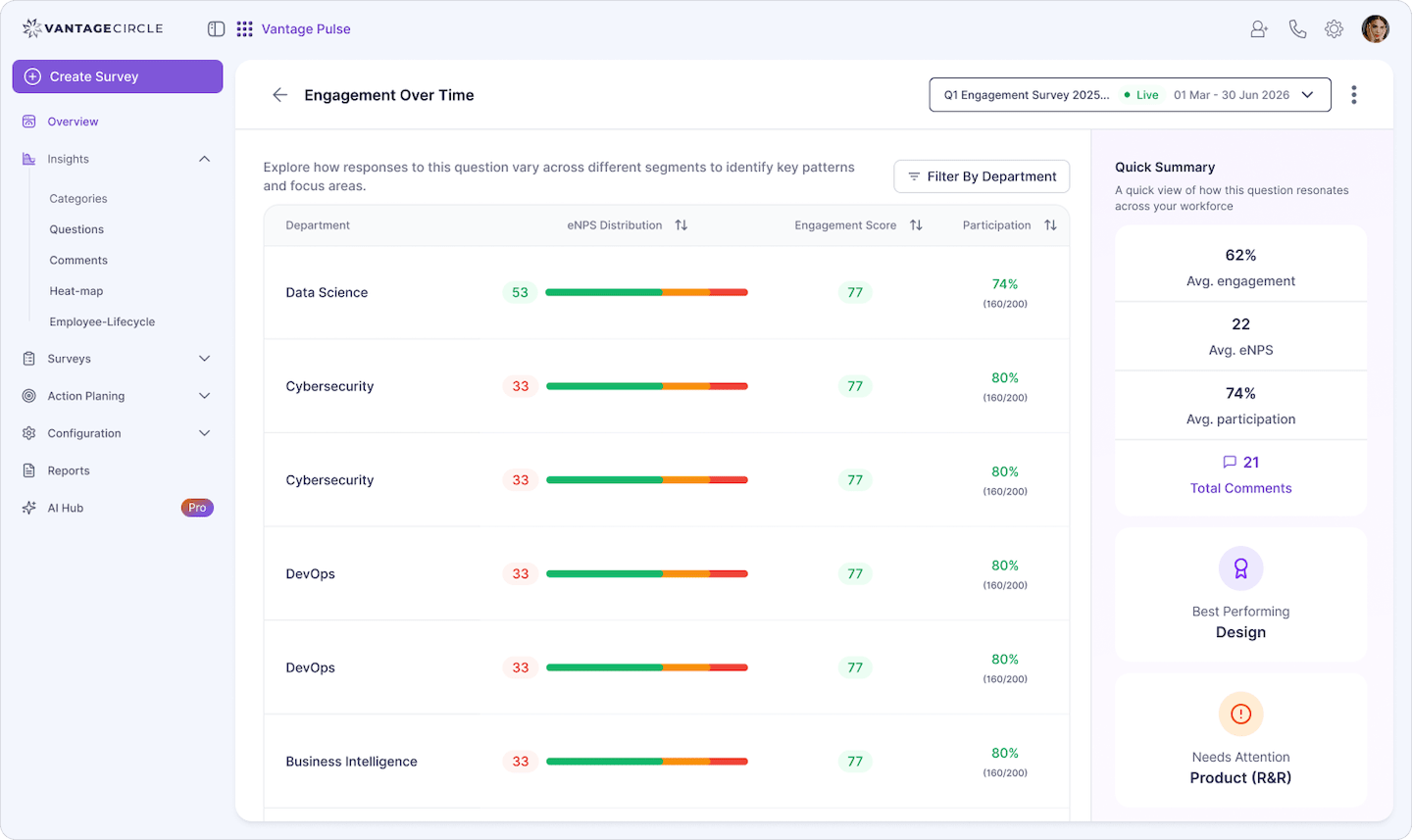
Recognition data is one of the few places this shows up in a system rather than a hunch. Recognition analytics can break peer-to-peer and manager recognition down by team and category, showing which department has gone quiet even when the company-wide number still looks healthy, which is often the first real clue to check further.
Isolation and burnout are also frequently confused for each other. If output has dropped alongside visible exhaustion, burnout is at least as likely an explanation, and the two call for different conversations.
What Causes Loneliness at Work
Loneliness at work has four recurring causes: how work is organized, how teams communicate, whether contribution is visible, and whether the culture makes it safe to be known.
Remote and hybrid work
Working away from a shared physical space removes most of the incidental contact that used to happen without anyone planning it. Gallup's 2024 data found fully remote employees report loneliness at close to double the rate of onsite employees, 25% versus 16%. The fix is not forcing people back to an office. It is designing deliberate, low-effort ways to interact that do not depend on a shared hallway, from a virtual team building activity to a shared step challenge through Vantage Fit that gives a distributed team something to do together without anyone leaving home.
Team structure and communication patterns
A team can be fully staffed and still leave someone out of the loop by default, simply because updates travel through channels that person is not part of. Reviewing who actually gets included in day-to-day workplace communication, not just who appears on the org chart, is the fastest way to find this kind of gap.
Invisible contribution
People who work outside the visible center of a team often do work nobody happens to see. A social recognition feed that surfaces appreciation publicly, not just between two people privately, puts that work in front of colleagues who would otherwise never know it happened.
When exclusion is deliberate
Not every gap is incidental. If someone is being left out of lunches, side conversations, or decisions on purpose, that is ostracism, a workplace conduct issue rather than a wellbeing-program gap. A team-building activity is the wrong response to deliberate exclusion, since it treats a conduct problem as a connection problem and can leave the excluded person feeling worse, not better. Handle it through the same channel as any other conduct concern, and escalate to HR rather than trying to fix it socially.
What Workplace Loneliness Costs an Organization
Loneliness at work is associated with lower job performance, weaker employee engagement, reduced motivation, and a higher chance an employee eventually leaves, and the research behind that is well established.
| Effect | What the research found | Source and year |
|---|---|---|
| Job performance and workplace behavior | Employees who feel lonely at work are rated lower on performance by their own supervisors and are less likely to help colleagues | Ozcelik & Barsade, Academy of Management Journal, 2018 |
| Overall mortality risk | Weak social relationships carry a mortality risk comparable in size to smoking about 15 cigarettes a day | Holt-Lunstad et al., meta-analysis of 148 studies, PLoS Medicine, 2010 |
| Coronary heart disease | Poor social relationships are linked to a 29% higher risk of developing coronary heart disease | Valtorta et al., Heart (BMJ), 2016 |
| Broader health risk | Named loneliness and isolation a public health concern linked to a higher risk of depression, anxiety, and premature death | U.S. Surgeon General's Advisory on the Healing Effects of Social Connection and Community, 2023 |
| Prevalence at work | 1 in 5 employees worldwide feel lonely at work; the rate is 25% among fully remote employees versus 16% onsite | Gallup, State of the Global Workplace, 2024 |
The performance effect is not really about mood. Ozcelik and Barsade's study found that lonely employees become more self-focused, more alert to perceived slights, and more likely to misread ordinary interactions as rejection, which makes them harder to work with exactly when they most need a way back in. That pattern shows up downstream as reduced engagement and, without a working retention strategy, a decision to leave the organization rather than fix something that feels personal and unaddressable. None of this needs a dramatic intervention, just noticing early, which is what the detection signals above are for.
How to Reduce Loneliness on Your Team
Reduce loneliness by changing how work is structured rather than by adding social events, since an event a lonely person does not attend changes nothing.
Structure connection into onboarding
New hires who feel intimidated to approach leaders or peers in their first weeks often stay isolated well past onboarding, which is also why "feeling isolated at a new job" is such a common way people describe this. Introduce a new hire to the team's actual work culture and assign them a specific person to check in with, before their first day if possible, to close most of this gap early.
Give people a reason to interact outside their own team
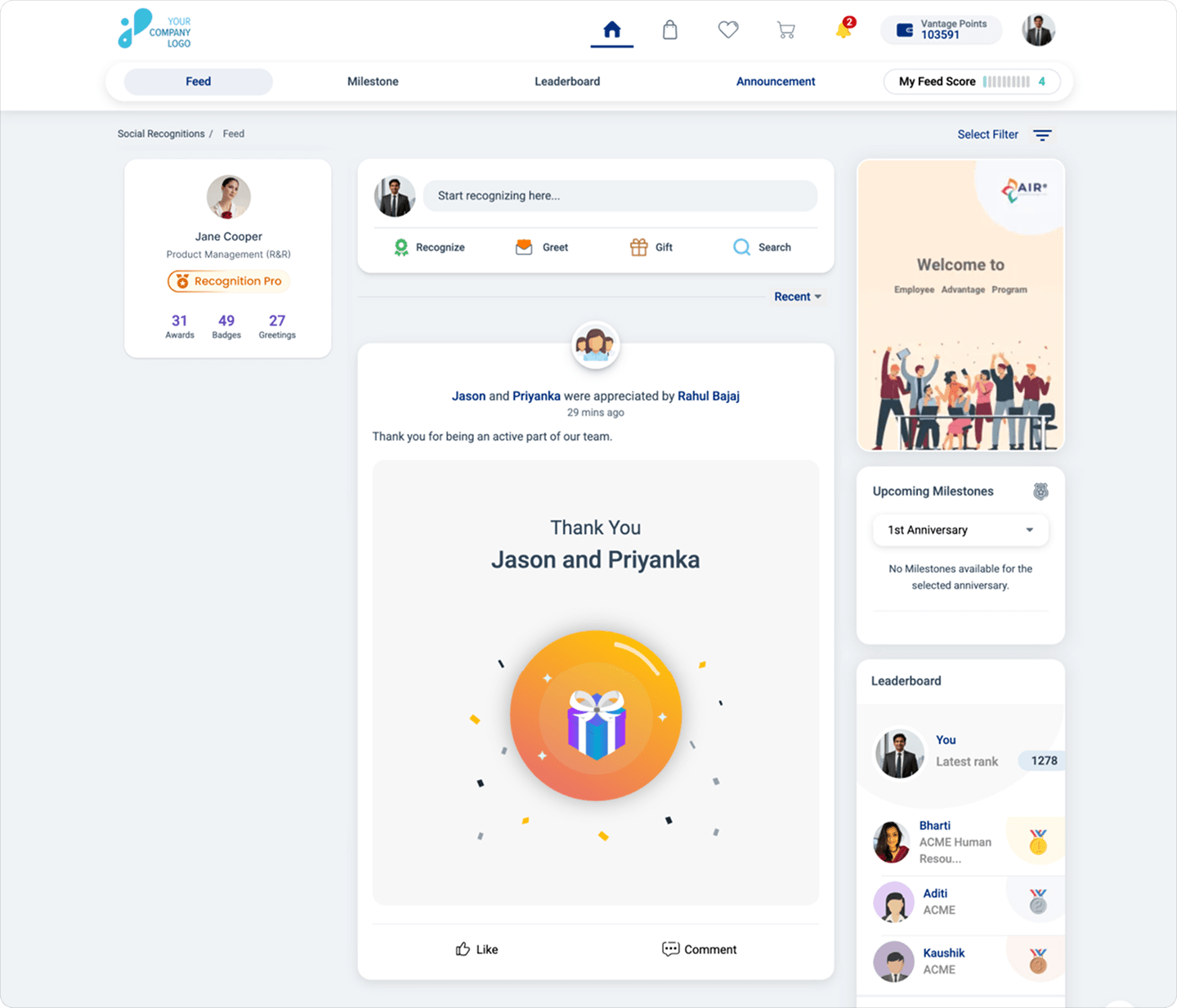
Social events ask people to be sociable, which is exactly what a lonely person finds hardest. Peer-to-peer recognition asks something easier: notice a colleague's work and say so. It creates contact through the work itself rather than around it. Structured formats still have a place too, from team building activities to a team lunch, as long as they are not the only mechanism on offer.
Make contribution visible
Employee connection rarely survives on good intentions alone. It needs a visible record of who did what and who noticed. Public recognition and inclusion in decisions that affect a person's own work both make it harder for a contribution to go unnoticed for a full quarter.
Build in one-to-one manager time
A manager with a structured reason to recognize each report individually also has a structured, recurring reason to talk with each of them. Manager recognition built into a regular cadence gives that reason a specific occasion, and for someone on the edge of a team, that recurring contact is often the most reliable one they have. It also keeps an open door in practice, not just in policy, so a struggling employee has a low-stakes way to say something before it becomes a resignation conversation.
Design remote work for connection, not just output
Remote and hybrid teams need deliberate structure where an office used to provide it by accident: a recurring optional social slot, a wellness challenge through Vantage Fit that people join for the activity rather than the socializing, or simply making sure no one goes weeks without a call where they are asked something other than a status update.
Measure it rather than assuming
Guessing which team has a connection problem wastes effort on the wrong one. Anonymous responses matter here specifically because almost nobody tells a manager they feel isolated in an attributed survey, particularly if the manager is part of the reason. Splitting results by department then tells you whether the problem is organization-wide or contained to one team.
What We Do About It on a Distributed Team
The change that mattered most for our own team was not a social one. It was making sure nobody went a full month without being named in someone else's work.
That sounds small, and it is small, on purpose. Wright, Burt and Strongman built the Workplace Loneliness Scale in 2006 around two ideas: emotional deprivation at work and a lack of social companionship at work. Ozcelik and Barsade's later study of more than 670 employees and their supervisors, published in the Academy of Management Journal, found that people who scored high on that kind of loneliness were rated lower by their own managers, not just by themselves. It shows up in how other people rate you, not only in how you feel.
On a distributed team specifically, we stopped treating recognition as a nice-to-have and started treating it as the one lightweight signal that someone is still part of the team's daily rhythm. It does not replace a real conversation, but it gives you a reason to have one before an exit interview tells you why someone left.
Frequently Asked Questions
What does it mean to be isolated at work?
Being isolated at work means having few real opportunities to interact with colleagues, regardless of how you feel about it emotionally. It is a structural condition, not necessarily an emotional one. Someone can be isolated and content, or isolated and lonely, and the two call for different responses.
What to do if you are being isolated at work?
Start by naming what is actually missing: access to information, inclusion in decisions, or simply contact with other people. For a manager, the fix is usually structural: put the person in the channels and meetings where decisions happen, assign a specific point of contact, and check whether the gap is incidental or closer to deliberate exclusion. On a distributed team, this often has to be done on purpose, since nobody organizes the interaction by accident the way an office sometimes does.
Is loneliness at work the same as burnout?
No, though the two frequently occur together and get mistaken for each other. Loneliness is about unmet social needs, while burnout is about prolonged exhaustion from work demands. Someone can be burned out and well-connected, or lonely and not overworked at all, so treating one as the other usually means treating the wrong problem.
What does isolation do to a person mentally?
This is a question best answered by naming an authority on it rather than offering our own view. The U.S. Surgeon General's 2023 advisory, "Our Epidemic of Loneliness and Isolation," names chronic loneliness and isolation as a public health concern linked to a higher risk of depression, anxiety, and premature death. That advisory, not a workplace program, is the right reference point for the clinical picture. If a team member appears to need more support than a manager can reasonably give, the right response is pointing them to your organization's mental health resources or an employee assistance program, not treating it as something HR alone can resolve.

Lupamudra is a content marketing specialist at Vantage Circle, where she has written 50+ articles on employee recognition, rewards, and workplace culture, alongside employee engagement, diversity and inclusion, and HR compliance topics, including how India's tax rules apply to recognition and rewards programs.
Connect with Lupamudra on LinkedIn.