
There is a meaningful difference between an employee who stays and one who is genuinely committed. The first shows up. The second shows up, does more than they need to, and invests in outcomes that have nothing to do with their job description.
Most managers know which employees are which. The harder question is whether their organization is doing anything to build more of the second kind, or whether it is treating retention and commitment as the same problem.
Vantage Circle's State of Recognition and Rewards 2025 found that only 55% of employees feel truly recognized at work. Employees with all four recognition signals active are 16 points higher on intent to stay than those without them, and that difference shows up long before anyone hands in a resignation.
This guide covers what employee commitment looks like in practice, the signs that it is slipping, what causes it to erode, and 10 ways managers and HR teams can build the kind that produces real discretionary effort.
Key Takeaways
- Affective commitment, the kind employees choose rather than feel obligated to, is the form most strongly linked to discretionary effort. The other two keep people present, not invested.
- Employees with all four recognition signals active report motivation and intent to stay significantly higher than those who lack them. Recognition is the most immediate lever HR controls.
- Relational factors, feeling undervalued and lacking belonging, drove the Great Attrition more than compensation did. Employers consistently underestimated this.
- Programs built around reinforcing behavior outperform those built around retention directly, at least by employers' own measure.
- Commitment builds in daily manager interactions, not in annual programs. The direct manager is one of the most influential variables.
Employee commitment in one line: The degree to which employees feel attached to their organization and willing to give more than the minimum, because they want to, need to, or feel they ought to.
What is employee commitment?
Employee commitment is an employee's emotional and practical attachment to the organization and its goals. It determines how much of themselves they bring to work every day and, ultimately, how long they will choose to stay.
The most widely cited definition comes from organizational psychologists John Meyer and Natalie Allen: "a psychological state that characterizes the employee's relationship with the organization and has implications for the decision to continue or discontinue membership in the organization" (Meyer and Allen, 1991, Human Resource Management Review).
In practice, Meyer and Allen identified three forms of commitment:
- Affective commitment — employees stay because they want to. They are emotionally invested.
- Continuance commitment — employees stay because leaving feels costly.
- Normative commitment — employees feel they ought to stay out of a sense of obligation.
Affective commitment is the form most strongly linked to discretionary effort, the going above and beyond that separates high-performing teams from adequate ones. For the full breakdown of the model, see the guide to three types of organizational commitment.
Employee commitment vs engagement vs loyalty
HR leaders often use commitment, engagement, loyalty, and satisfaction interchangeably, but each describes something different and solving the wrong one wastes effort. Engagement is how energized an employee is by the work itself. Commitment is how attached they are to the organization. Loyalty is the active choice to stay and advocate. Satisfaction is how content someone feels in the role day to day.
| Concept | What it describes | How it shows | Time horizon | Read more |
|---|---|---|---|---|
| Commitment | Attachment to the organization and its goals | Stays, advocates, gives discretionary effort | Long-term | Organizational commitment |
| Engagement | Energy and enthusiasm for the work itself | Productivity, creativity, active participation | Day-to-day | Engaged employee |
| Loyalty | The active decision to stay and advocate for the organization | Long tenure, referrals, positive employer brand | Medium to long-term | Employee loyalty |
| Job satisfaction | How content someone feels in their current role | Low absenteeism, reduced complaints, stable output | Day-to-day | Job satisfaction |
A committed employee is not necessarily highly engaged on every project. An engaged employee is not automatically committed to the organization long term. Understanding which is missing determines where to focus.
12 observable examples of employee commitment at work
Committed employees show it through behavior, not through what they say about themselves in performance reviews or interviews. Here are 12 observable examples that managers can actually spot.
- Follows through without reminders. Completes work on time, closes open loops, and does not wait to be chased. Reliability is one of the clearest behavioral indicators of organizational attachment.
- Volunteers for work outside their formal role. Steps in because the team needs it, not because it was assigned. The person is invested in the outcome, not just the job description.
- Raises problems early instead of hiding them. Flags an issue before it becomes a crisis, often with a proposed fix. Loyalty here is to the outcome, not to avoiding an uncomfortable conversation.
- Learns new skills on their own initiative. Seeks out training and applies it without being prompted, reflecting a belief that their growth and the organization's future are connected.
- Supports and onboards new colleagues. Invests genuine time in helping others get up to speed. They see the team's success as part of their own stake in the outcome.
- Protects quality under deadline pressure. Pushes back on shortcuts that would produce substandard work, even when the timeline is tight. This is ownership, not compliance.
- Speaks up with ideas to improve the process. Raises a better way of doing something without being asked, which shows investment in how the work gets done, not just whether it gets done.
- Stays steady through change or setbacks. Remains productive during restructures, leadership transitions, or difficult quarters. The manager who notices this is watching someone whose investment does not depend on conditions being ideal.
- Represents the company well externally. Speaks positively and accurately about the organization in conversations with customers, candidates, and professional contacts, showing alignment between their personal values and the organization's.
- Recognizes peers' contributions. Notices and names what colleagues are doing well, a team orientation rather than a transactional relationship with the job.
- Owns mistakes and fixes them. Admits an error, understands what went wrong, and prevents a repeat. Accountability here is rooted in caring about the result, not in managing optics.
- Plans for the long term. Participates in career conversations, development planning, and succession discussions without being pushed. This signals a genuine belief that the future here is worth investing in.
Signs of a committed (and uncommitted) employee
The clearest sign of commitment is discretionary effort: doing more than the role requires because the person genuinely cares about the outcome. It shows up in the quality of work, in how people treat colleagues when things are difficult, and in whether they stay invested when conditions are not in their favor.
Recognition is closely associated with this. Employees missing even one of the four recognition signals, compared with those who receive all four, show workplace sentiment dropping from 98% to 83% and discretionary effort nearly halving (State of Recognition and Rewards 2025, Vantage Circle). The table below shows how this plays out in observable day-to-day behavior.
| Committed employee | Uncommitted employee |
|---|---|
| Volunteers for tasks outside their formal role | Limits contribution to what is strictly required |
| Raises concerns through the right channels | Stays silent or vents outside of work |
| Actively engages in career and development conversations | Shows little interest in growing within the organization |
| Supports new colleagues and shares knowledge freely | Guards information or disengages from team dynamics |
| Remains productive during change or uncertainty | Withdraws effort when conditions feel unstable |
| Treats quality as a personal standard, not a floor | Delivers the minimum required to avoid consequences |
| Stays present and participates in difficult conversations | Avoids conflict or quietly disengages from important discussions |
Why employee commitment matters
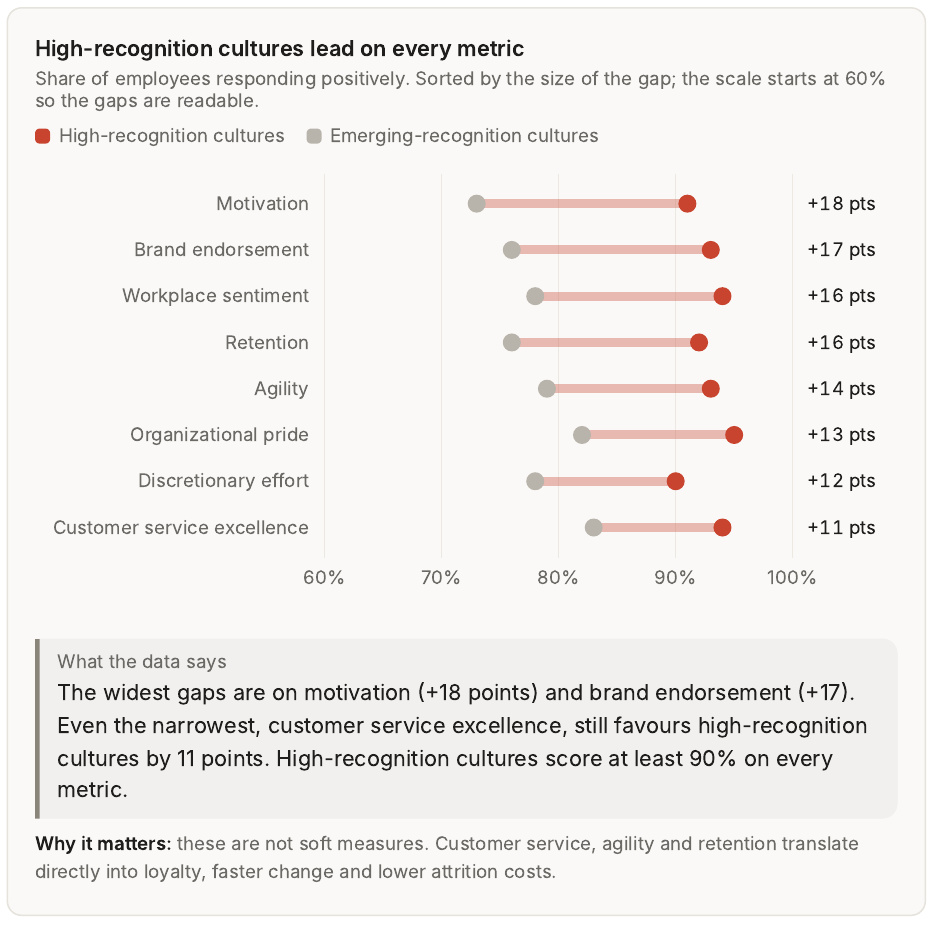
92% of employees in high-recognition cultures express intent to stay, compared with 76% in emerging-recognition cultures (The Recognition Effect, Great Place To Work India x Vantage Circle, 2025). That 16-point gap is not an engagement score. It is an early warning of who is likely to leave.
Deloitte's 2020 Global Human Capital Trends report found that 79% of organizations rated fostering a sense of belonging as important or very important to their success over the next 12 to 18 months, and 93% agreed that belonging drives organizational performance. Belonging, the sense of being valued and included, is one of the primary conditions that sustains affective commitment. When it is present, employees invest. When it is absent, even capable people disengage.
Gary Dessler argued in "How to Earn Your Employees' Commitment" (Academy of Management Executive, 1999) that committed employees show better attendance, stronger performance, and longer tenure than those who are present without being invested. The conditions that produce that outcome have not changed: people who feel their organization is genuinely invested in them are more likely to reciprocate.
Source: The Recognition Effect, Great Place To Work India x Vantage Circle, 2025
Suggested Reading: Employee Engagement Metrics: How to Track and Calculate Them
What weakens employee commitment?
McKinsey's 2021 Great Attrition research found that feeling undervalued (54% of leavers) and lacking belonging (51%) outranked compensation as reasons employees left, while managers consistently assumed pay was the primary driver. The gap between what employees needed and what employers thought they needed was the real attrition risk.
That reframe matters because it changes what HR focuses on. Five patterns come up repeatedly in exit interviews and commitment research.
- Unrecognized effort. When contributions go unacknowledged consistently, the emotional signals that sustain commitment stop arriving. Effort without acknowledgment becomes, over time, effort without purpose.
- Broken promises and unfairness. Commitments made during hiring or performance cycles that are later quietly ignored. Inconsistent application of policies. Promotions that seem arbitrary. Each instance chips away at the trust that makes affective commitment possible.
- No visible future. Employees who cannot see where the role leads and receive no development support eventually conclude the organization is not invested in them. The internal calculation shifts from "I want to stay" to "I need to, for now."
- Manager inconsistency. The direct manager is one of the most influential variables in whether an employee stays committed. Managers who recognize one quarter and go quiet the next, or who say one thing and reward another, undermine the consistency that psychological safety requires.
- Values on paper only. Steve Simpson, creator of the Unwritten Ground Rules (UGRs) framework, has observed that an organization can have extensive documentation proclaiming its culture, but if the unwritten rules governing daily behavior contradict it, the documentation counts for nothing. ("Creating a Corporate Culture for Employee Engagement: Introducing UGRs," Vantage Influencers Podcast.) The gap between the stated culture and the lived one is one of the fastest ways to erode trust.
Organizations that address low commitment through loyalty programs alone tend to find limited results. Two in three companies (67%) that targeted behavioral reinforcement through their R&R programs reported high to very high levels of effectiveness, versus less than 50% of companies that targeted loyalty or retention directly (AIRe Benchmarking Report India 2024-25, Vantage Circle). Programs built around reinforcing behavior outperform those built around retention directly, at least by employers' own measure.
How to build employee commitment: 10 practical ways
Build commitment by making people feel seen, heard, safe, and able to grow, consistently. The following 10 practical ways are not a checklist to run through once. Commitment builds in daily interactions, not in annual programs, and these conditions need to be present on an ongoing basis.
1. Recognize specific contributions, often
Recognition is not the only lever that builds commitment, but it is the most immediate and the most commonly underdone. Employees who consistently feel Appreciated, Accepted, Validated, and Accomplished, compared with those who do not, report motivation 18 points higher and intent to stay 16 points higher (State of Recognition and Rewards 2025, Vantage Circle), and the gap opens with the first signal lost.
The practice: recognize specific actions, not general effort. Name what the person did and explain why it mattered to the outcome. Peer-to-peer recognition builds the "accepted" signal. Manager recognition tied to company values builds the "validated" and "accomplished" signals. Make it regular, not an annual exercise. Start with giving recognition at work the way it actually lands.
Vantage Rewards
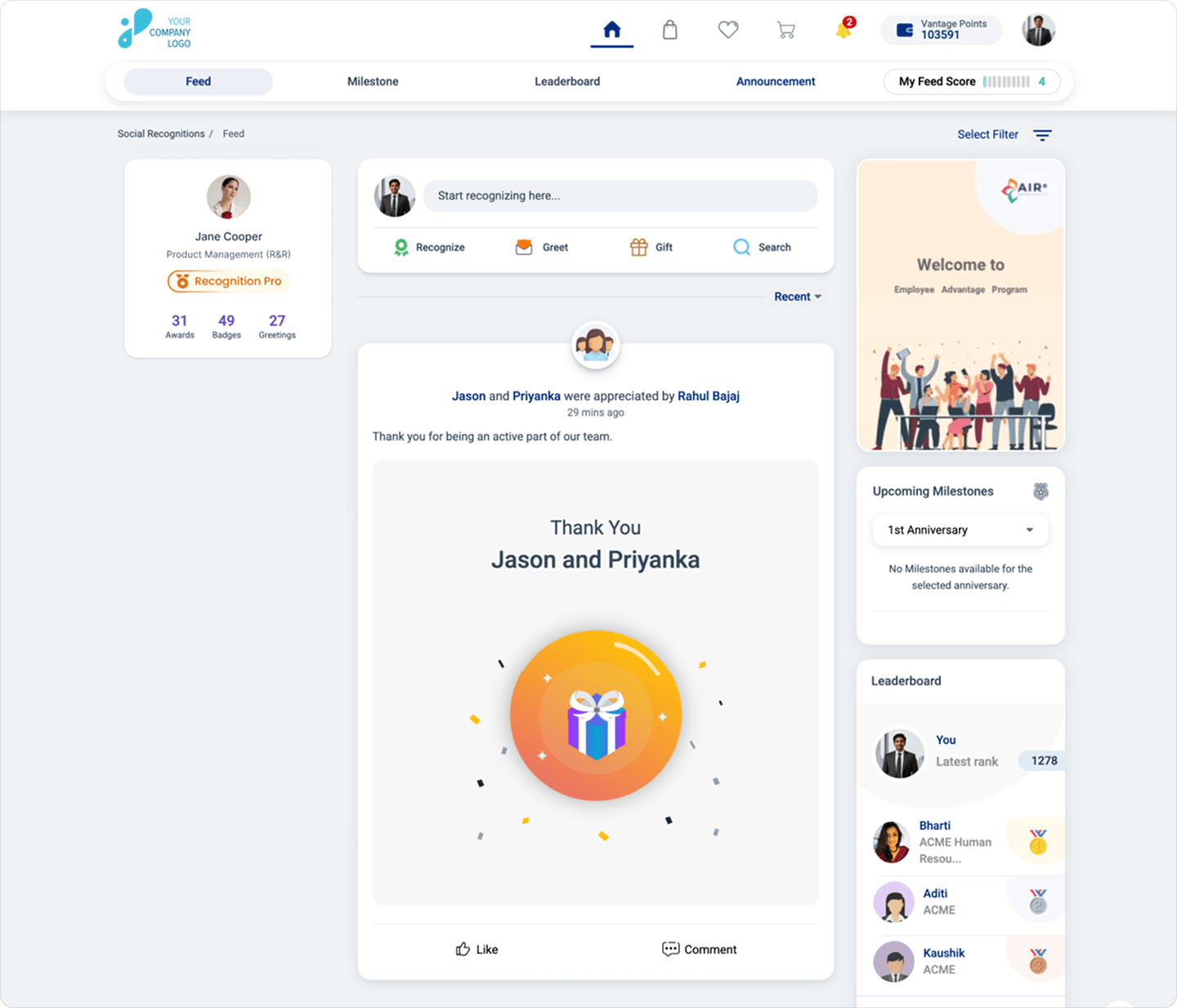
Recognize the effort behind the result, not just the result.
Peer-to-peer and manager recognition tied to company values keeps all four commitment signals active. Vantage Rewards makes it part of how work happens, not a separate HR exercise run once a year.
2. Give employees a real voice
Employees who feel heard are more likely to stay invested in outcomes. This is not about having a feedback channel. It is about closing the loop: when employees raise something and hear what happened as a result, or an honest explanation of why it could not change, they experience the validation signal that sustains commitment.
The practice: build ongoing feedback into the rhythm of the team, not just into the annual survey. Regular one-on-ones, structured check-ins, and genuine inclusion in decisions that affect the team all matter. Anonymous responses matter especially, because employees rarely tell a manager directly that something is unfair. Structuring employee voice so that it is safe and consistently acted on is what separates programs that build commitment from ones that build cynicism.
Vantage Pulse
Collect the honest feedback employees won't say out loud.
Anonymous eNPS surveys broken down by team surface the trust and fairness gaps that erode commitment long before they show up in an exit interview.
3. Make leaders live the values
Leaders who recognize behavior consistent with stated values make those values credible. Leaders who contradict them, whether by rewarding politics over performance or by tolerating poor behavior from high performers, erode trust faster than any policy can repair.
The practice: tag recognition explicitly to company values so employees can see which values are actually rewarded in practice. Audit the gap between what is published and what managers reinforce. When the two align consistently, employees have evidence that the culture is real, which is one of the most durable sources of affective commitment.
4. Be fair and transparent in decisions
Fairness in how promotions, pay decisions, and role changes are handled is a prerequisite for trust, and trust is a prerequisite for commitment. Employees do not need every decision to go their way. They need the reasoning to be honest and consistent.
The practice: communicate the rationale behind decisions that affect people's work, particularly the ones where some employees will be disappointed. Consistency in how policies are applied, across teams and levels, matters as much as the policies themselves.
5. Build trust through manager consistency
Trust at the team level is built through reliability: following through on commitments, managing the employer-employee relationship with consistency, and addressing problems while they are still manageable. Managers who are reliable on small things build the credibility to handle the large ones.
The practice: include manager behavior explicitly in engagement survey design. Trust in the workplace builds through repeated small acts of follow-through, not through quarterly speeches about culture. When a pattern of inconsistency shows up in survey data, address it as a performance issue, not a personality one.
6. Create psychological safety
Employees who feel safe raising a concern, admitting a mistake, or sharing an unfinished idea are more likely to bring discretionary effort to their work. Amy Edmondson's research on psychological safety (Administrative Science Quarterly, 1999) and Google's Project Aristotle (2016) both identified it as one of the defining conditions of high-performing teams. The logic is simple: people invest more in outcomes they feel safe enough to care about.
The practice: managers build psychological safety by modeling the behaviors they want to see, acknowledging their own errors, asking for input before announcing decisions, and responding to concerns without dismissal. It builds through repeated small moments across many interactions, not through a single workshop.
7. Show a visible future
People commit to a company when they can see themselves growing there. When career paths are unclear, development conversations do not happen, and internal mobility is rare, employees eventually conclude that staying is a holding pattern rather than a choice.
The practice: make development conversations a regular part of the manager relationship, not a once-a-year performance review item. Employee development plans, mentoring programs, and internal mobility all make the future concrete. Learning benefits make it feel accessible and within reach, not reserved for a designated high-potential cohort.
8. Start commitment at onboarding
A 2003 IES review concluded that early job experiences and long-term organizational commitment are closely linked (Robinson, IES, 2003). The conditions established in the first weeks, how welcomed, informed, and purposeful a new employee feels, shape the attachment they develop over the months that follow.
The practice: a structured induction covering the organization's values, expectations, and team context, paired with a buddy or mentor from day one, establishes commitment before an employee has had any real reason to question it. What people experience in the first 90 days tends to set their frame for the rest of their tenure.
9. Support work-life balance and wellbeing
Employees commit to organizations that treat them as whole people, not just as outputs. Flexibility and wellbeing support signal that the organization's investment extends beyond the formal role, strengthening the sense of reciprocity that sustains affective commitment.
The practice: review flexibility policies with the goal of removing unnecessary friction. Work-life integration support, including fitness and wellness programs through platforms like Vantage Fit, extends that care into daily life. The signal it sends matters as much as the benefit itself.
10. Celebrate tenure and long-term contribution
Long-term commitment deserves acknowledgment proportional to its length. Automated emails and generic certificates tell employees their tenure was logged, not that it was valued. Planned, personal milestone celebrations say something different: that staying has been noticed, and that the organization considers it worth marking.
The practice: build a long service award calendar at meaningful milestones, one, three, five, and ten years, with recognition that is thoughtful and specific to the person. A personalized milestone moment sends a different signal than a voucher dropped in an inbox.
Vantage Rewards
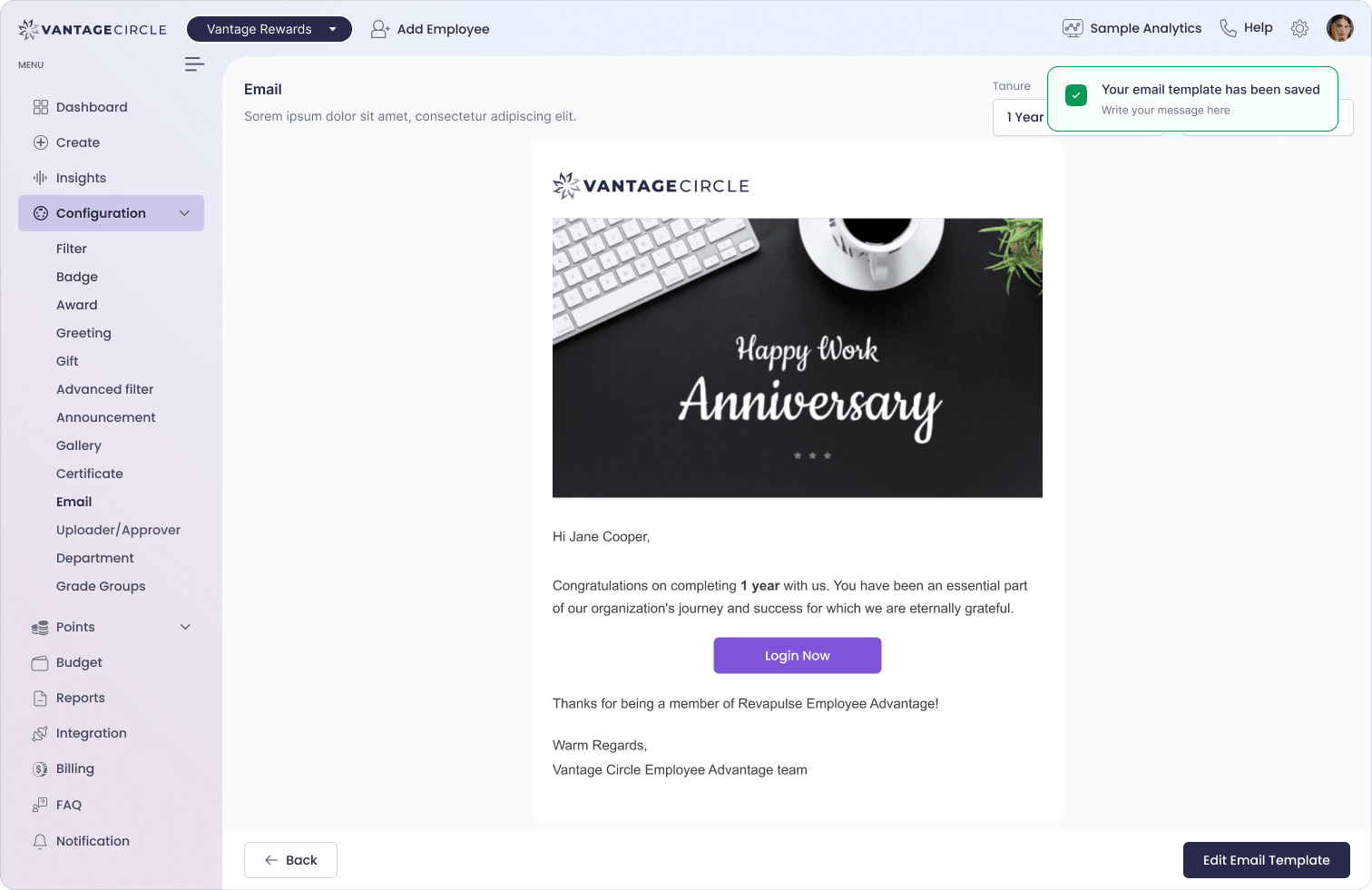
Make tenure worth celebrating, not just noting.
Long service award dashboards track upcoming milestones so managers can plan recognition that is personal and proportional, not a certificate generated by a script.
How to measure employee commitment
Measure commitment with a short, regular, anonymous survey combined with behavioral signals: voluntary turnover rate, absenteeism trends, and whether discretionary effort is visible in everyday output across teams.
The questions that most directly test commitment ask whether employees see a future for themselves at the organization, whether they would recommend it as a place to work, and whether they feel their contributions are genuinely valued. A monthly or quarterly pulse, broken down by department and manager, gives a leading indicator before the problem shows up in your annual engagement score or, worse, in a resignation. For a full 20-question template and the scoring model, see employee commitment survey questions.
Vantage Pulse
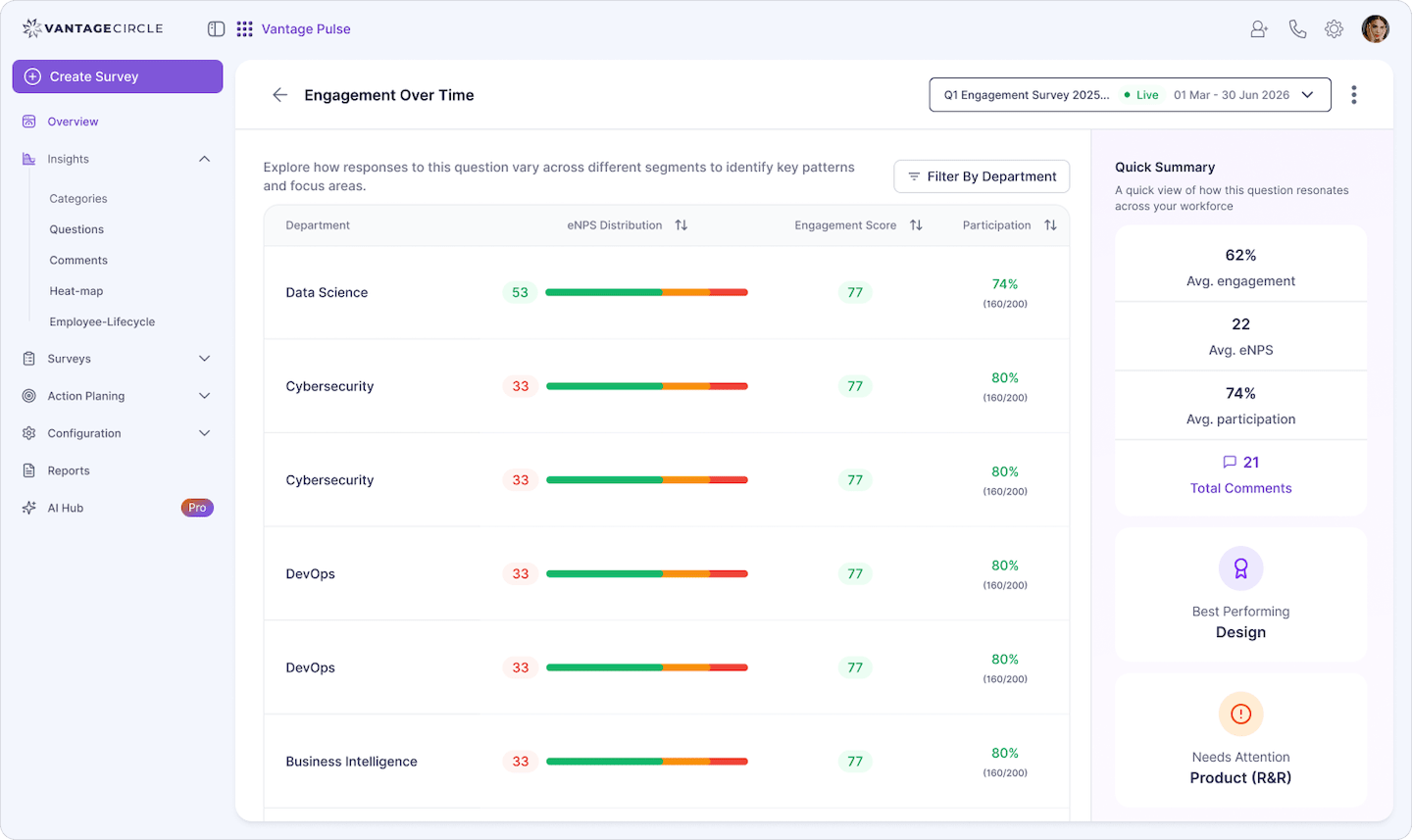
See where commitment is holding and where it is slipping, by team.
Department-wise eNPS insights give HR a leading indicator of commitment before it shows up as voluntary turnover or a flat annual engagement score.
Conclusion
Joey Price, CEO of Jumpstart:HR, puts it plainly: every effective team needs two things, competency and commitment. ("The Importance of Team Engagement in Startups," Vantage Influencers Podcast.) Skills without commitment produce average output. Commitment without skills produces effort without direction. Both matter, and building commitment is the part that is within an organization's control.
The organizations that sustain it do not rely on a single initiative. They make people feel seen through consistent, specific recognition. They make people feel heard by closing the loop on feedback. They make the future visible through development and internal mobility. And they make belonging real by matching what they publish about their culture with how managers actually behave day to day. Done consistently, that combination turns employees who happen to be present into employees who genuinely contribute.
Frequently Asked Questions
How to demonstrate commitment in the workplace?
Through behavior: following through without prompting, raising concerns early, supporting teammates when it is not your job, and staying productive when conditions are difficult.
What are some examples of commitment at work?
Volunteering outside your role, flagging problems early, learning independently, representing the organization well externally, and recognizing colleagues. The full 12 are in the section above.
What is a good example of commitment for a job interview?
Name a specific situation, what you did, and the outcome. "I flagged a quality issue before a client delivery and we caught it in time" lands better than a general statement.
What are the four types of commitment?
Affective (want to stay), continuance (need to stay), and normative (feel obligated to stay) are Meyer and Allen's three. A fourth, occupational commitment, describes attachment to a career field rather than a specific employer.
How does ethics contribute to employee commitment?
Consistent, fair behavior builds the trust that sustains affective commitment. A single visible instance of unfairness, one political promotion, one policy applied inconsistently, can erode years of it.

Supriya is a Content Marketing Lead at Vantage Circle, where she writes on employee engagement, recognition, workplace communication, and culture. She spent the earlier part of her career in corporate communications at Burson, ESPN Star Sports, and CBRE, advising organizations on the messages employees actually hear.
Connect with Supriya on LinkedIn.