
57% of Wipro's associates received recognition last fiscal year. That is a workforce of 230,000 people across 66 countries, running on one program called Winners' Circle.
Most large companies cannot produce that number for their own workforce. Not because the answer would be embarrassing. Because nobody measures it. A program gets launched, a few visible teams adopt it, and what share of the company it actually reached is never asked.
So it looks healthy in the teams using it, and invisible everywhere else.
That share has a name. Coverage. It is the difference between a recognition program and a recognition announcement.
Below are 18 employee recognition and appreciation ideas for large companies, grouped by the layer of the organization that owns them. At scale, the hard question is rarely which idea to run. It is who runs it, on what budget, and how you know it worked.
Why Recognition Breaks Down at Scale
Recognition breaks down in large companies for three structural reasons. Budget authority fragments across business units, managers recognize at wildly different rates with no visibility into the variance, and a large share of the workforce has no corporate email address to receive recognition through.
None of these are motivation problems. They are design problems.
Budget fragments. In a 20,000-person company, recognition budget rarely sits in one place. Each business unit holds a slice. Some units spend it in the first quarter. Others never touch it. HR finds out at year end, when the reporting arrives and half the organization has been running on nothing.
Manager variance is invisible. Two managers with identical teams can differ by a factor of ten in how often they recognize people. Nobody notices, because there is no report that shows it. The employees notice. They just do not raise it.
A large share of your people have no inbox. Between 60% and 70% of manufacturing and logistics workforces have no corporate email and no laptop, based on Vantage Circle's sector deployment data across those industries. If your recognition program runs on email and an intranet, those employees are not underserved. They are structurally excluded.
This is the recognition gap that scale creates. And it explains why so many enterprise programs report healthy engagement numbers from the teams that adopted them, while the majority of the company never sees a single recognition moment.
A recognition program that reaches 20% of your workforce is not a small success. It is a fairness problem with a budget attached.
What Good Recognition Coverage Looks Like at Enterprise Scale
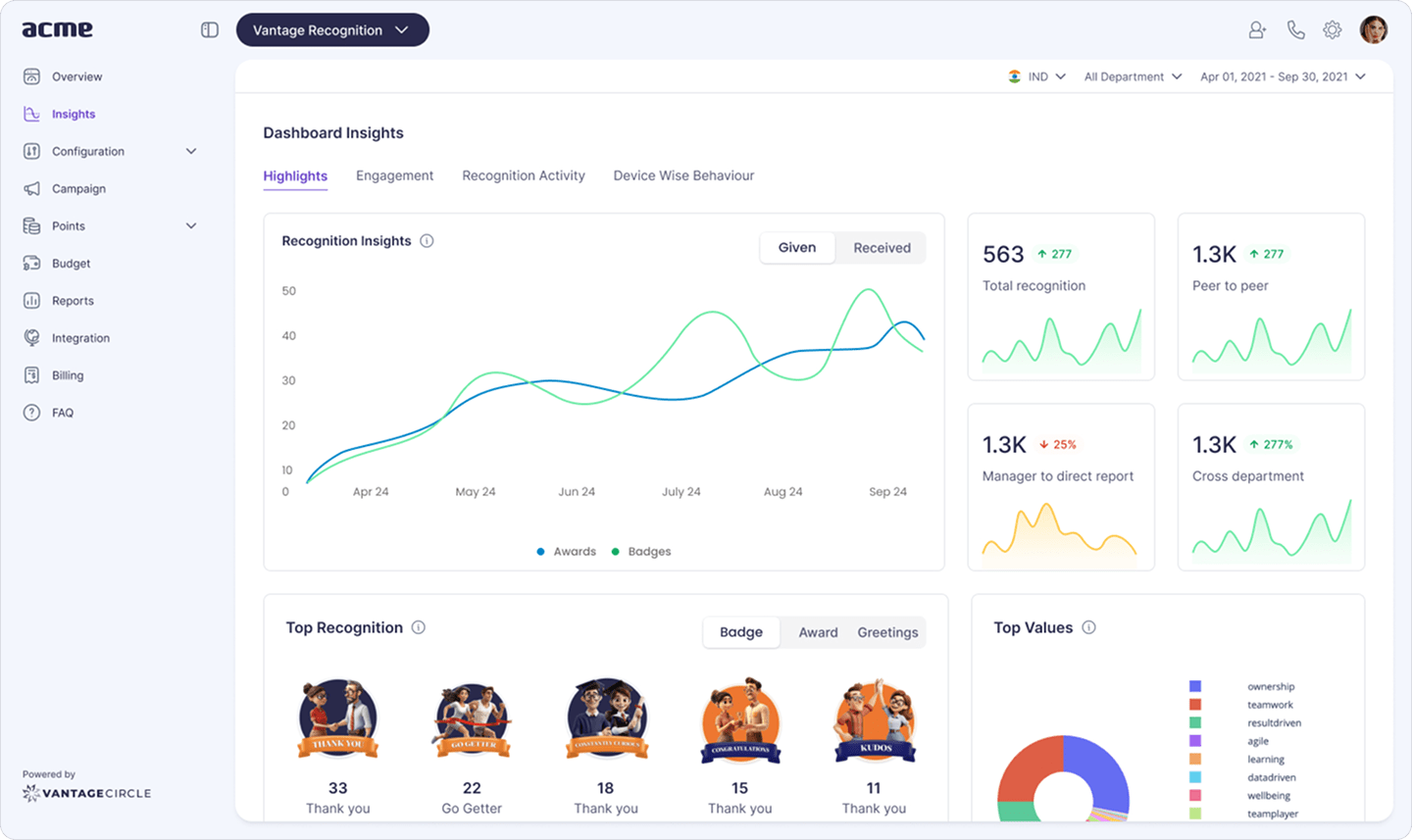
At enterprise scale, the real measure of a recognition program is coverage. That means the share of your workforce that actually receives recognition in a given cycle. Programs that work reach somewhere between 55% and 93% of employees annually. Programs that fail concentrate recognition among a visible minority.
Most published recognition advice never puts a number on this. So here is what coverage looks like in five large-company programs Vantage Circle has run, arranged from 5,000 employees to 230,000.
| Company | Workforce | Program | Coverage and participation | Recognition volume |
|---|---|---|---|---|
| Wipro | 230,000+ across 66 countries | Winners' Circle | 57% of associates recognized in the last fiscal year | One recognition every 1.2 minutes in 2023 |
| L&T Technology Services | 23,800 professionals | ROAR | 93% of registered employees actively participated; 83% of active users received recognition in 2023-24 | 78,000+ recognition moments in two years |
| Tata Motors | 19,000+ | Accolades | 88% of registered employees actively engage with the platform | 85,000+ recognition moments in three years |
| Tata Communications | 10,000+ across 190 countries | Applause | 134% increase in active platform users | One recognition every two minutes in FY 2024-25 |
| DHL | 5,000+ across five countries | GSC Rewards & Recognition | 74% of registered employees participated; 60% of active users recognized in 2023-24 | 7,100+ recognition moments in 2023-24 |
Two things stand out.
First, scale does not cap coverage. LTTS reached 93% participation across 23,800 professionals. DHL reached 74% across five countries. Size is not the constraint people assume it is.
Second, volume compounds once coverage is real. Tata Communications saw a 185% surge in peer-to-peer non-monetary recognition and a 26% increase in managerial monetary recognition over a five-year period. That is what happens when recognition stops being an annual event and becomes something people do on a Tuesday.
Can you tell your board what percentage of your employees received recognition last quarter? If the answer is no, that number is almost certainly lower than you think.
For wider context on how recognition correlates with retention and motivation across industries, the employee recognition statistics worth tracking are collected separately.
18 Employee Recognition and Appreciation Ideas for Large Companies
The 18 ideas below are grouped by the organizational layer that owns them. At scale, the question is rarely which idea to run. It is who is accountable for running it, and whether that layer has the budget and visibility to sustain it.
Many of these build on general employee recognition ideas that work at any company size. What changes above 5,000 people is ownership, budget and reach.
Enterprise-Wide Recognition Ideas (1 to 5)
Enterprise-wide ideas are the ones HR owns directly. They set the ceiling for what recognition means in your company, and they are the only ideas that reach every employee regardless of which manager they report to.
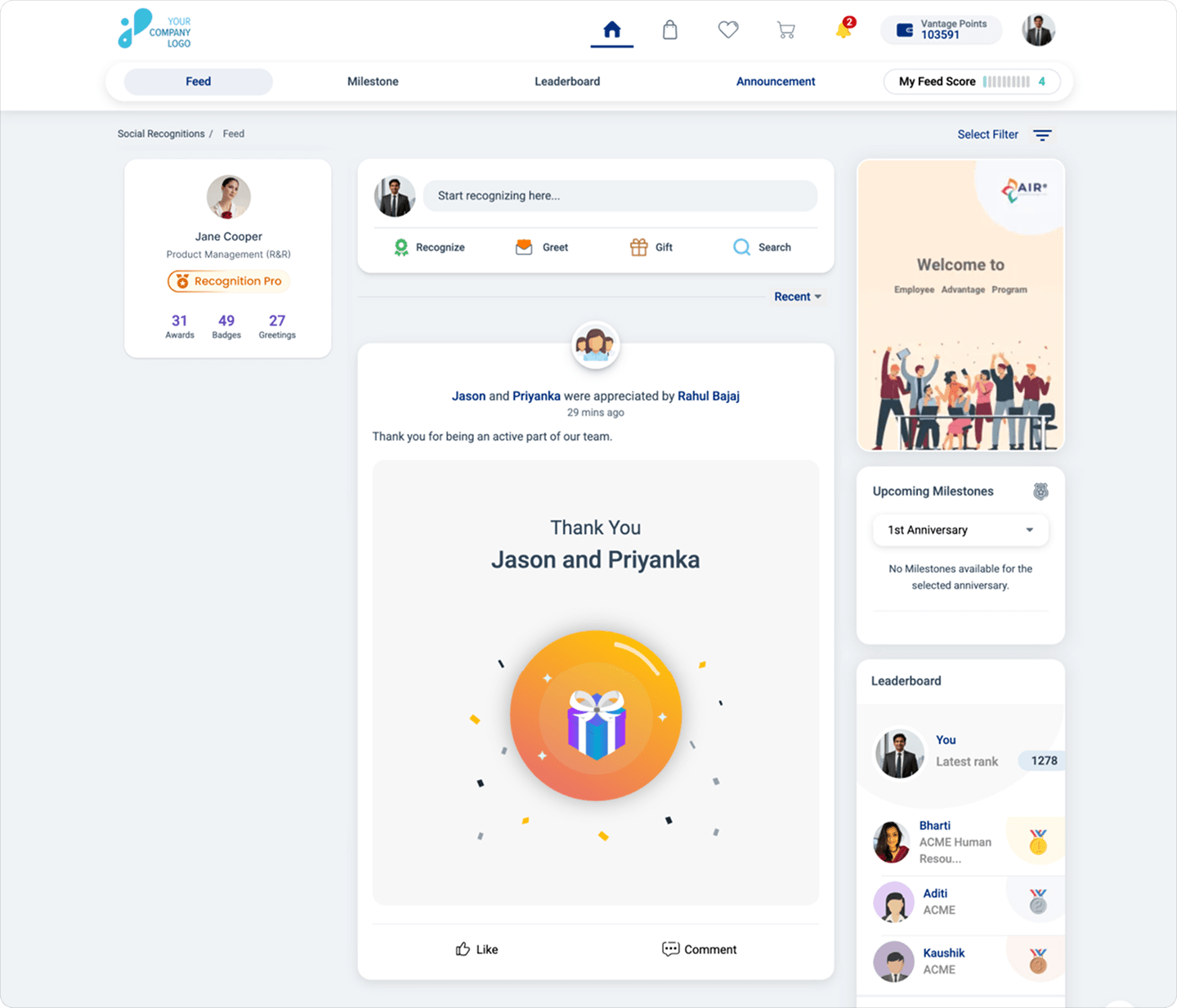
1. A company-wide recognition feed. A single feed where recognition is visible beyond the recipient's own team does something a manager cannot. It lets an engineer in Pune see work happening in Guadalajara. This is the backbone of social recognition at scale, and it is usually the first thing to build. Pair it with a regular employee spotlight so individual contributions get the depth a short feed post cannot carry.
2. Values-based award categories. Tie every award to a named company value. Tata Motors used this to embed core values like bold action, ownership, collaboration and empathy into daily work. Without it, recognition drifts toward popularity.
3. Automated long service awards. At 20,000 employees, work anniversaries do not arrive evenly. They cluster around campus intakes and fiscal-year starts, so a single date can carry hundreds of them. Automating milestone recognition against hire dates is the difference between a program that celebrates tenure and one that forgets it.
4. An annual recognition campaign calendar. Plan recognition moments across the year the way you plan a product roadmap. Appreciation weeks, quarterly award cycles, values campaigns. Publish the calendar so business units can align to it.
5. Executive-led recognition moments. When the CEO recognizes someone publicly, it signals what the company rewards more clearly than any policy document. Tata Communications built its entire program around leaders modeling daily recognition, and earned a Brandon Hall Gold award for it.
Business-Unit and Regional Appreciation Ideas (6 to 9)
Business-unit ideas solve the problem that a single global program cannot account for local context. A recognition moment that lands in Bengaluru may fall flat in Rotterdam. These four ideas push ownership down without losing consistency.
6. Unit-level award budgets. Give each business unit a defined recognition pool rather than drawing from a central fund. It makes spend predictable and stops one aggressive unit exhausting the pool by March.
7. Regional celebration calendars. Respect local holidays and cultural moments. LTTS named this explicitly as a challenge, managing recognition across diverse cultures, time zones and preferences. The fix is not one global calendar. It is a shared framework with regional flexibility.
8. Business-unit leaderboards. Publish recognition activity by unit, not by individual. It creates useful peer pressure at the leadership level without turning employees into competitors.
9. Cross-unit nomination exchanges. Let teams nominate people outside their own reporting line. This surfaces the coordination work that is invisible inside a single org chart, and it is often the most under-recognized work in a large company.
Getting the structure right across units is largely a question of program design. The mechanics of building a recognition program that holds together across a complex organization are worth working through before you scale any of these.
Manager-Led Recognition Ideas (10 to 13)
Manager-led ideas address the largest single source of variance in enterprise recognition. Two teams under the same VP can have completely different recognition experiences, and the only way to fix that is to make manager behavior visible and budgeted.
10. A defined recognition budget per manager. Not a request process. A pool each manager can spend without approval. Approval queues are where spontaneous recognition goes to die.
11. Values-tagged spot awards. Give managers a fast way to recognize something the same week it happened. Speed matters more than size. A small award on Tuesday beats a large one next quarter.
12. Recognition prompts inside one-on-ones. Build the question into the meeting template. "Who on the team did something worth calling out this month?" Most managers do not skip recognition deliberately. They just never get prompted.
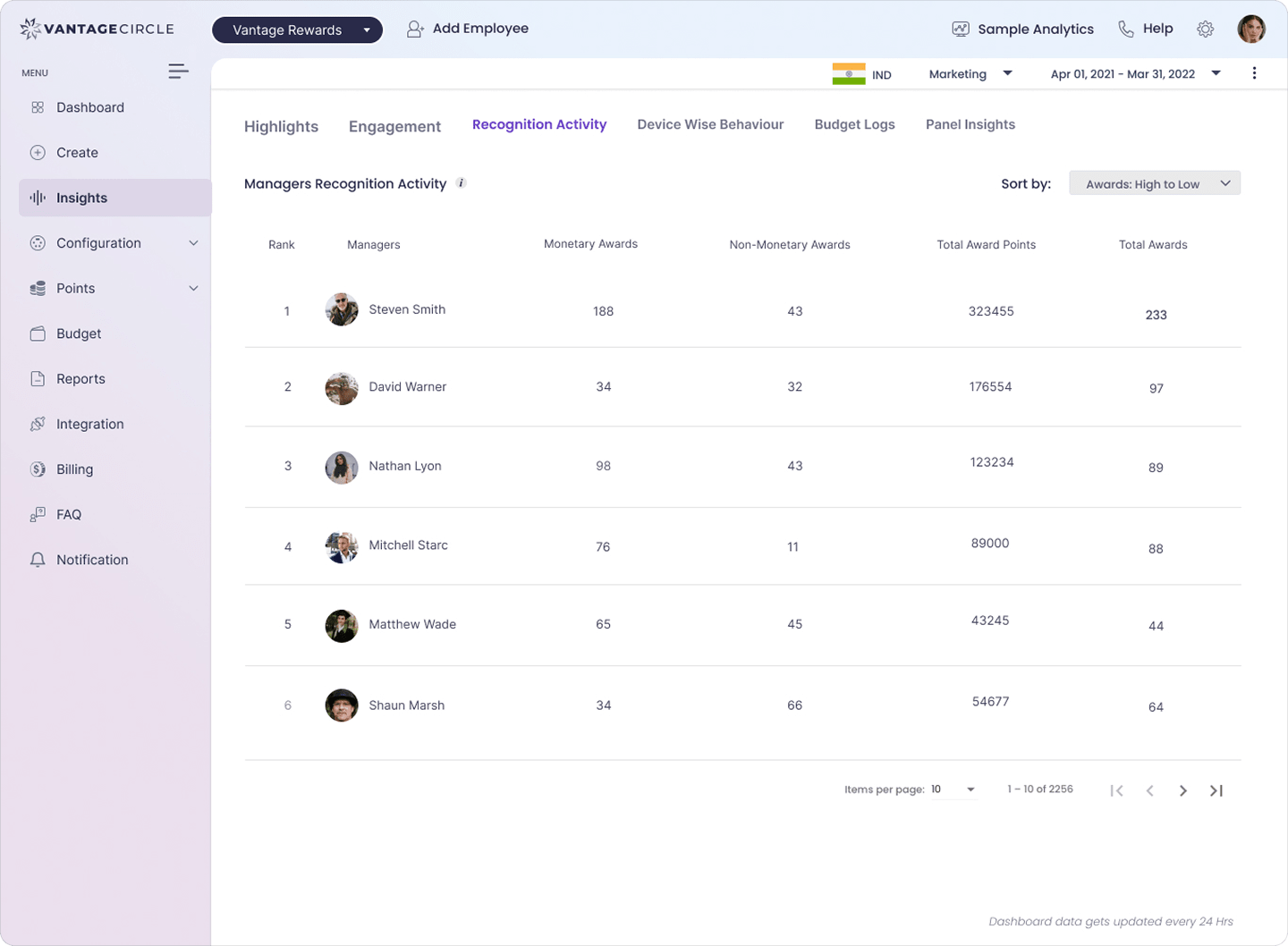
13. Manager participation scorecards. Report recognition activity by manager and by team. This is the single most useful report HR can run, because it converts an invisible fairness problem into a visible management one.
Peer-to-Peer Appreciation Ideas (14 to 16)
Peer ideas are what generate volume at scale. Manager-led recognition is bounded by how many managers you have. Peer recognition is bounded only by headcount, which is why it is the fastest route to real coverage.
14. Open peer nomination. Let any employee recognize any colleague without routing through a manager. Tata Communications saw peer-to-peer non-monetary recognition surge 185% once this was in place.
15. A digital kudos wall. A shared space for lightweight appreciation. Not every recognition moment needs a monetary award attached. Many of the most meaningful ones do not. Setting up a recognition board gives casual appreciation somewhere to live.
16. Peer points allocation. Give every employee a small monthly allowance of points to award to colleagues. It distributes recognition authority across the whole company instead of concentrating it in management.
The design choices behind peer-to-peer recognition matter more at 20,000 people than at 200, because the failure modes are harder to spot and slower to correct.
Frontline and Deskless Recognition Ideas (17 and 18)
Frontline ideas exist because most recognition advice silently assumes a desk. If 60% to 70% of your workforce has no corporate email, the ideas above reach a minority of your company no matter how well you execute them.
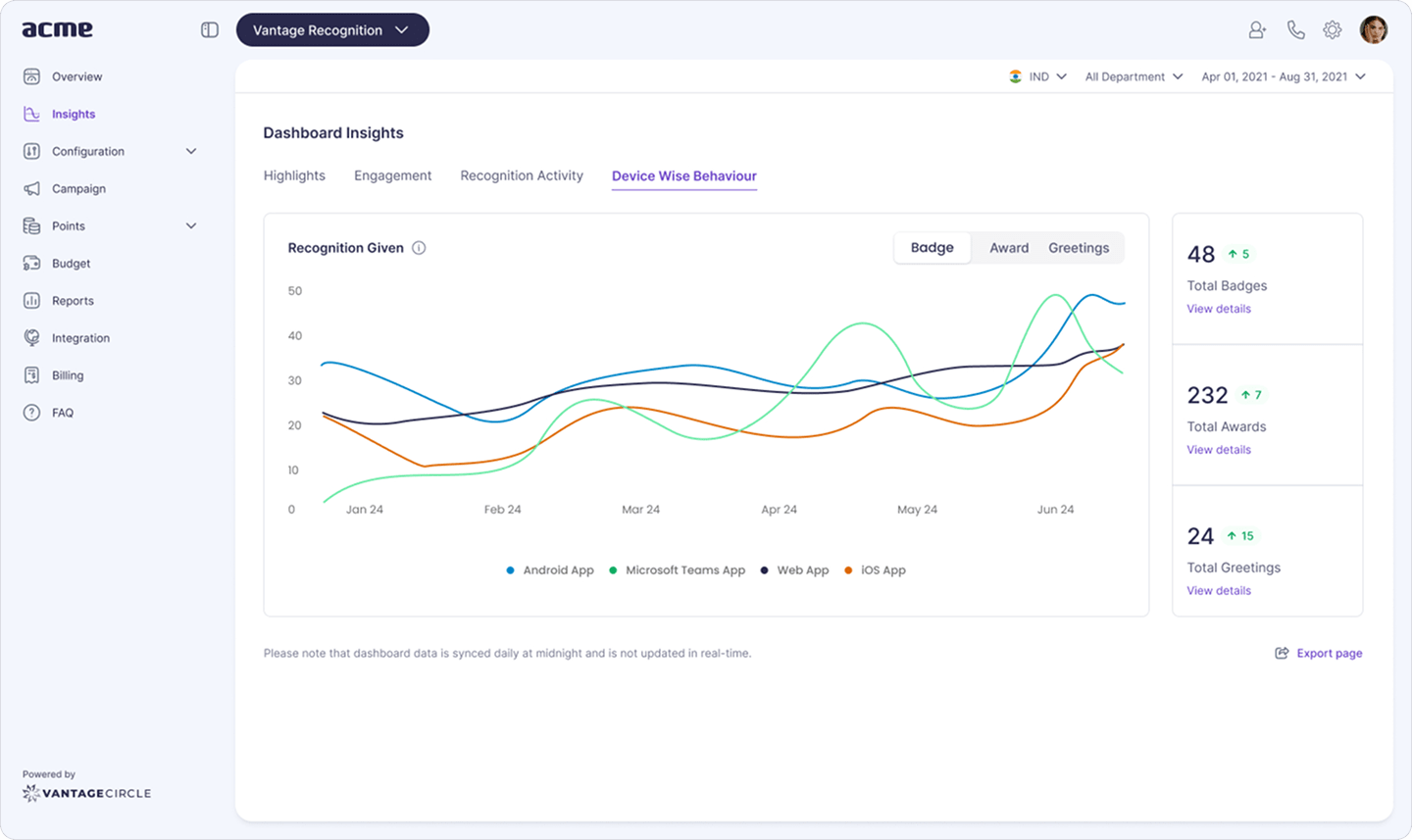
17. Mobile and kiosk-based recognition. Recognition that works on a personal phone, a shared shop-floor tablet or a kiosk. The delivery mechanism is the entire problem for frontline teams. Solve it and the rest of the program follows.
18. Physical recognition cards for shop floor and warehouse. A printed card a supervisor can hand over on shift, carrying a code that redeems digitally. It bridges a workforce that has no inbox but does have a phone at home.
DHL built its program around exactly this constraint. Limited reach to offline workers was one of its four stated challenges, alongside inefficient manual processes and equity concerns. The program that followed reached 74% of registered employees across five countries.
Before choosing any idea from this list, count how many of your employees have a company email address. That number decides which half of this list is actually available to you.
How to Run Recognition Across Business Units Without Losing Fairness
Running recognition fairly across business units requires three controls. One platform every employee can reach, recognition tied to named company values rather than manager discretion, and budget allocated per unit with spend visible to HR in real time.
Fairness at scale is not a sentiment. It is an audit question. And it was the challenge named most often by the enterprises in the table above. Tata Motors listed eliminating bias and ensuring transparency as core objectives. DHL listed equity across levels, regions and employee segments.
Here is how the common risks map to controls.
| Risk at scale | Control | What to measure |
|---|---|---|
| Recognition concentrates in headquarters | Publish coverage by location, not just company-wide | Coverage percentage per site |
| One unit exhausts the shared budget | Ring-fenced budget per business unit | Spend against allocation, by unit, monthly |
| The same people win repeatedly | Cap repeat awards per cycle; track distribution skew | Share of total recognition going to the top 10% of recipients |
| Managers apply different standards | Values-tagged awards with defined criteria | Manager participation rate by team |
| Frontline teams are structurally excluded | Mobile and offline recognition channels | Coverage percentage for non-desk roles specifically |
The pattern across all five rows is the same. Every fairness risk becomes manageable the moment it becomes measurable. Before that, it is just a complaint nobody can act on.
How to Budget Recognition at Scale
Budgeting recognition at scale means moving from a single central fund to allocated pools with visible spend. The three decisions that matter are how much sits with each manager, who can release it without approval, and what happens to unspent budget at year end.
Start with per-employee allocation rather than a total figure. A total budget tells you nothing about whether coverage is achievable. A per-employee figure tells you immediately whether your program can reach everyone or only a subset.
Then push spend authority down. Recognition that requires two approvals is not recognition. It is a procurement process. Managers need a pool they can draw on the same week something happens.
Finally, decide the year-end rule before the year starts. Use-it-or-lose-it drives a December spike that devalues the awards. Full rollover means some units never spend. A partial rollover cap usually lands in the right place.
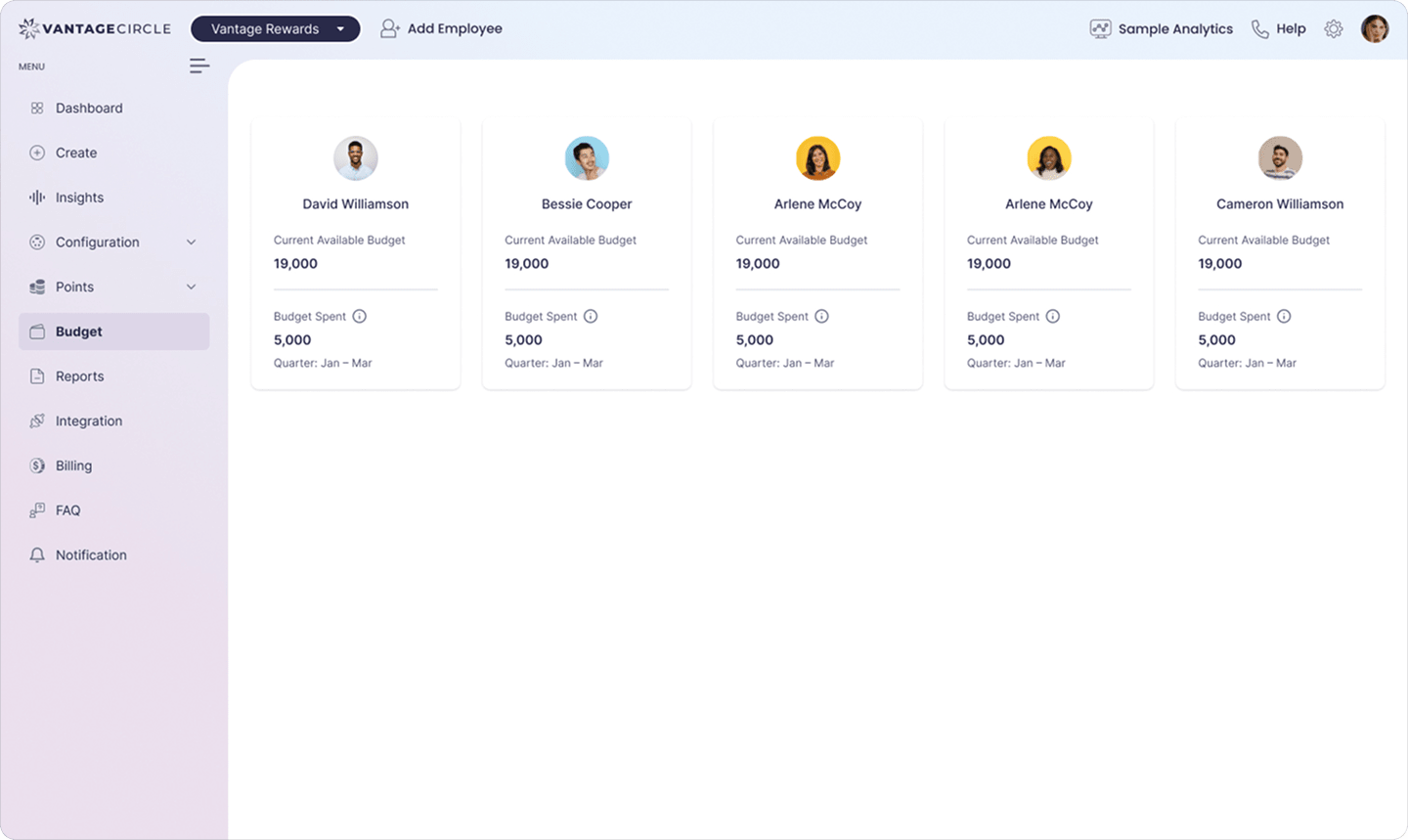
The specifics of sizing the pool are worth a closer look, and the benchmarks for setting an employee recognition budget will tell you whether your current number is in range.
How to Measure Whether Recognition is Reaching Everyone
Measure enterprise recognition with four numbers. Coverage as a percentage of headcount recognized per quarter, recognition frequency per employee, manager participation rate by unit, and distribution skew showing how much recognition goes to your top decile of recipients.
Most recognition dashboards report total awards given. That number always looks healthy and tells you almost nothing. Ten thousand awards across 20,000 employees could mean half your company was recognized once, or it could mean 800 people were recognized twelve times each.
| Metric | Definition | What healthy looks like | Where it comes from |
|---|---|---|---|
| Coverage | Share of total headcount that received recognition in the period | 55% to 93% annually, based on the enterprise programs above | Recognition platform, matched against HRIS headcount |
| Frequency | Average recognition moments per recognized employee | Roughly three awards per employee over two years at Wipro scale | Recognition platform |
| Manager participation | Share of people managers who gave recognition in the period | Tracked by unit; flag any unit below the company median | Manager recognition report |
| Distribution skew | Share of all recognition going to the top 10% of recipients | Falling quarter on quarter | Recognition analytics |
Pair these with sentiment data. Recognition analytics tell you what happened. Employee listening tells you whether it landed. Vantage Pulse, Vantage Circle's employee engagement and pulse survey tool, compares sentiment at the department level, which is how you spot a unit where recognition is technically running but not being felt.
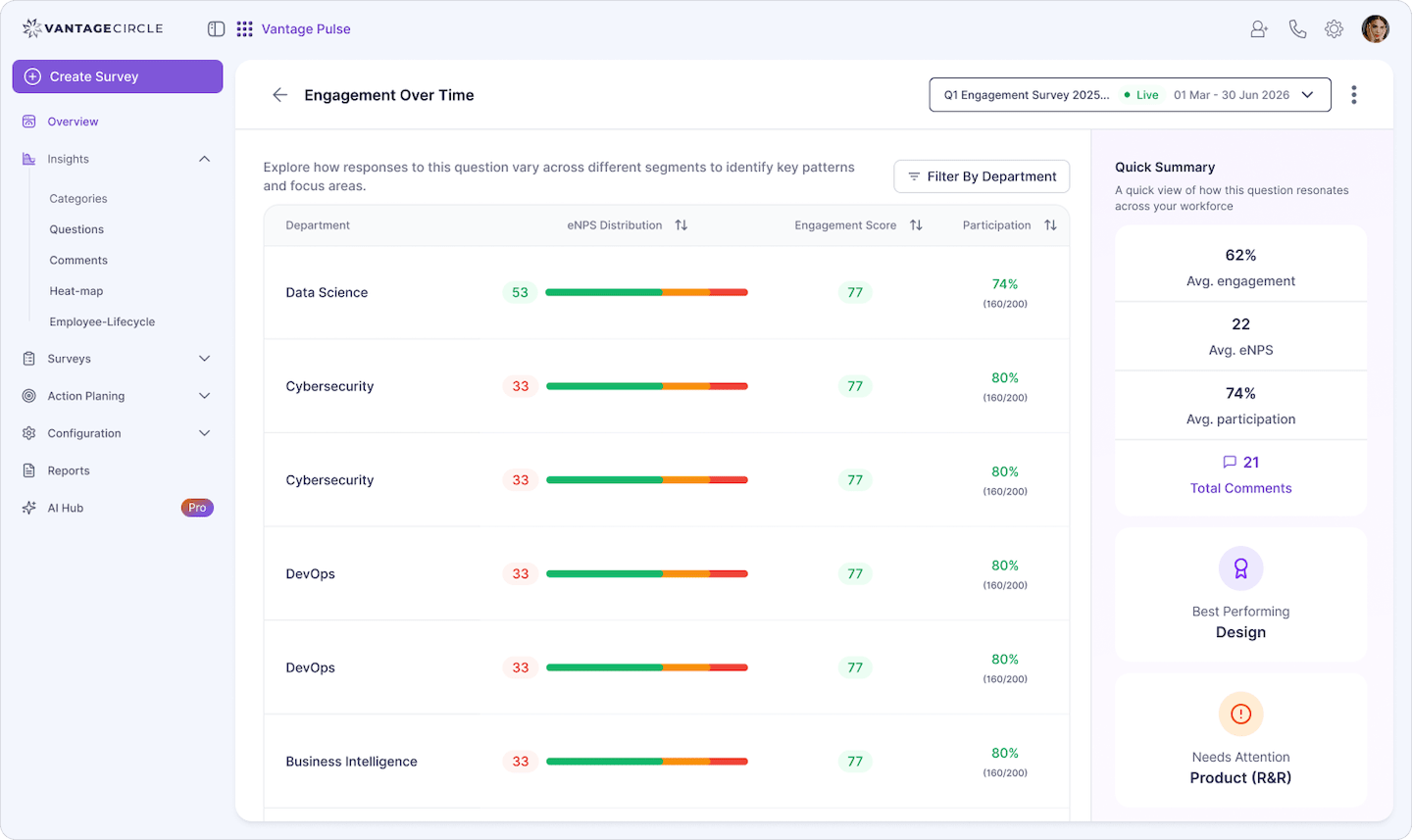
If you want to see what these ideas look like written out as actual recognition moments, the employee recognition examples collected separately cover the wording and the context.
Free Download · 4-Page Worksheet
The Enterprise Recognition Program Worksheet
Seven decisions that turn a recognition idea into a funded, measurable program you can report to your board.
- Coverage benchmarks from five enterprise programs, 5,000 to 230,000 employees
- Fill-in worksheets for reach, budget allocation and manager participation
- Four measurement metrics and a 90-day rollout plan

4 pages · Free
Vantage Recognition, Vantage Circle's employee recognition platform, is built around exactly this problem set. A company-wide social feed, peer-to-peer recognition, manager budgets and coverage analytics in one place, with offline channels for frontline teams. That combination is what made the coverage numbers in the benchmark table possible. For a structured read on how mature your current program is, the AIRe Assessment scores recognition programs against a behavioral science framework rather than a feature checklist.
Book a demo to see how coverage reporting works across business units.
Summing It Up
Recognition in a large company is not harder because the company is large. It is harder because scale hides the failure. A program can look healthy in the teams that adopted it while never reaching the majority of your workforce.
Coverage is the number that exposes this. The enterprises in this post reached between 57% and 93% of their people, across workforces from 5,000 to 230,000. Those results came from structure, not enthusiasm. Allocated budgets, visible manager participation, peer recognition that does not queue behind approval, and channels that reach people without an inbox.
Pick the ideas that match the layer of your organization that will own them. Then measure coverage every quarter and report it the way you would report attrition.
If you are working with a smaller headcount, many of these controls are overbuilt. The recognition ideas for smaller teams are a better starting point.
FAQ
What are good employee recognition ideas?
Good employee recognition ideas are specific, timely and tied to a named behavior or company value. The strongest ones at any company size include peer-to-peer recognition, values-based spot awards from managers, public recognition in a company-wide feed, automated milestone and long service awards, and executive-led recognition moments. What separates a good idea from a forgettable one is speed. Recognition given the same week it was earned carries far more weight than a larger award delivered a quarter later.
How to reward a large group of employees?
Rewarding a large group of employees requires three things: a single platform every employee can access including those without corporate email, recognition budget allocated per business unit rather than held centrally, and awards tied to defined criteria so standards stay consistent across managers. Distribute the authority to recognize rather than routing everything through HR. Peer recognition and manager spot awards scale with headcount. Centralized approval processes do not.
What are appreciation ideas for big teams?
Appreciation ideas that work for big teams include team-level awards that recognize collective outcomes, cross-team nomination programs that surface coordination work, business-unit leaderboards, shared kudos walls, and regional celebration calendars that respect local holidays. The key difference from small-team appreciation is ownership. In a big team, appreciation needs a named owner and a budget, otherwise it depends entirely on whether an individual manager remembers.
What are some ideas for corporate recognition awards?
Corporate recognition awards typically fall into four categories. Performance awards tied to measurable outcomes, values awards tied to named company behaviors, milestone awards for tenure and career progression, and peer-nominated awards that recognize contribution outside the formal reporting line. Large companies get the best results by running all four rather than choosing one, because each category catches contributions the others miss.
What are some fun employee recognition awards?
Fun employee recognition awards work when they stay specific rather than generic. Examples include awards for the best solution to a difficult customer problem, recognition for the colleague most people go to for help, awards for the best internal knowledge share, and team awards for projects that shipped under difficult conditions. The risk with fun awards is that they drift into popularity contests. Tying each one to an actual contribution keeps them credible.
What are some unique employee awards?
Unique employee awards are ones built around your specific company values rather than borrowed from a generic list. The most effective approach is to name awards after the behaviors your organization actually needs more of, then let employees nominate against those named behaviors. Companies that do this well treat the award catalog as something they revise annually, retiring categories that no longer reflect priorities and adding new ones as the business changes.

Nilotpal M Saharia is an Assistant Manager, Content Marketing at Vantage Circle and a recognition-and-rewards (R&R) strategist with 9 years of experience spanning Marketing, HR, and content strategy. He helps HR leaders turn employee recognition and leadership research into practical workplace programs.
Connect with Nilotpal on LinkedIn.