"For the things we have to learn before we can do them, we learn by doing them," Aristotle stated in the Nicomachean Ethics around 350 BC.
Experiential learning in the workplace means employees build skills by doing real or realistic work, then reflecting on what happened and applying the lesson next time. It turns training into practice: role-plays, simulations, stretch projects and on-the-job coaching, followed by a deliberate debrief.
This guide covers the model behind it, 10 workplace examples, and how learning and development (L&D) teams can make a new skill stick.
What Is Experiential Learning in the Workplace?
The model comes from psychologist David A. Kolb, whose 1984 book built on the work of John Dewey, Kurt Lewin and Jean Piaget. The book is called Experiential Learning: Experience as the Source of Learning and Development. Kolb's experiential learning model turned their ideas into a four-stage cycle, which you'll find below.
The difference from classroom training is where the learning happens and what counts as success:
| Classroom training | Experiential learning |
|---|---|
| Information is delivered by a trainer or a slide deck | Employees practice on real or realistic work |
| Learners listen, take notes and take a quiz | Learners act, reflect and try again |
| Success is a completed course | Success is a changed behavior on the job |
Because the learning happens in the flow of work, experiential learning fits naturally with continuous learning rather than a one-off course.
Kolb's Experiential Learning Cycle: The 4 Stages
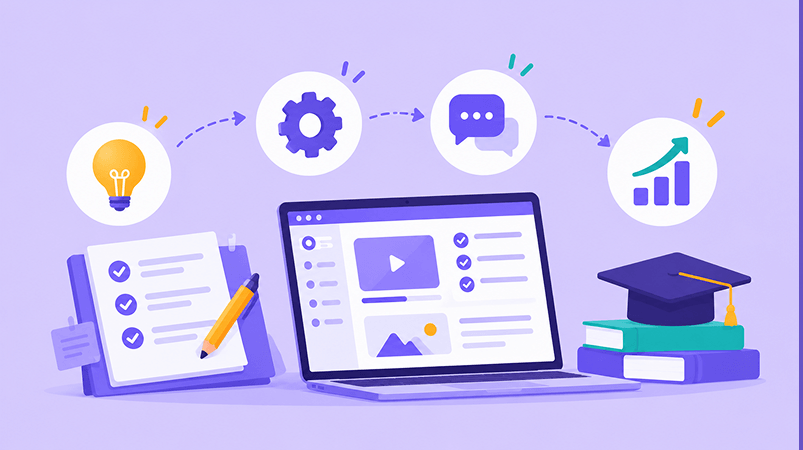
Kolb's cycle has 4 stages: concrete experience, reflective observation, abstract conceptualization and active experimentation. Learners move through them in order, and the last stage leads into a new experience.
"Learning is the process whereby knowledge is created through the transformation of experience" (Kolb, 1984, p. 38).
Here is what each stage looks like in practice:
| Stage | What happens | Workplace example |
|---|---|---|
| Concrete experience | The employee does a real or realistic task, such as a live project, a role-play or a simulation | A new hire leads a client meeting, or a team runs a practice drill |
| Reflective observation | The employee looks back and notices the gap between what they expected and what happened | The employee and a coach review the activity and note what worked and what did not |
| Abstract conceptualization | The employee turns the reflection into a lesson that applies beyond this one situation | The employee works out why it went that way and writes down a rule to reuse |
| Active experimentation | The employee tests the lesson in a new situation, which becomes the next experience | The employee applies the rule in the next similar situation and checks the result |
A Note on Kolb's Learning Styles
Kolb also described four learning styles, but matching training to a person's preferred style has not been shown to improve learning. Pashler and colleagues' 2008 review found the evidence for that approach weak. A better use of the idea is to offer several ways to practice, such as hands-on tasks, discussion and reflection, so every employee gets more than one route to the skill.
What Is the 70-20-10 Rule for Learning?
The 70-20-10 model says that roughly 70% of development comes from challenging on-the-job experience, 20% from other people, and 10% from formal training. Researchers Morgan McCall, Michael Lombardo and Robert Eichinger developed the 70-20-10 model in the 1980s while working with the Center for Creative Leadership (CCL), a nonprofit leadership research and education institution.
Treat the percentages as a rule of thumb. They summarize how successful managers described their own learning and are not an exact formula to hit. Experiential learning covers the 70 and a good part of the 20, which is why the model is a useful way to plan it:
- 70% experience: stretch assignments, job rotation and real projects.
- 20% other people: coaching, mentoring and peer feedback.
- 10% formal training: courses, workshops and e-learning.
In practice, plan the experience first, then the coaching around it, then the course that fills any gap. You can build all three parts into each employee development plan.
Benefits of Experiential Learning
The main benefits of experiential learning:
- Engagement: employees control how they practice and get feedback as they go, so they stay involved.
- Skills that transfer: they try the task before they need it, so they meet the real situation having already made their first mistakes.
- Independent thinking: coaches guide people instead of handing over answers, so learners work out their own solutions.
- Feedback while it counts: debriefs and coaching give people feedback straight after they act, when they can still use it.
10 Experiential Learning Examples in the Workplace
Effective workplace examples put people into real or realistic work and then debrief it. Each of the 10 examples below builds a stage of Kolb's cycle, and the table at the end gives a debrief question for each one.
1. Expert-Led On-the-Job Knowledge Transfer
In expert-led knowledge transfer, an experienced colleague teaches a skill while the learner does the real work. During India's 5G rollout, Ericsson brought in 5G specialists from other countries to work next to local teams on live deployments.
When you have people sitting next to you who've done that and they're teaching it to you on the job … it just accelerates the pace of learning for the people who are learning it for the first time.
Anand describes it as a two-way win: the visiting experts also got to work on a scale of 5G deployment they had not seen before. The approach, Anand says, led to record-breaking deployment, higher engagement and stronger retention, as explained in the Vantage HR Influencers Podcast episode Upskilling: Fuelling India's Tech Evolution. To copy the approach, pair a specialist with a learner on a live task and schedule a short debrief afterward.
2. Role-Playing
Role-playing lets employees practice a difficult conversation with a colleague before it happens for real. A client service manager can play the customer, or a manager can play an employee to hear how a certain way of speaking lands. It gives people a safe setting to make mistakes, get feedback and try again, which builds confidence. A good scenario to start with is active listening, and it also fits team-building activities.
3. Simulations and VR
Simulations recreate real-world challenges in a controlled setting, so employees can make mistakes without real consequences. They can be software-based, role-based or immersive virtual reality (VR). Jessie Osborne, Vice President, Global Learning and Development at AML RightSource, says the team uses VR and simulation for leadership training.
I would say the simulation training is probably one of the things that really gains people's attention. It keeps them engaged and they are able to apply it in a more meaningful way when they leave the training.
Osborne also cautions that game-style tools do not suit everyone. On gamification, Osborne says that "not all employees really care for it. They want to get the information quickly and then apply it." Use simulations where mistakes are costly, and keep a quick, practical option for people who want to learn and apply right away. Listen to Reimagining L&D: Bridging Gaps and Embracing Innovation for the full answer.
4. Gamified On-the-Job Challenges
Gamified challenges turn real work targets into a structured, time-boxed competition. Dr. Ujjal Sengupta, Deputy General Manager, Human Resources at Reliance Jio, says the learning happens on the job, with people learning from peers while working toward their targets.
It has to get linked with the KPIs, that is first and foremost. If it is not linked with the KPIs, it doesn't make any differences.
Sengupta adds that rewards matter too, and that without an incentive for people it will never work. The episode Unlocking Productivity in Large Workforces Through Gamified Learning covers it in more depth. For more on the approach, see our guide to gamification in the workplace.
5. Case Studies
Give a small group a real past event, such as a missed deadline or an unhappy client, and ask what they would do before revealing what actually happened. Comparing their answers with the real outcome is where people learn.
6. Stretch Assignments and Job Rotation
Stretch assignments and job rotation hand employees real work just beyond their current skills, such as leading a project for the first time or covering another role for a few weeks. They work best when a manager sets a clear goal and checks in along the way.
7. Mentoring and Shadowing
In mentoring and shadowing, employees learn by working alongside someone more experienced. A new hire might sit in on a client meeting and then talk through the choices with the senior colleague afterward. That after-meeting conversation is the "20" in 70-20-10.
8. Lunch and Learns Led by Employees
A lunch and learn is a short session where an employee shares a skill, a story or a lesson with colleagues. The topic can be a project that went well or one that failed. The colleague who hosts is teaching, so recognize them as well as the attendees. Peer-to-peer recognition makes that easy and helps you find the next volunteer.
9. Volunteering and Skills-Based Projects
In skills-based volunteering, employees practice a skill on a real project outside their usual role. An analyst might build a budget for a nonprofit, or a manager might lead a community project. The learning comes from practicing the skill and reflecting on it afterward, and the community benefits too.
10. Blended Learning Paths
Blended learning paths combine courses, assessments and hands-on practice, so employees get theory beside experience. Ganesh Iyer, Global Head, Learning and Development at IBS Software, says the team offers e-learning, classroom training and experiential options.
There are a set of people who like to learn in a very, very different way. They want more of an experiential learning. And for that, we create an environment like a hackathon or a coding challenge kind of environment.
IBS Software combines the approaches in Personalizing Learning at Scale with Assessments and Impact Metrics.
Which Kolb Stage Does Each Example Build?
Use this table to plan the debrief for each activity.
| Activity | Kolb stage it builds | One debrief question |
|---|---|---|
| 1. Expert-led on-the-job knowledge transfer | Concrete experience | What did the expert do that you would not have tried? |
| 2. Role-playing | Concrete experience | What did you say that worked, and what would you change? |
| 3. Simulations and VR | Active experimentation | Which decision would you make differently next time? |
| 4. Gamified on-the-job challenges | Active experimentation | What did you try that moved your target number? |
| 5. Case studies | Abstract conceptualization | Which lesson from this case applies to our team? |
| 6. Stretch assignments and job rotation | Concrete experience | What was hardest, and what did it teach you? |
| 7. Mentoring and shadowing | Reflective observation | What did you notice that a manual could not have taught you? |
| 8. Lunch and learns led by employees | Reflective observation | What surprised you in what a colleague shared? |
| 9. Volunteering and skills-based projects | Active experimentation | Which skill did you use in a new way, and what happened? |
| 10. Blended learning paths | Abstract conceptualization | Which part of the course helped you explain what you saw in practice? |
Pair these with a wider employee training program.
How to Make Experiential Learning Stick: Debrief, Recognize, Repeat
A new skill sticks when people reflect on it straight away and get recognized the first few times they use it on the job. Without that follow-up, a good experience fades into a one-off event.
Debrief While the Experience Is Fresh
A good debrief is short and asks three questions.
Three debrief questions
- What happened?
- What did you learn?
- What will you do differently?
Ask them right after the activity, in a small group or one-on-one. The table above gives an extra question for each of the 10 examples.
Recognize the Behavior, Not Just the Result
Recognize the new behavior the first time you see it, and not only the outcome it produces. A result can take months to show up, but the behavior is visible today.
A badge for the first time someone runs the new process solo turns a training moment into a visible milestone. It tells the learner, and their peers, that the skill is now part of how the team works. You can set up skill badges like these in Vantage Recognition. Explore skill badges.
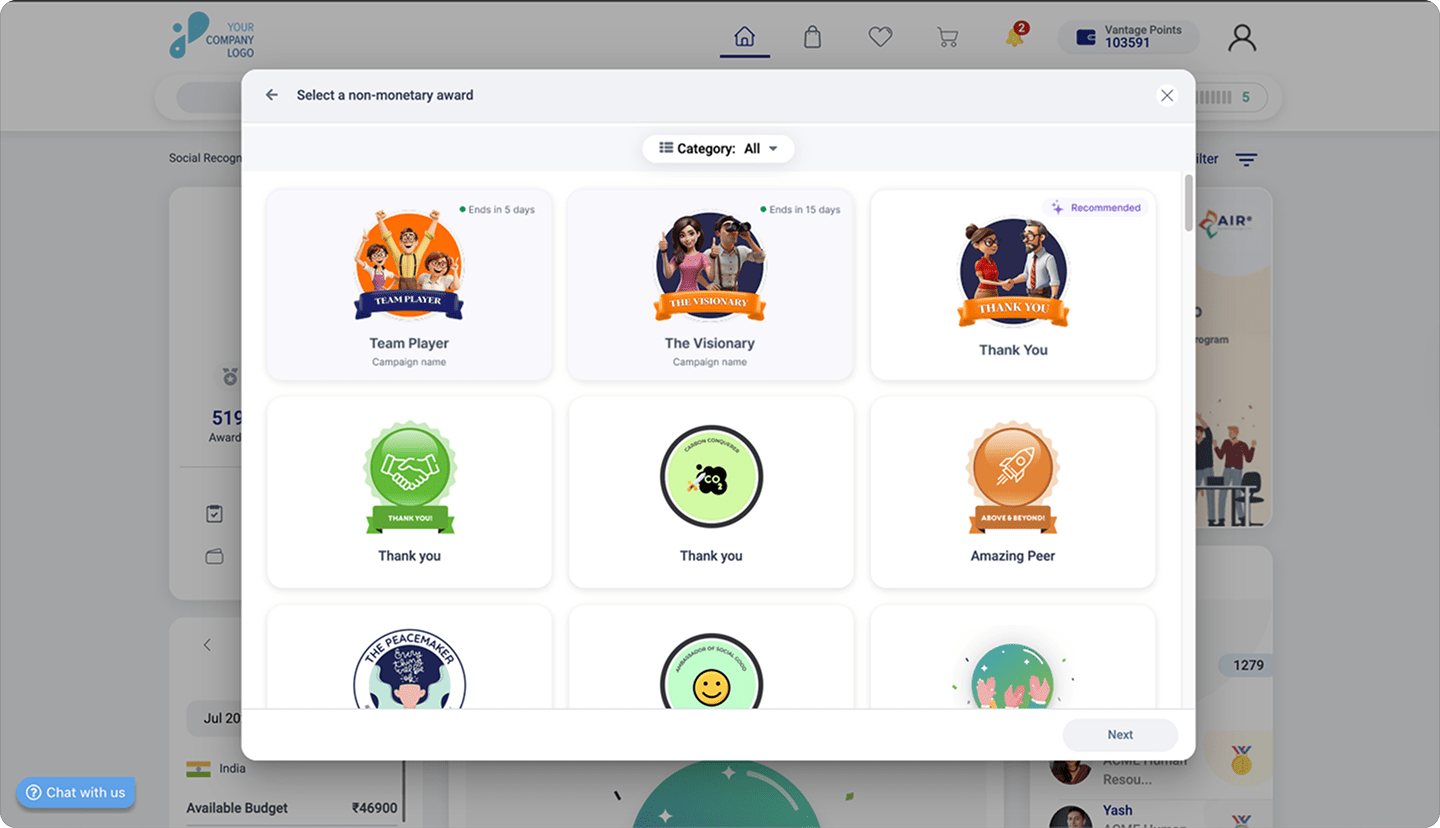
Source: Vantage Circle, Vantage Recognition badge catalog
Certificates still matter for formal milestones, like finishing a stretch assignment or a mentoring cycle. Pair them with a public note about what the person actually did.
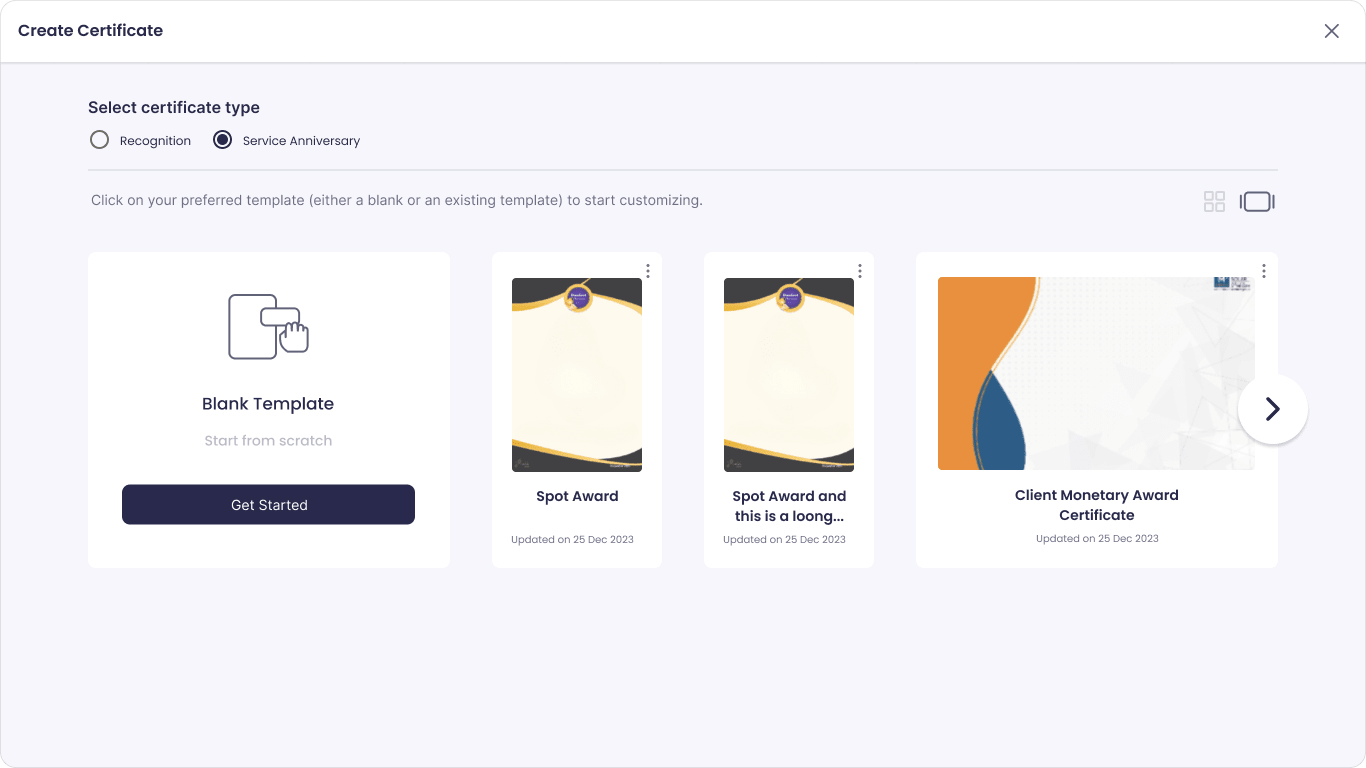
Source: Vantage Circle, Vantage Recognition certificates
Repeat: Keep Noticing It All Year
Keep noticing the skill after the first win. Recognition can happen any day of the year, so you have many chances to reinforce it. Make it easy to recognize it in the moment, while the learning is still fresh.
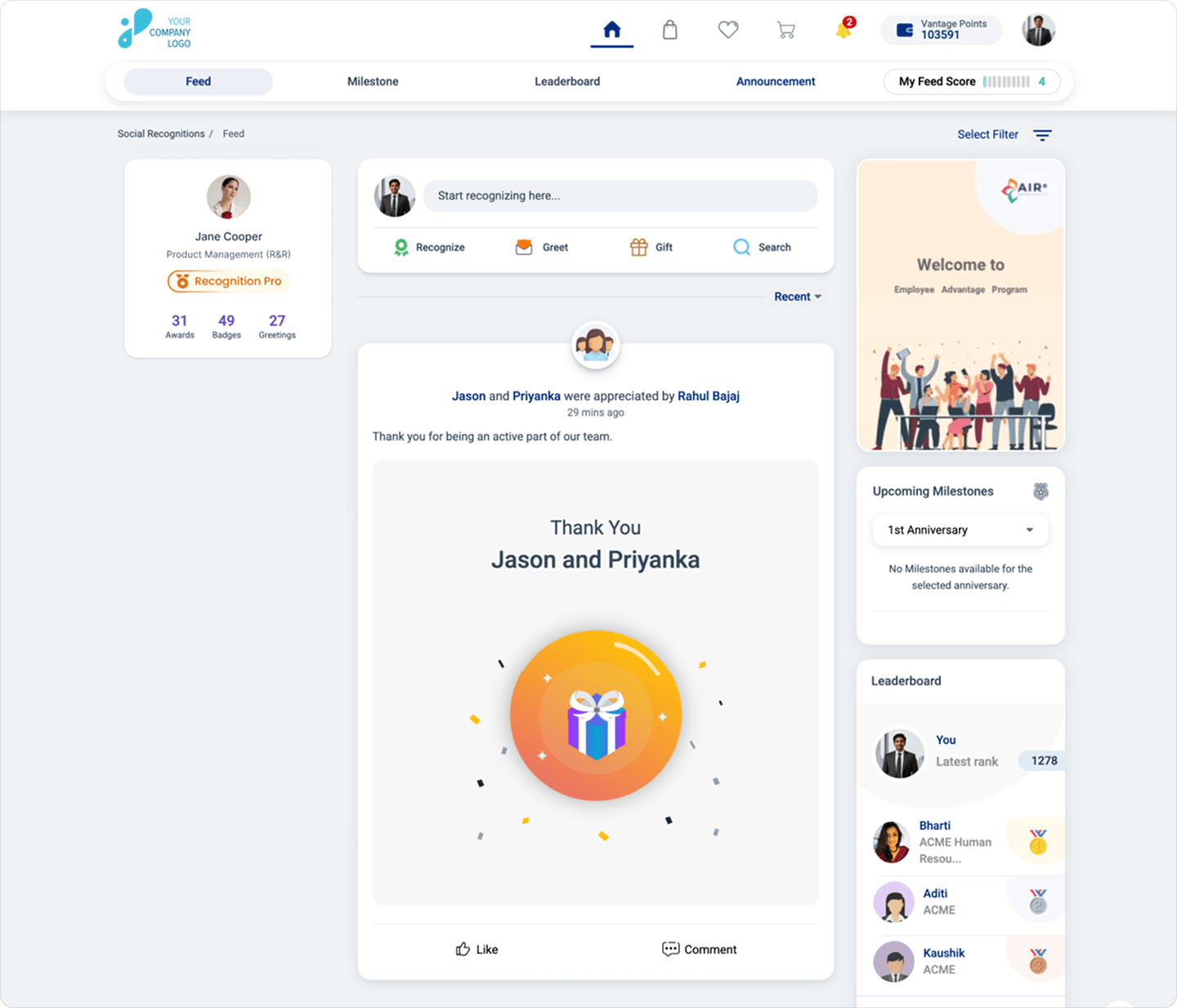
Source: Vantage Circle, Vantage Recognition social feed
How to Measure Whether Experiential Learning Worked
Measure behavior on the job, not just course completion. The Kirkpatrick model gives L&D teams four levels to check:
- Reaction: Did people find the activity useful?
- Learning: What did they learn?
- Behavior: What do they do differently on the job?
- Results: What effect does it have on the business?
Completion reports mostly show reaction and learning. Behavior and results show whether the experience changed anything. To measure them, send a two-question pulse survey after each activity: was it useful, and have you used it since? Then add a manager check-in at 30 days to see whether the new skill is in use. Our list of training effectiveness survey questions is a good place to start.
You can run these surveys in Vantage Pulse, which also reads the sentiment in the answers. Try Vantage Pulse.
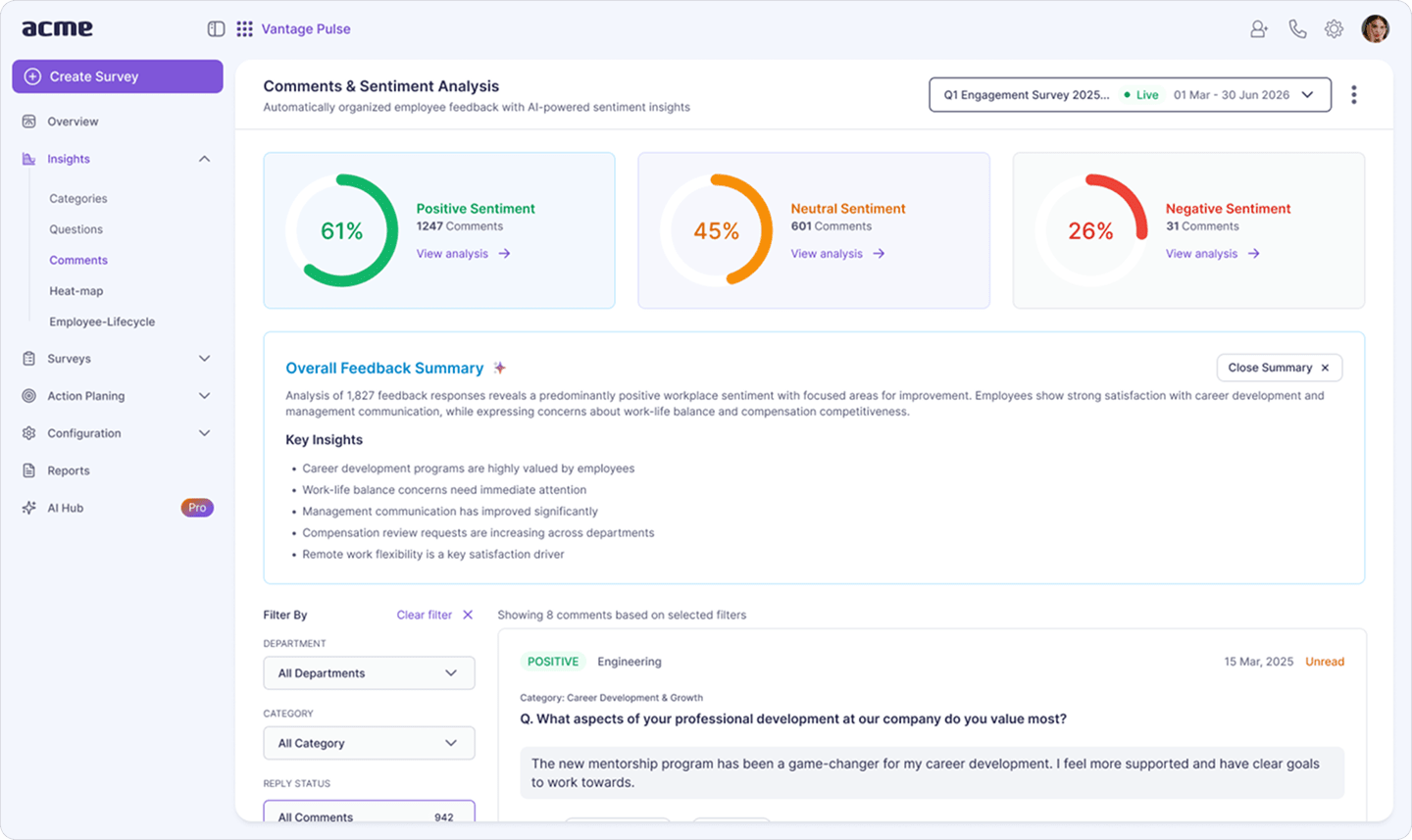
Source: Vantage Circle, Vantage Pulse sentiment analysis
Conclusion
Experiential learning works when the experience is followed by reflection and the new behavior is noticed. Start with one activity from the list, debrief it, and recognize the first person who uses the new skill on the job. Then repeat.
Key takeaways
- Kolb's cycle has 4 stages: concrete experience, reflective observation, abstract conceptualization and active experimentation.
- Debrief right after each activity with three questions: what happened, what did you learn, and what will you do differently.
- Recognize the new behavior early and often so it sticks.
Frequently Asked Questions
1. Can you give me an example of experiential learning?
Yes. During India's 5G rollout, Ericsson brought in experts from other countries to teach local teams on live deployments. Role-plays, simulations, stretch assignments and mentoring work the same way: real or realistic work, then a debrief. The 10 examples above show more.
2. What is the 70-20-10 rule for learning?
The 70-20-10 model is a rule of thumb for splitting development between on-the-job experience, other people and formal training. It is not an exact formula. The section above shows how to use it.
3. What are the 5 principles of experiential learning?
There is no single official list of five. The Association for Experiential Education publishes 12 principles of practice. The first five are: carefully chosen experiences paired with reflection and analysis, learner initiative and accountability for results, active questioning and experimenting, engagement of the whole person, and personal results that shape future learning.
4. What is John Dewey's experiential learning theory?
John Dewey argued in Experience and Education (1938) that education should be based on the quality of experience. Two principles define an educational experience: continuity, meaning it grows out of earlier experiences and leads to later ones, and interaction, meaning it meets the learner's needs and goals. Experiences that stop or distort later growth are mis-educative, and those without reflection leave nothing lasting. Experiential education has a summary of his ideas.
5. What are the six pillars of experiential learning?
There is no single standard set of six pillars. The phrase is used for several different frameworks, so check which source a list comes from before you rely on it. For workplace learning, Kolb's four-stage cycle and the principles of practice above are better-documented starting points.

Susmita Sarma is a Digital Marketer at Vantage Circle, making employee recognition less of a checkbox and more meaningful - helping organizations say we value our people and truly mean it.
Connect with Susmita on LinkedIn.