Ask a company if it cares about its people and the answer is almost always yes. Ask if people leave each year healthier, more skilled and more secure than when they joined, and the room tends to go quiet.
Human sustainability is the degree to which an organization creates value for people as human beings, leaving them with better health, stronger skills and a stronger sense of belonging and purpose (Deloitte, 2024). For HR, it means people leave each year, and eventually the company, better off than they arrived. It is the people pillar of sustainability in HR.
Most leaders agree it matters. In the same Deloitte research, 81% of executives call human sustainability very or critically important, yet only 12% say they are leading on it.
What Is Human Sustainability?
Human sustainability is how much value an organization creates for people as human beings. Deloitte's definition goes past health to include stronger skills, good jobs with sustainable wages, opportunities for advancement, and greater belonging, equity and purpose.
The idea is a simple reversal. Instead of asking what the company can extract from people, ask what people take away from the company. The numbers show how far most organizations are from that shift:
- 79% of executives in Deloitte's skills-based organization research say their organization has a responsibility to create value for workers as human beings and for society.
- 81% say human sustainability is very or critically important.
- Only 12% say they are leading in this area.
- Only about a quarter of workers (27%) say their employer is making progress in creating value for them.
- Only 43% of workers say their organization has left them better off than when they started.
That gap between belief and delivery is the reason this topic needs an operating plan, not another slogan.
Where does it sit? Some frameworks, such as this Open University course material, list human sustainability as one of four pillars of sustainability, alongside social, economic and environmental. It also overlaps with the S in ESG (environmental, social and governance), the part that covers how a company treats people. And in day-to-day HR terms, it is the long view of employee experience: not how a Tuesday feels, but where years of work leave a person.
Human vs People vs Workforce Sustainability
Human sustainability, people sustainability and workforce sustainability describe the same idea, and none of them has a single owner. "Human sustainability" is the term Deloitte uses in its 2024 Global Human Capital Trends. "People sustainability" appears in a World Economic Forum article from Davos 2023 on the benefits of a people-first approach. "Workforce sustainability" is used loosely, and we did not find a single origin for it.
Whichever term your leadership uses, the work underneath is the same.
What Is Sustainability in HR?
Sustainability in HR, also called sustainable human resource management (HRM), means running people practices so they protect people, the planet and long-term business health at the same time. Human sustainability is its people pillar, and the one HR controls most directly.
HR teams are already doing more of this than they might realize. Recognition and rewards (R&R) programs are a good example.
89% of companies now use R&R programs to reinforce behaviors and shape culture, and three in four (74%) extend this to DE&I and sustainability-related behaviors, according to The State of Recognition & Rewards 2025 (Vantage Circle).
When a company tags recognition to values such as sustainability and inclusion, a policy on a slide becomes a visible behavior on someone's profile. Value-tied badges in a recognition platform work this way: they turn a value into a daily signal rather than an annual reminder.
Sustainable HRM works through three lenses:
- People. This is human sustainability: health, skills, security, belonging and purpose. It is where HR has the most direct control.
- Planet. This is Green HRM, the environmental side of HR practice. Paperless onboarding, commuting policies and hybrid-work choices all sit here.
- Profit. This is long-term workforce capability over short-term output. A team run flat out for a quarter is not a profitable team over three years.

Green HRM deserves one paragraph and no more here, because it is a different job from the one this guide covers. If your question is how to run a greener office, our guide to sustainable workplace practices goes deeper, and these CSR activities give employees concrete ways to give back.

One boundary to keep clear: if you want employees to take part in your environmental goals, see our guide to engaging employees in sustainability. This guide is about sustaining the employees themselves.
The 5 Dimensions of Human Sustainability
Human sustainability has 5 dimensions: health, skills and employability, economic security, belonging, and purpose. A workforce is sustained when all five improve over time, not just one.
Deloitte's definition lists more items, including advancement and equity. We group them into five so HR can assign each one an owner and a measure. Advancement sits under skills and employability, and equity sits under belonging.
| Dimension | What it means | What HR does | How to measure it |
|---|---|---|---|
| Health and well-being | People finish the year with energy left | Wellbeing programs, workload visibility, burnout early warning | Exhaustion themes in open-text feedback, absence trends |
| Skills and employability | People are more employable after a year with you | Learning budgets, internal mobility, career paths | Internal promotion rate, learning hours completed |
| Economic security | Pay and benefits people can plan a life around | Benefits design, financial wellness support, pay benchmarking | Benefits uptake, financial-stress pulse questions |
| Belonging and connection | People feel seen and included | Peer recognition, inclusion work, manager training | Recognition reach by team and level, belonging pulse score |
| Purpose | People see what their work changes, and for whom | Connect roles to outcomes, values-based recognition | Purpose and meaning pulse questions, eNPS |
Health and Well-being
Health is the dimension that erodes first and most quietly. Nobody resigns in the week they start feeling worn down. They keep working, a little slower each month, until employee burnout makes the decision for them.
HR can offer wellbeing programs, but habits stick when they are social. Team challenges make recovery visible and give distributed colleagues a reason to connect, which covers health and belonging at once. Vantage Fit runs wellness challenges built around that idea.
Skills and Employability
People should be more employable after a year with you, not less. A role that stops teaching someone anything is quietly spending their future market value.
One quick check worth running: can each person name one skill they have built in the past 12 months? If many cannot, your employee development offer may not be reaching them, whatever the course catalog says.
Economic Security
Economic security means pay and benefits people can plan a life around. HR rarely sets pay bands alone, but it can reduce everyday financial strain.
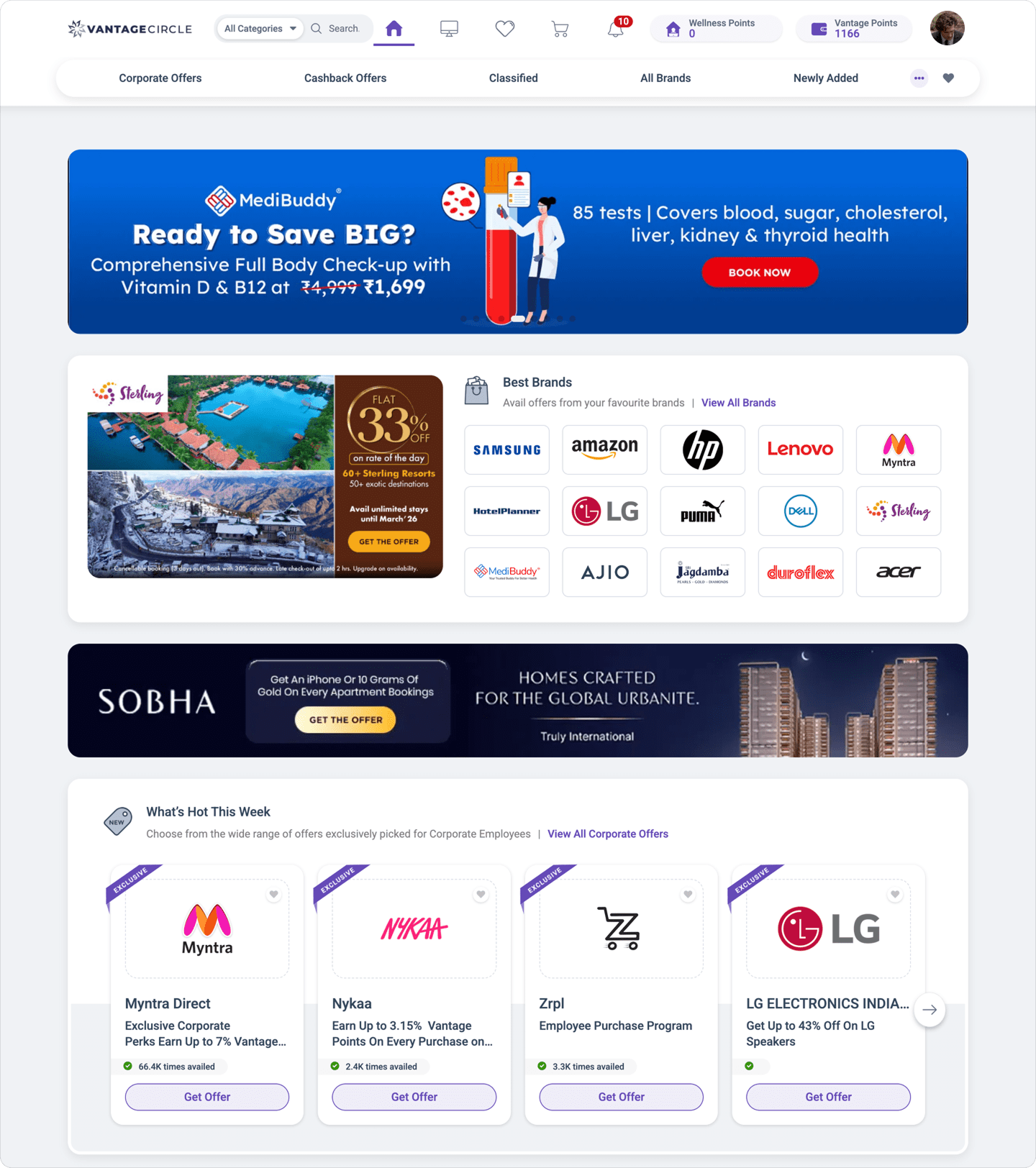
Benefits employees choose themselves stretch take-home value without a payroll change. Discounts on everyday spending are one low-cost way to do it, and Vantage Perks offers discounts across categories that employees browse and pick from.
Belonging and Connection
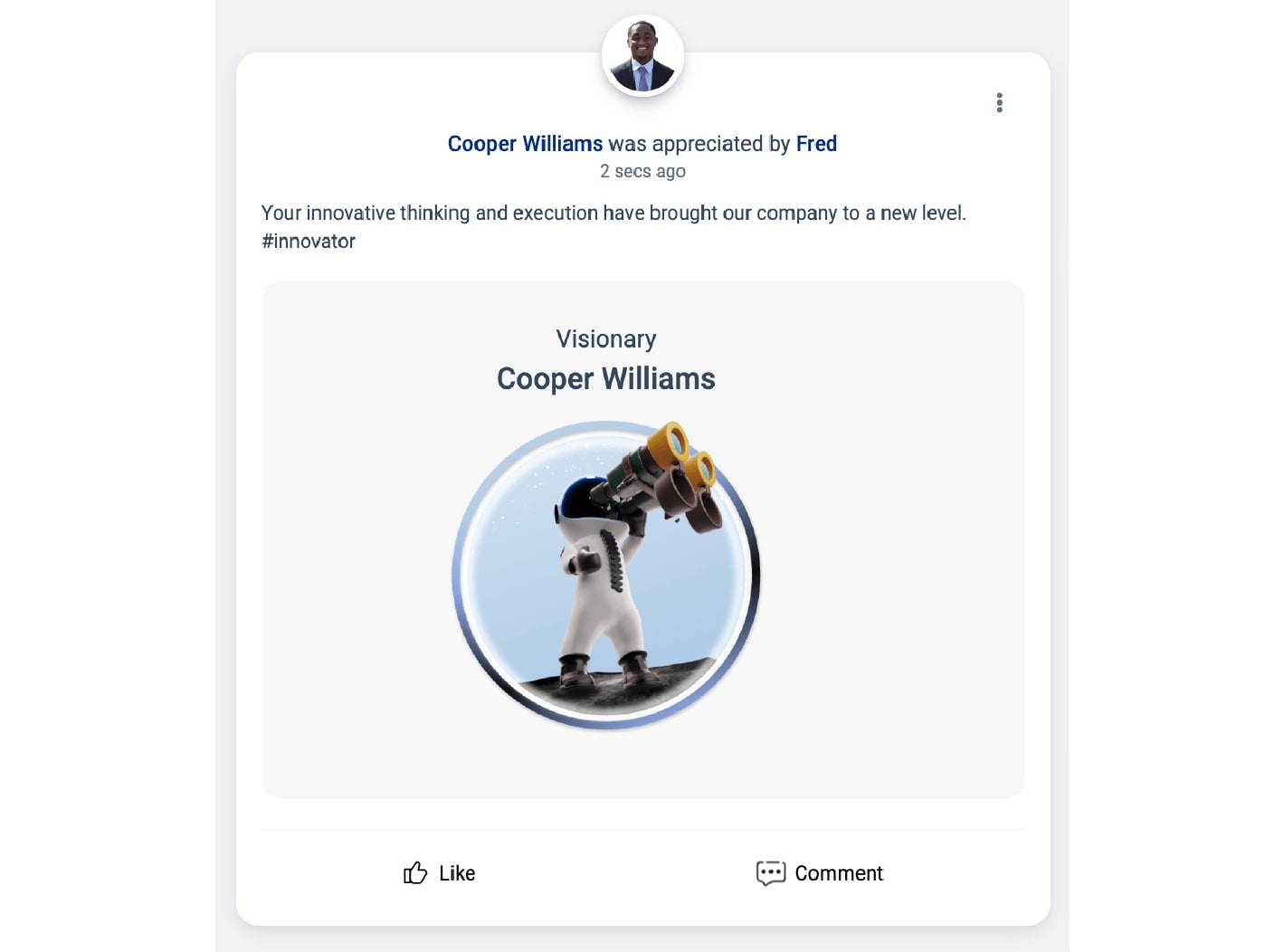
Belonging is built in frequent moments of being seen, not in an annual survey. A manager cannot notice everything, which is why peer recognition matters: it makes those moments routine and visible to the whole team.
When employees consistently feel Appreciated, Accepted, Validated, and Accomplished, motivation rises by 18 percentage points, intent to stay by 16, agility by 14, and customer excellence by 11, according to The State of Recognition & Rewards 2025 (Vantage Circle).
That is the case for building a real sense of belonging through everyday appreciation. It also connects to DEIB in the workplace (diversity, equity, inclusion and belonging), because recognition that only reaches some people widens the gap it was meant to close. Vantage Recognition supports peer-to-peer recognition for this reason.
Purpose
Purpose is people seeing what their work changes, and for whom. It is the dimension that lets someone tolerate a hard quarter, because they know why it matters.
HR cannot hand out purpose, but it can stop hiding it. Connect each role to an outcome, and recognize work by the value it served.
What HR Owns and What the Business Owns
HR directly controls 4 levers of human sustainability: recognition, development, wellbeing programs and belonging work. Workload, staffing levels, pay competitiveness and job design sit with operations, finance and leadership.
Deloitte makes the same point. Human sustainability crosses almost every part of an organization, so HR cannot do the job on its own. The table shows who holds each lever.
| Lever | Primary owner | HR's role |
|---|---|---|
| Recognition and appreciation | HR with managers | Design the program, equip managers, check who is being missed |
| Learning and career development | HR with managers | Fund and structure learning, build internal mobility |
| Wellbeing programs and benefits | HR | Design, communicate and measure use and impact |
| Belonging and inclusion work | HR with senior leaders | Run the programs, track reach by team and level |
| Workload and staffing levels | Operations and line leaders | Surface the signal by team, escalate with data |
| Pay competitiveness | Finance and senior leaders | Benchmark, flag gaps, propose fixes |
| Job design and autonomy | Business and line leaders | Advise on role design, report where control is low |
| Manager behavior | Senior leaders and HR together | Train, coach and give managers feedback on their teams |
So a program that promises all 5 dimensions from HR alone cannot deliver them, because some of the levers that drive depletion are not HR's to pull.
Practitioner view: Dr. Amit Singh, Chief Human Resources Officer at CARE Hospitals, breaks burnout into six drivers: workload, control, reward, community, fairness and alignment with personal values. In our reading, workload and control are largely set by how operations run, which is why a wellbeing program alone rarely fixes depletion. Hear his full conversation on rebuilding resilience after burnout.
A healthy company average can hide a depleted team. One team may be overloaded while another is fine. Looking at signals by team or department shows leadership where workload, not wellbeing programming, is the problem.
Recognition is the one lever leaders can pull every day without a budget cycle. Our guide to sustainable leadership shows how it connects to lasting business growth.
Human Sustainability vs Employee Wellbeing
Employee wellbeing is how people feel now. Human sustainability is whether work leaves them better off over years. Wellbeing is one of its 5 dimensions, so it is necessary but not enough.
A company can run a strong wellness program and still fail on skills, security and belonging.
Practitioner view: Meera Mohandas, India Head of Rewards at Wipro, says employees judge wellbeing offerings less by how many benefits exist and more by how supported they feel when they actually need help. She describes wellbeing as shaped by psychological safety, social connection, financial confidence and everyday manager behavior. Her episode, wellbeing in total rewards, goes through how to measure it past benefit usage.
If you want the engagement side of this, our guide to engagement and well-being covers how the two feed each other.
How to Measure Human Sustainability
Measure human sustainability with one external benchmark and five internal signals. The benchmark is Aon's Human Sustainability Index (HSI) for direction. The five signals are eNPS, exhaustion language in open-text feedback, recognition reach, wellbeing participation, and voluntary exits of high performers.
Most organizations are not set up for this. Only 19% of leaders say they have very reliable metrics for measuring the social component of ESG, according to the same Deloitte survey.
The Human Sustainability Index is Aon's tool. It measures wellbeing, resilience and sustainability at the individual, team and organization levels. Aon says improving these factors can raise company performance by at least 11% and up to 55%, a figure from its own 2022-2023 Global Wellbeing Survey, so treat it as the vendor's claim, not independent research.
These five signals use data HR already has or can collect. The directions in the last column are our suggested targets, not published benchmarks.
| Signal | What it tells you | Direction to aim for |
|---|---|---|
| eNPS (employee Net Promoter Score) | Whether people would recommend working here, a lagging sign of being sustained or depleted | Stable or rising, and not splitting sharply by team |
| Exhaustion language in open-text feedback | Early strain, before it appears in resignations | Fewer exhaustion and overload themes over time |
| Recognition reach | Whether appreciation is reaching every team and level | Even spread across teams, levels and tenure |
| Wellbeing participation | Whether people use what you offer, and which groups do not | Rising and broad, not concentrated in a few teams |
| Voluntary exits of high performers | Whether your strongest people are choosing to leave | Falling, with no spike in any one team |
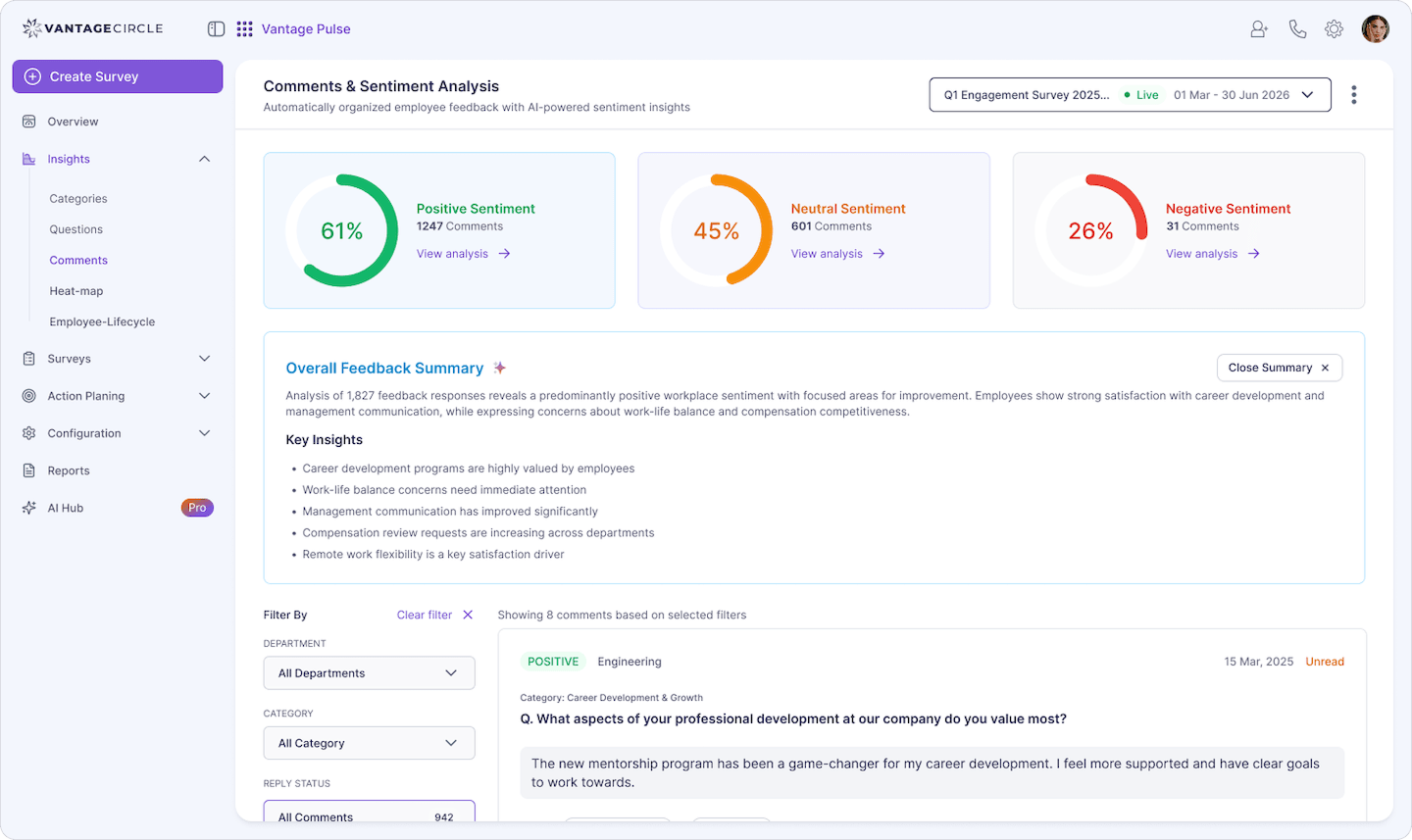
Depletion shows up in language before it shows up in resignations. Reading open-text pulse responses for exhaustion themes, alongside eNPS trends, gives HR a leading signal it can act on. Vantage Pulse offers comment sentiment analysis and eNPS for exactly this.
Here is what happens to outcomes when recognition stops reaching people.
When even one of the four emotional recognition signals drops, workplace sentiment slips from 98% to 83%, motivation and retention fall by over 20 points, and discretionary effort nearly halves, according to The State of Recognition & Rewards 2025 (Vantage Circle).
Every missing signal costs outcomes
Share of employees responding positively, by how many of the four emotional signals they feel, from the complete recognition experience (all four) to none.
Losing just one of the four signals drops workplace sentiment from 98% to 83%; with none, only 10% remain positive. Motivation ends lowest of all, at just 8% (down from 96%).
Why it matters: recognition is not all-or-nothing, but the decline is steep. When recognition is unequal, so are the outcomes: the few who feel seen give their best, and the rest give what's left.
Source: The Recognition Effect (Great Place To Work® India × Vantage Circle, 2025)
For a wider view of what to track, see our guide to engagement metrics, and for the how-to on collecting signals regularly, our guide to pulse surveys.
Why Human Sustainability Pays Off
Sustained people stay, and staying is where the business case starts. PayPal's case in Deloitte's report shows the arithmetic: it estimated that every one percent reduction in attrition would save about US$500,000 a year in recruiting, onboarding and training costs and through improved productivity.
92% of employees in high-recognition cultures express intent to stay, compared with 76% in emerging-recognition cultures, according to The Recognition Effect (Great Place To Work® India × Vantage Circle, 2025).
High-recognition cultures lead on every metric
Share of employees responding positively. Sorted by the size of the gap; the scale starts at 60% so the gaps are readable.
The widest gaps are on motivation (+18 points) and brand endorsement (+17). Even the narrowest, customer service excellence, still favors high-recognition cultures by 11 points. High-recognition cultures score at least 90% on every metric.
Why it matters: these are not soft measures. Customer service, agility and retention translate directly into loyalty, faster change and lower attrition costs.
Source: The Recognition Effect (Great Place To Work® India × Vantage Circle, 2025)
Human Sustainability Examples
These 4 companies changed how they measure, fund or pay for people outcomes, not just what perks they offer. The first three come from Deloitte's 2024 report, and the fourth from a Harvard Business Impact case study.
| Company | What changed | Result | Source |
|---|---|---|---|
| PayPal | In 2018 it found many entry-level and frontline workers were struggling financially. In 2019 it launched a program: lower healthcare costs, stock awards for all workers, higher wages where appropriate, financial education and earned wage access | Estimated net disposable income raised to 26% globally (it had been as low as around 5% for some entry-level and frontline workers), with far less financial stress and absenteeism, and all-time highs in engagement, productivity and retention | Deloitte Global Human Capital Trends, 2024 |
| Genpact | Uses internal tech tools, including an AI chatbot, to check in with workers and gauge mood. It aggregates a workforce "mood score" | The score is linked to 10% of bonuses for its top 150 leaders, including the CEO | Deloitte Global Human Capital Trends, 2024 |
| Mastercard | Determines bonuses for all workers in part on the organization's performance on carbon neutrality, financial inclusion and gender pay parity | People and planet goals now affect everyone's pay, not only senior leaders | Deloitte Global Human Capital Trends, 2024 |
| Wipro | From 2022 it unified its fragmented wellbeing programs into one initiative covering physical, mental and financial wellbeing, with courses, Wellbeing Champions and links to its ESG goals | A 2-point lift in employee engagement (2024 to 2025), a 0.5-point year-over-year improvement in overall wellbeing, and 126,500+ employees completing wellbeing courses | Harvard Business Impact case study |
The Wipro figures come from a training vendor's case study, which shows no publication date and is not an audit, so read them as reported results. What the four share is accountability: each tied a people outcome to money, targets or pay.
How to Start: A 5-Step Human Sustainability Plan
Start with a baseline, not a program. Most efforts fail because nobody knows where the workforce stands today.
- Baseline the 5 dimensions. Rate each dimension for your organization today, using the measures in the table above, and note where you have no data.
- Agree on ownership. Use the lever table to decide which levers HR holds and which need an operations, finance or leadership owner.
- Pick 2 HR-owned levers. Do not launch five programs. Choose two from recognition, development, wellbeing and belonging, and run them well.
- Set leading indicators. Choose from the five signals above, such as exhaustion language and recognition reach, so you see problems before resignations arrive.
- Review quarterly with leadership. Bring the signals by team, not the company average, and ask owners of the non-HR levers what they will change.
Conclusion
Human sustainability is an operating discipline, not a slogan. The companies that get it right name an owner for each dimension, measure early signals, and tie people outcomes to real accountability.
You do not have to fix all five dimensions at once. Start with the baseline in step 1 of the plan above, and you will know which one is quietly eroding.
Frequently Asked Questions
What does it mean to have sustainability in the workplace?
Sustainability in the workplace has two meanings. The environmental one covers energy, waste and a greener office. The people one, human sustainability, means the organization leaves employees healthier, more skilled, more secure and more connected than it found them. HR leads the second, and the two work best when planned together.
How to encourage sustainability in the workplace?
Start with what you can influence directly. Recognize the behaviors you want to see, tie them to company values, and make the recognition visible to the team. Give people time to learn, track exhaustion signals so workload problems surface early, and give each non-HR lever an owner. Small, repeated actions from managers matter more than a one-off campaign.
What are examples of sustainable practices?
People practices include regular workload reviews, funded learning time, financial wellness support, peer recognition tied to values, and manager training on spotting strain. A Green HRM example is paperless onboarding, which cuts printing and signals that sustainability is part of how HR works. The strongest programs combine both kinds rather than choosing one.
What are the four types of sustainability?
Some frameworks list the four types of sustainability as human, social, economic and environmental, though others use different pillars or only three. Human sustainability is about the health, skills and wellbeing of people. In an HR context, it is the pillar HR controls most directly. Which framework your leadership uses matters less than naming an owner for the people pillar.

Lupamudra is a content marketing specialist at Vantage Circle, where she has written 50+ articles on employee recognition, rewards, and workplace culture, alongside employee engagement, diversity and inclusion, and HR compliance topics, including how India's tax rules apply to recognition and rewards programs.
Connect with Lupamudra on LinkedIn.