


Team communication is how the members of a team share information, make decisions, and give each other feedback as they work toward a shared goal. It covers every channel the team uses, from meetings and chat to documents and recognition.
Most teams aren't short on channels. They're short on agreement about how to use them, and the gap is widening: once employees adopted AI tools, time spent in chat and messaging rose 145%, according to ActivTrak's 2026 State of the Workplace. More messages haven't made for clearer teams.
So the fix starts with your team's rules rather than another tool. Agree on where a quick question goes, how fast people reply, and where decisions get recorded. That's the team-level side of workplace communication, and it's the part a manager can change this week.
Key Takeaways
- Team communication does three jobs: it moves information, closes decisions, and closes the feedback loop.
- Most breakdowns come from unclear channels, unnecessary meetings, and invisible decisions, not from weak skills.
- A one-page team communication charter turns unwritten rules into agreed ones.
- Recognition is part of team communication. It tells everyone what good work looks like.
What is Team Communication?
Team communication is the exchange of information, decisions, and feedback between people who share the same goal and depend on each other's work. It includes everything from a stand-up meeting to a two-line chat message.
Think of it as doing three jobs at once:
- Moving information. Everyone has what they need to do their part, when they need it.
- Closing decisions. Choices get made, recorded, and owned, so nobody reopens them next week.
- Closing the feedback loop. People hear how their work landed, whether it needs fixing or deserves credit.
Most teams are decent at the first job. The second and third are where things quietly fall apart.
Team Communication vs. Collaboration vs. Workplace Communication
Team communication is the exchange itself, collaboration is the joint work that exchange makes possible, and workplace communication is the wider layer that reaches the whole organization.
The exchange
Team Communication
How one team shares updates, makes decisions, and gives feedback day to day.
Fix it with: agreed channel rules and a decision log.
The joint work
Collaboration
What the team builds together once information is flowing: plans, problem-solving, and shared output.
Fix it with: clear roles and agreement on the work itself.
The organization-wide layer
Workplace Communication
Leadership updates, policies, and company news that reach every team at once.
Fix it with: consistent leadership messaging and internal channels.
They overlap, but the fixes are different. A company newsletter won't fix a team's broken handoffs. And clearer handoff messages won't fix a team collaboration problem, where people disagree about the work itself.
Why Team Communication Matters
Team communication matters because it decides whether work moves forward or loops back for rework. When it breaks down, coordination becomes a hidden second job that nobody has time for.
And right now, that second job is growing. In Atlassian's research, 87% of knowledge workers say that with everyone in execution mode, they lack the time or capacity to coordinate. The same State of Teams 2026 report puts the cost of this "fragmentation tax" at $161 billion a year for the Fortune 500 alone.
AI hasn't eased the load either. Beyond the rise in chat time, ActivTrak's analysis of 443 million work hours found that email time rose 104% after employees adopted AI tools, and focus efficiency fell to 60%, a three-year low.
The manager sits at the center of this. Gallup finds that managers account for 70% of the variance in team engagement (Gallup). Engagement isn't the same thing as communication. But much of what drives it happens in conversation: how a manager shares context, runs meetings, and responds to bad news.
When team communication works, you see it in four places:
- Less rework. Handoffs land the first time.
- Faster decisions. Choices get made once and stay made.
- More trust. People speak up early because it's safe to, which is the core of psychological safety.
- Better retention. People stay on teams where they know what's going on and feel heard.
Types of Team Communication
Teams communicate in six main ways, and each one suits a different kind of message. Problems start when a team uses one type for everything.
| Type | Best for | Watch out for |
|---|---|---|
| Verbal | Nuance, conflict, quick alignment | Nothing gets written down |
| Nonverbal | Reading reactions, building rapport | Gets lost on camera-off calls |
| Written | Updates, decisions, instructions | Tone gets misread |
| Visual | Plans, data, processes | Slides that replace thinking |
| Synchronous | Decisions that need debate | Meetings that should have been a message |
| Asynchronous | Status updates, distributed teams | Slow replies on urgent issues |
Each of these can be formal (a project review, a written policy) or informal (a hallway chat, a quick message). Both matter. Formal communication carries the decisions. Informal communication carries the trust that makes people willing to raise a problem. Small signals count too, which is why nonverbal cues deserve more attention on hybrid teams than they usually get.
The 5 C's of Team Communication
The 5 C's of communication are clear, concise, concrete, correct, and courteous. They're a simple test for any message before you hit send.
| 5C's | What it means | Team example |
|---|---|---|
| Clear | One message, one ask | "Can you review the draft by Thursday?" instead of three requests in one paragraph |
| Concise | No more words than the reader needs | A three-line update instead of a forwarded email thread |
| Concrete | Specific names, dates, and numbers | "Jordan owns the client deck, due May 12" instead of "someone should handle the deck" |
| Correct | Accurate facts and the right audience | Checking the latest numbers before sharing them with the whole team |
| Courteous | Respectful, even when the news is bad | "This missed the mark, and here's what would fix it" instead of "This is wrong" |
You'll also see a different set of 5 C's used for teamwork. We cover that one in the FAQ at the end.
What Gets in the Way of Team Communication
Most team communication breakdowns come from five sources. Almost none of them are about people lacking skills.
1. Too many channels and no rules for using them. A question arrives by chat, email, a comment on a document, and a hallway mention. Nobody knows which one counts. So the answer gets lost in the one place nobody checked.
2. Meetings that should have been a written update. Whimsical's State of Async 2026 survey found that 8 in 10 workers attend meetings that could have been handled asynchronously. Every one of those meetings takes time away from the work it was meant to support.
3. Decisions that live in someone's head. A choice gets made in a meeting. Half the team wasn't there. Two weeks later, someone reopens it, and the team pays for the same decision twice.
4. Uneven airtime. The same three voices fill most meetings. The quiet person who spotted the problem doesn't say it out loud.
5. A silent feedback loop. Work goes out and nothing comes back. People don't hear when something landed well, so they stop knowing what "good" looks like on this team. For more on how these gaps play out, see these common miscommunication examples.
How to Improve Team Communication: 8 Practical Ways
Improving team communication starts with writing down the rules your team already argues about. Then you build simple rhythms that keep those rules alive.
1. Write a Team Communication Charter
A team communication charter is a one-page agreement on where messages go, how fast people reply, and how decisions get recorded. It turns a dozen unwritten rules into one shared page.
This isn't paperwork for its own sake. In the same Whimsical survey, high-performing teams were 2.7x more likely to have documented communication guidelines. Writing the rules down is a habit the best teams share far more often.
Block 45 minutes. Fill it in with the team, not on its behalf. Post it where everyone can see it, and review it every quarter.
Free Download · 1-Page PDF
Team Communication Charter
A one-page template your team can fill in together in a single meeting. No sign-up, no gate.
- Where each type of message goes, with response times
- Meeting rules and a simple decision log
- A feedback and recognition loop
- Four signals to review every quarter
2. Match Every Message to the Right Channel
Pick the channel based on how urgent and how complex the message is, not on habit. This is the single most useful part of the charter.
| Message type | Channel | Expected response time |
|---|---|---|
| Urgent blocker | Phone or direct call | Within 1 hour |
| Complex decision or conflict | Meeting or video call | Scheduled within 2 days |
| Project or status update | Work management tool | Read by end of day |
| Quick question | Team chat | Same business day |
| Team-wide announcement | Email or pinned post | Read within 1 day |
Treat these as starting defaults. A support team will need faster response times than a research team. What matters is that everyone agrees on the same answers.
3. Default to Async, Meet with a Purpose
Put updates in writing and save meetings for decisions, conflict, and anything that needs real conversation. A status meeting is usually a written update that got scheduled.
Before booking a meeting, ask one question: does this need people talking to each other, or just reading the same thing? If it's the second, send a written update instead. Then keep the meetings that earn their place. Here's a look at the types of meetings worth keeping.
4. Make Decisions Visible
Record every decision with an owner, a date, and a one-line reason, in one place the whole team can find. That's a decision log.
It sounds small. But a decision log stops the most expensive habit in team communication: making the same decision twice. When someone asks "wait, why did we do it this way?", the answer is a link, not a meeting.
5. Run One-on-Ones That Go Both Ways
A one-on-one works when the employee sets half the agenda. It's the one meeting built for listening rather than reporting.
Hold them at least monthly. Give managers a few starter questions and coach them to ask, listen, and support rather than run a status check.
Vantage Influencers Podcast
"That one on one meeting is probably the most effective tool you have."
Jason Lauritsen, Keynote Speaker, Author, and Leadership Trainer
Listen to the Episode6. Build Listening Into the Routine
Ask your team how communication is working on a regular schedule, then act on what you hear. Listening that happens only when something breaks is damage control.
Two questions, every quarter, are enough to start: "Do you get the information you need to do your job?" and "Do you know where to raise a problem?" Track the answers by team, not just as a company average.
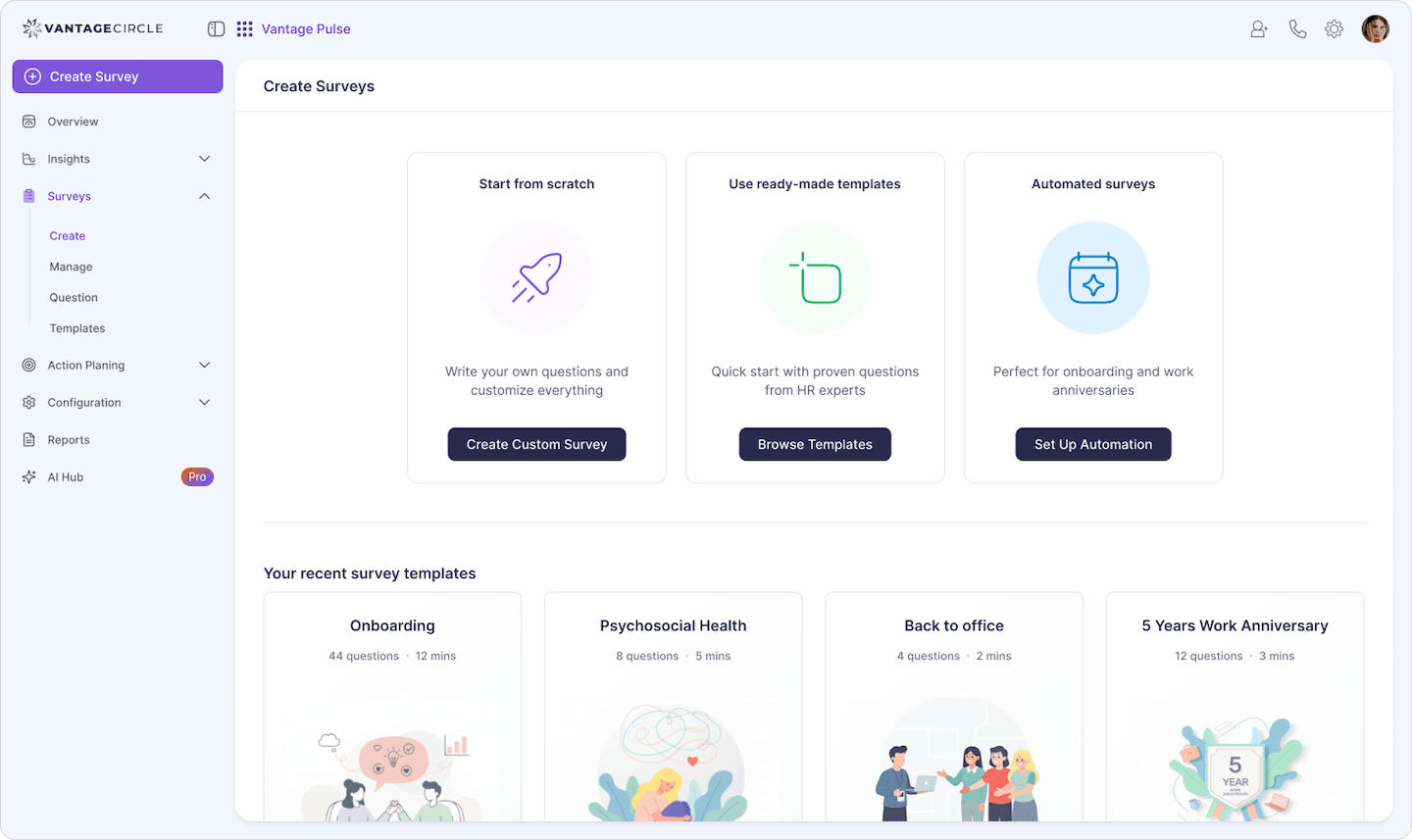
Vantage Pulse, Vantage Circle's employee engagement and pulse survey tool, lets you run these checks with anonymous responses. That matters for the quietest people on the team, who often see a problem first but won't say it in a meeting. In the meetings themselves, managers who practice active listening hear far more than the words being said.
7. Make Recognition Part of How the Team Talks
Recognition is communication. A public thank-you tells one person their work landed, and it tells everyone else what good work looks like on this team.
A lot of communication advice stops at information and decisions. It skips the feedback loop. But people take their cues from what gets noticed. Management thinker Dave Ulrich makes this point in his Expert Speak for Vantage Circle's AIRe Benchmarking Report (USA) 2023-2024: "R&R signals what matters most in a company by what is measured and rewarded."
Recognition also heads off friction before it starts. When people feel their effort is seen, small grievances have less room to grow.
Vantage Influencers Podcast
"Employee recognition is actually conflict prevention."
Christopher Littlefield, International and TEDx Speaker, Founder of Beyond Thank You
Listen to the EpisodeSo make it a habit, not an event. Recognize good work the same week it happens. Make it specific. And let peers recognize each other, not just managers, so the people closest to the work are the ones closing the loop. That's the idea behind social recognition.
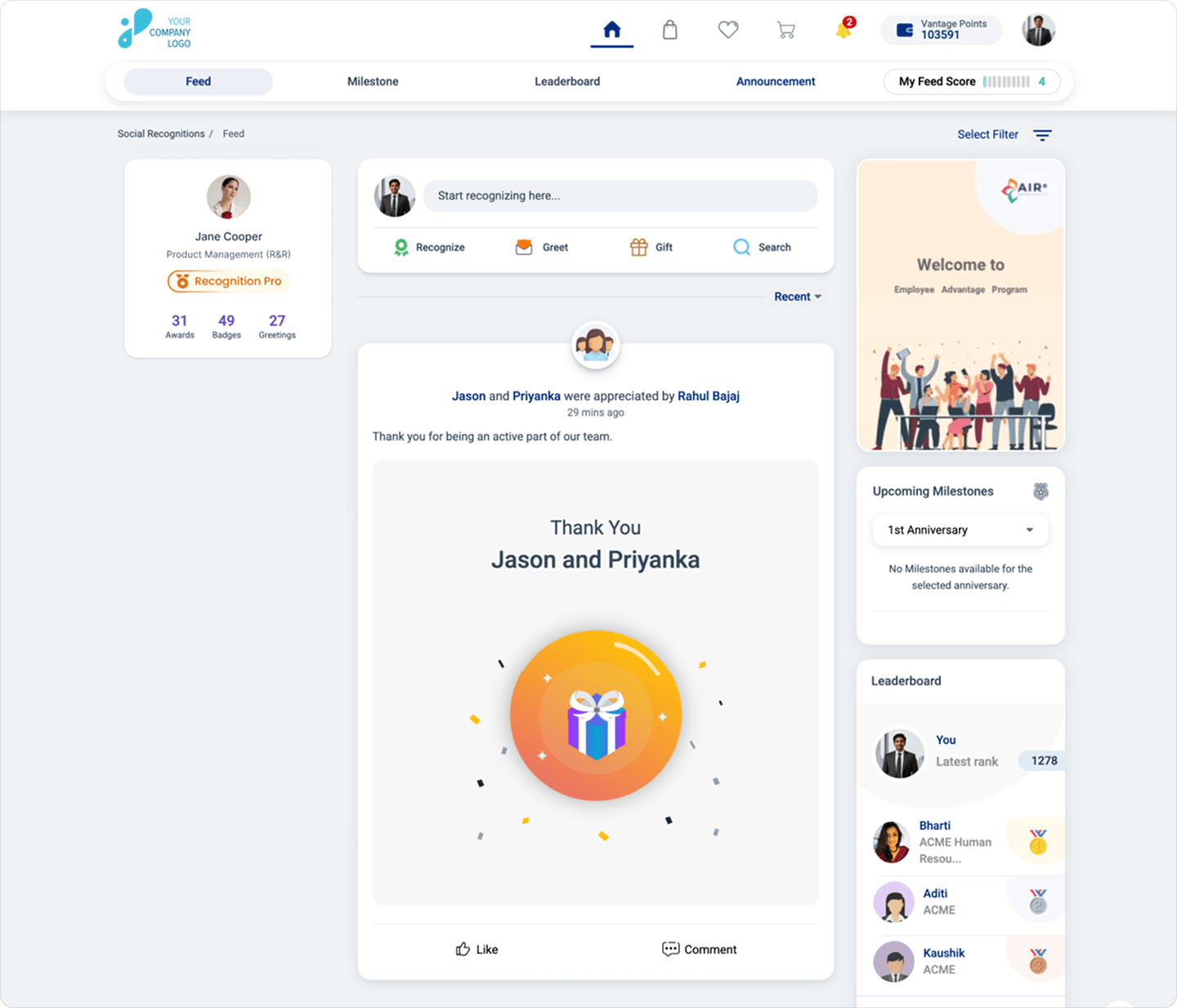
Vantage Recognition, Vantage Circle's employee recognition platform, puts that loop on a shared feed. Every appreciation post becomes a visible example of what the team values.
8. Clarify Roles Before You Clarify Messages
Many "communication problems" in handoffs are really ownership problems. Name one owner for every deliverable, and the messages get clearer on their own.
When two people think they own a task, you get duplicate work. When nobody thinks they own it, you get silence. Either way, the fix isn't a better message. It's team alignment on who does what.
How to Choose Team Communication Tools
Choose tools by the job they do on your charter, not by feature lists. A tool without a clear purpose becomes one more place where information disappears.
Most teams need five kinds of tools:
- Team chat for quick questions, such as Slack, Microsoft Teams, or Google Chat.
- Video calls for decisions and conflict that need a real conversation.
- A work management tool for tasks, owners, and status updates.
- Shared documents for decisions, plans, and anything people need to find later.
- A recognition and feedback platform for closing the loop on good work.
Resist adding more. Tool sprawl is already growing fast: ActivTrak found the average organization went from 2 AI tools in 2023 to 7 in 2025, and that's AI tools alone. Every new tool needs an answer to one question before it goes live: which row of our charter does this serve?
Team Communication Skills Every Member Needs
Five skills do most of the work in team communication. These are active listening, clear writing, asking good questions, giving feedback, and reading the room.
- Active listening. Hear the whole point before you respond, then play it back to check.
- Clear writing. Lead with the ask, then the context. Most team communication is now written.
- Asking good questions. "What would make this easier?" opens more than "Any questions?"
- Giving feedback. Specific, timely, and about the work, not the person.
- Reading the room. Notice who hasn't spoken and make space for them.
None of these are personality traits. They're habits a team can practice, and they're the same communication skills at work that make someone easy to work with anywhere.
How to Measure Team Communication
You can measure team communication with signals most HR teams already have: survey answers, meeting load, rework, and recognition activity. You don't need a new system. You need to look at the data you already collect, team by team.
| Signal | Where to find it | What a warning looks like |
|---|---|---|
| "I get the information I need to do my job" | Pulse survey | Agreement drops for two quarters in a row |
| Hours in recurring meetings per person | Calendar data | Rising, while output stays flat |
| Decisions reopened or work redone | Retros or the decision log | The same decision comes up more than once |
| Recognition moments per team member | Recognition platform | One team, or one manager, falls far below the rest |
The last signal is the one teams tend to overlook. A manager who rarely recognizes anyone may be quiet in other ways too. And recognition data moves every week, so it's worth checking between quarterly surveys.
Summing It Up
Back to where we started. Most teams don't need to communicate more. They need to agree on how they communicate.
So write the rules down. Match each message to its channel. Make decisions visible. And treat recognition as part of the conversation, because it's how a team learns what good looks like.
Start this week with one 45-minute meeting and the charter. Then review it every quarter, and let the signals tell you what to fix next.
If you want to see how a shared recognition feed fits into that loop, book a demo of Vantage Recognition.
FAQ
What is the meaning of team communication?
Team communication means the way team members share information, make decisions, and give feedback while working toward a shared goal. It includes meetings, chat, email, documents, and recognition, both spoken and written.
What are the 5 C's of communication?
The 5 C's of communication are clear, concise, concrete, correct, and courteous. Together, they help a message get understood the first time, without confusion or follow-up questions.
What are the 5 C's of teamwork?
A common version of the 5 C's of teamwork is communication, commitment, coordination, collaboration, and contribution. Other lists swap in terms like trust or accountability.
What are the 7 teamwork skills?
Seven widely cited teamwork skills are communication, active listening, collaboration, reliability, problem-solving, conflict resolution, and adaptability. Strong teams build these as shared habits, not just individual strengths.
What are 5 basic communication skills?
Five basic communication skills are listening, speaking clearly, writing clearly, reading nonverbal cues, and giving and receiving feedback. They apply in one-on-one conversations, meetings, and written messages alike.
How do you work on team communication?
Start by agreeing on shared rules: which channel each message goes to, how fast people reply, and where decisions are recorded. Then build regular habits around one-on-ones, short pulse checks, and recognizing good work.
What are some examples of team communication?
Examples of team communication include a daily stand-up, a written project update, a decision recorded in a shared document, a one-on-one between a manager and an employee, and a public thank-you for a teammate's work.
Written by