EN
EN  FR
FR  ES
ES  DE
DE 





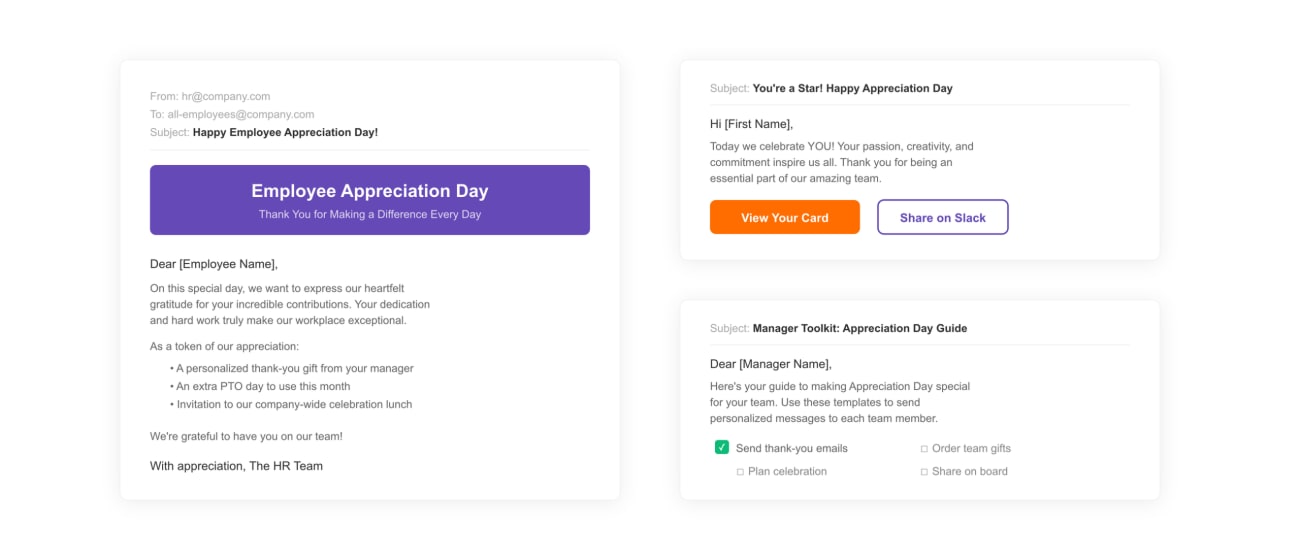
What Is an Employee Appreciation Day Email Template?
An Employee Appreciation Day email template is a pre-written message framework that HR teams, executives, and managers customize to thank employees on the first Friday of March each year — March 6, 2026 for the upcoming celebration. The template structures the message so it consistently includes acknowledgment, specificity, and a connection to company values.
Employee Appreciation Day was created in 1995 by Dr. Bob Nelson, co-founder of Recognition Professionals International, to give employers a single, dedicated day to express gratitude. Three decades later, it remains the most widely observed appreciation date in the U.S. corporate calendar, and one of the few days when sending a company-wide thank-you message lands as expected rather than as unusual.
Gallup research shows employees who receive regular recognition are 4x more likely to be highly engaged, yet 1 in 3 employees report receiving no recognition in the previous week. A well-crafted appreciation email is the lowest-cost way to mark the day and reinforce a habit the rest of the year is built on.
This page provides eight copy-paste-ready templates: CEO/leadership, manager-to-team, peer appreciation, remote team, work anniversary on Appreciation Day, milestone recognition, casual-tone, and a values-based variant — plus a subject line bank and a personalization guide. Pair these emails with the broader Recognition Templates hub for year-round structure.
Employee Appreciation Day 2026: Date, Origin, and Planning Timeline
Employee Appreciation Day always falls on the first Friday of March. Upcoming dates: March 6, 2026 — March 5, 2027 — March 3, 2028.
The day was established in 1995 by Dr. Bob Nelson and Workman Publishing to give organizations a clear, recurring moment to recognize employees. It is observed across the U.S. and increasingly in Canada, the U.K., and India, particularly in companies with formal recognition programs.
4 weeks before
Confirm the email sender (CEO, CHRO, or manager). Brief leadership on what to highlight. Decide whether the message is company-wide, function-specific, or both.
2 weeks before
Draft the email using a template below. Insert specific company achievements, named values, and at least one concrete contribution per recipient group.
Day-of (first Friday of March)
Send between 9:00 and 10:30 AM local time. Pair the email with a same-day moment — a leadership video, a small gift, or a managers-recognize-team prompt.
How to Use This Employee Appreciation Day Email Template?
A four-step guide to choosing, personalizing, and sending an appreciation email that lands as genuine, not corporate.
Step 1
Step 1: Choose the Right Template for Your Sender and Audience
A CEO sending a company-wide note uses different language from a manager thanking a 12-person team or a colleague writing a peer note. The eight templates below cover the most common combinations of sender and audience for Employee Appreciation Day.
Pick the variant that matches the relationship and tone you want to project. Most companies send two emails — a CEO/leadership message company-wide, plus a manager-to-team message from each people manager later in the day.
Step 2
Step 2: Personalize With Specific Achievements
The fastest way to make an appreciation email feel formulaic is to leave the placeholders generic. Replace each bracketed prompt with a specific achievement, milestone, or behavior — "the migration that shipped two weeks ahead of plan," not "all your hard work."
For company-wide messages, name two or three concrete results from the past year. For team messages, name two or three specific behaviors or moments. Specificity is what separates an appreciation email from a greeting card.
Step 3
Step 3: Choose the Right Send Time
The strongest open and read rates for Employee Appreciation Day emails sit between 9:00 and 10:30 AM local time on the first Friday of March. Sent before 8:00 AM, the email risks getting buried with overnight mail; sent after 11:30 AM, it competes with lunch and meetings.
For distributed teams, schedule the email by recipient time zone using your email tool's localized send feature. A 9:30 AM local arrival in each region beats a single 9:30 AM HQ-time send that lands at 6:00 AM in some inboxes and 11:00 PM in others.
Step 4
Step 4: Pair the Email With a Tangible Action
An email by itself is a gesture; an email paired with a meaningful action is recognition. Common pairings: an early-finish Friday, a small reward through a recognition platform, a leadership video or town hall, or a managers-thank-team prompt with named individuals.
The strongest Appreciation Day programs use the email as a starter and then sustain the cadence — peer recognition channels open the same week, manager prompts continue weekly, and the day becomes a reset rather than a one-off.
Personalization Guide: What Makes an Appreciation Email Feel Genuine
The single biggest determinant of whether an appreciation email lands is specificity. Three principles separate emails that feel like recognition from emails that feel like HR boilerplate.
1. Name the result, not the effort
"Your hard work" is generic and replaceable. "The work you put into the Q4 migration that closed two weeks early without a single client escalation" is specific. Specificity proves the sender paid attention.
2. Tie it to a named value
An email that links a specific behavior to a named company value ("This is what 'Customer Obsession' looks like in practice") reinforces culture while appreciating the individual. Avoid the values list dump — pick one value, named, with one example.
3. Sound like the person sending it
If your CEO does not normally write "synergistic execution" in 1:1 emails, do not put it in the appreciation email. Write in the sender's normal register. An email that sounds like Legal wrote it has less impact than one that sounds human.
What Makes a Strong Employee Appreciation Day Email?
The strongest Appreciation Day emails share six characteristics. Treat the list as a quick checklist before sending.
1. Genuine and authentic
Sincere, not scripted. Replace boilerplate phrases ("we couldn't have done it without you," "you are the heart of our company") with specific recognition.
2. Specific and concrete
Reference real achievements, real names, and real moments. Two specifics outperform six abstractions.
3. Aligned to one named value
Pick one company value and connect it to a behavior. Listing all your values reads as branding; naming one reads as recognition.
4. Inclusive across roles and locations
Recognize support functions and remote teams alongside front-line and HQ roles. Appreciation emails that name only sales or only engineering create more disengagement than they cure.
5. Clear and easy to read
Three to five short paragraphs. Strong opening, named achievements, closing line that signals what comes next. Aim for 150–300 words.
6. Timed for the day, paired with action
Sent on the first Friday of March, between 9:00 and 10:30 AM local. Followed by a tangible signal — early-finish Friday, recognition rewards, or a manager prompt with named team members.
Subject Line Bank: 12 Lines That Open
The subject line is the only part of the email that 100% of recipients see. Pair tone with the template you choose.
Formal
- A Note of Thanks on Employee Appreciation Day
- Recognizing Our Team — Employee Appreciation Day [Year]
- Thank You — Employee Appreciation Day
- To the Team, on Appreciation Day
Warm / Mid-tone
- Quick thank-you on Employee Appreciation Day
- For everything you do — Employee Appreciation Day
- Today is Appreciation Day. Here is what stood out.
- Thank you, [Team Name]
Casual
- Happy Employee Appreciation Day :clap:
- It is Appreciation Day — quick note from me
- Hey team — three things on my mind today
- A small thank-you for a big year
Sample Employee Appreciation Day Email Templates
Eight ready-to-send appreciation email templates. Each is fully written; replace the bracketed placeholders with specifics from your organization.
Template 1: CEO / Leadership — Company-Wide
Best for: an organization-wide appreciation message from the CEO or executive team.
Subject: A Note of Thanks on Employee Appreciation Day
Dear Team,
Today, on Employee Appreciation Day, I want to recognize and thank each of you for the work you bring to [Company Name].
This past year, we [specific achievement: shipped the [Product] platform on schedule / grew revenue by [X]% / closed [Y] customer renewals]. None of that happens without the people who fill in the gaps every day — the calls answered late, the documents reviewed before deadline, the colleagues helped through a bad week.
[Company Name] is the people in it. Thank you for what you put into this company and for each other.
[CEO Name]
Template 2: Manager-to-Team
Best for: a team-level note from a direct manager naming specific team contributions.
Subject: Thank You — [Team Name]
Hi Team,
On Employee Appreciation Day, I want to take a few minutes to thank each of you directly for the work you do.
Over the past [timeframe], you [specific behavior: covered for each other through the [event] / kept the [client] account on track when scope changed / shipped [project] without a single missed deadline]. That does not happen without trust and ownership across the team.
[Optional named call-out: Special thanks to [Names] for [specific contribution].]
Thank you for the work, the support you give each other, and the bar you hold for what good looks like here.
[Manager Name]
Template 3: Peer Appreciation
Best for: a colleague-to-colleague note thanking a specific peer for support during the year.
Subject: Quick thank-you on Appreciation Day
Hi [Name],
It is Employee Appreciation Day and I did not want to pass it without sending you a direct note.
[Specific support: When the launch slipped in October and I was buried, you stepped in and ran the customer comms / Reviewing my proposal the night before the client meeting was not your job — you did it anyway].
It made a real difference, and I wanted you to know I have not forgotten. Working with you is one of the things that makes this team good.
Thank you, [Your Name]
Template 4: Remote / Distributed Team
Best for: distributed teams whose work is easy to overlook across time zones.
Subject: Recognizing the Distributed Team — Employee Appreciation Day
Hi Team,
Working across [number] time zones means a lot of what each of you contributes happens while half the company is asleep. On Employee Appreciation Day I want to recognize that directly.
[Specific achievement: The Bangalore and Berlin teams pushing the EU release through Q1 / The async documentation that lets every region operate independently of HQ / The handoff discipline that has prevented a single dropped customer ticket this year.]
Distributed work is harder than co-located work. The fact that this team makes it look easy is something I do not take for granted. Thank you.
[Sender Name]
Template 5: Work Anniversary on Appreciation Day
Best for: employees whose work anniversary falls in the Appreciation Day week.
Subject: Appreciation Day & [X] Years — Thank You, [Name]
Hi [Name],
It is Employee Appreciation Day, and it also happens to mark [X] years since you joined [Company Name]. Two reasons for one note.
Over [X] years here, you have [specific contribution: built the customer-onboarding process from scratch / led three product launches / mentored four engineers who now lead their own teams]. The people you have worked with are better for having you here.
Thank you for [X] years, and for the way you have shaped this team.
[Sender Name]
Template 6: Frontline / Operations Team
Best for: frontline, support, or operations teams who carry the day-to-day load and rarely receive company-wide spotlight.
Subject: To the [Team Name] — Thank You
Hi Team,
A lot of what this company runs on happens because of work that does not show up in launch announcements. The [team]'s work is in that category.
[Specific achievement: Average response time dropped from [X] to [Y] minutes / [Z] customer escalations resolved without leadership involvement / Zero stockouts across [region] last quarter.]
On Employee Appreciation Day, I want this team to know the work is seen. Thank you for what you do.
[Sender Name]
Template 7: Casual / Short-Form Appreciation
Best for: cultures that prefer a brief, informal tone over a full message.
Subject: Happy Employee Appreciation Day
Hey Team,
It is Employee Appreciation Day. Three things on my mind today:
1. [Specific team win from the past month]
2. [Specific cross-team behavior worth repeating]
3. The people on this team are the reason most days here are good ones.
Thank you. Take the afternoon — the inbox can wait.
[Sender Name]
Template 8: Values-Based Appreciation
Best for: organizations with named, well-known company values; ties the day to the values vocabulary employees already use.
Subject: Living Our Values — Employee Appreciation Day
Hi Team,
On Employee Appreciation Day, I want to recognize this team specifically for [one named company value, e.g., "Customer Obsession"].
Over the past year, that value has shown up in [specific examples: the way the [team] handled the [customer] escalation / the decision to rebuild the onboarding flow rather than patch it / the engineering call to delay the release until accessibility was right].
[Value name] is not a phrase on a wall when it shows up like that. It is the way this team works. Thank you for keeping the bar where it is.
[Sender Name]
Explore Employee Recognition & Engagement Templates
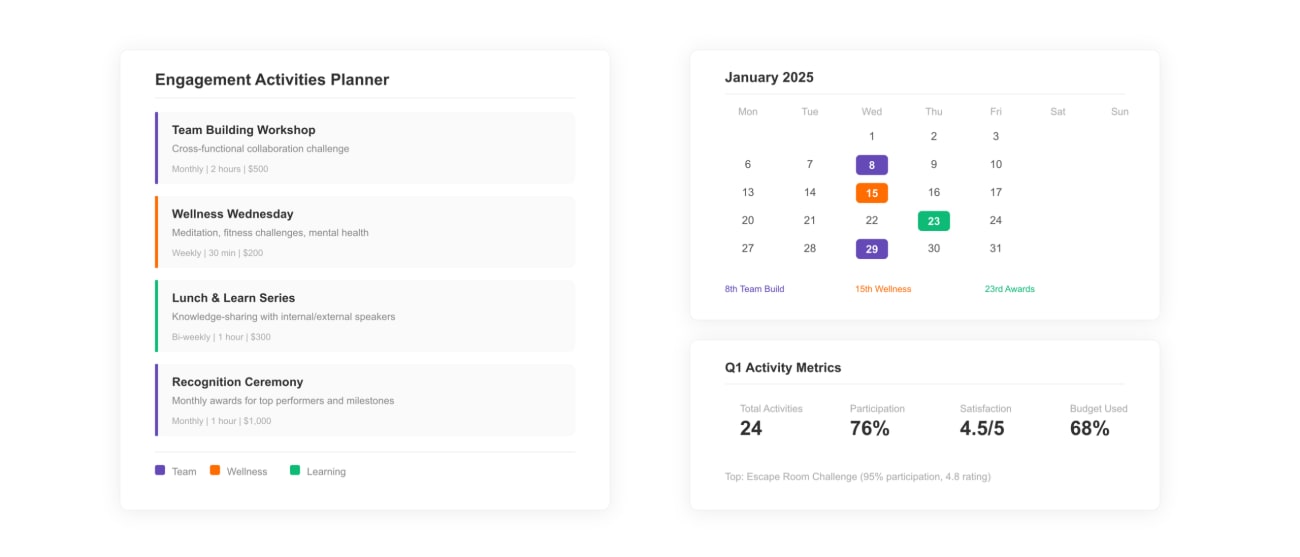
Employee Engagement Activities Template
Plan engagement activities to extend Appreciation Day momentum across the year.
View Template ›
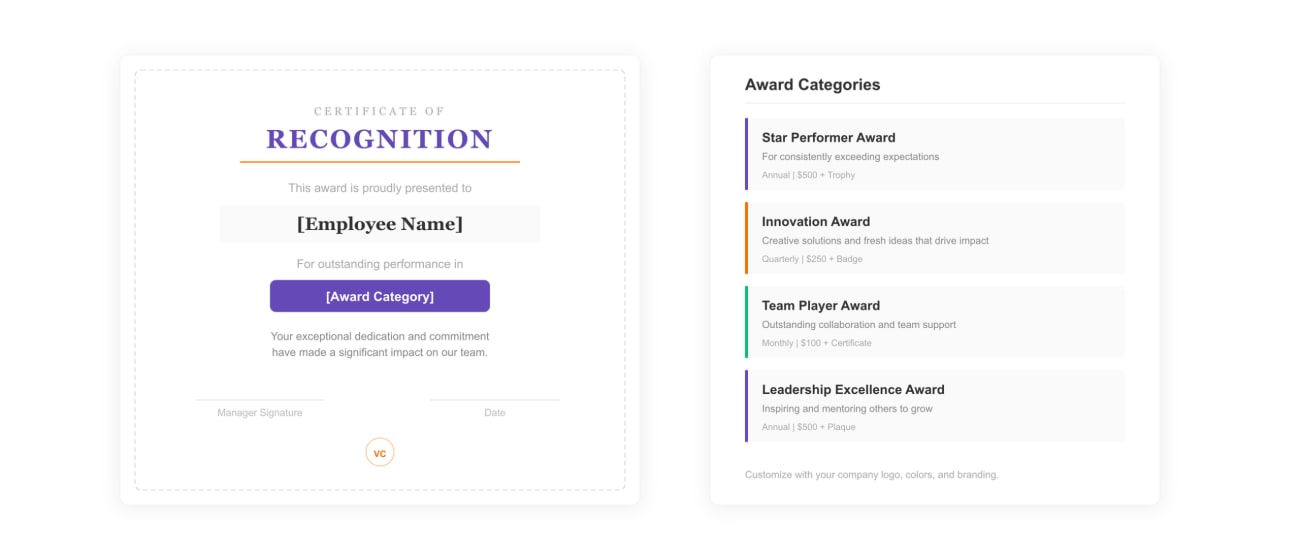
Employee Recognition Award Template
Pair Appreciation Day emails with formal awards for top contributors.
View Template ›
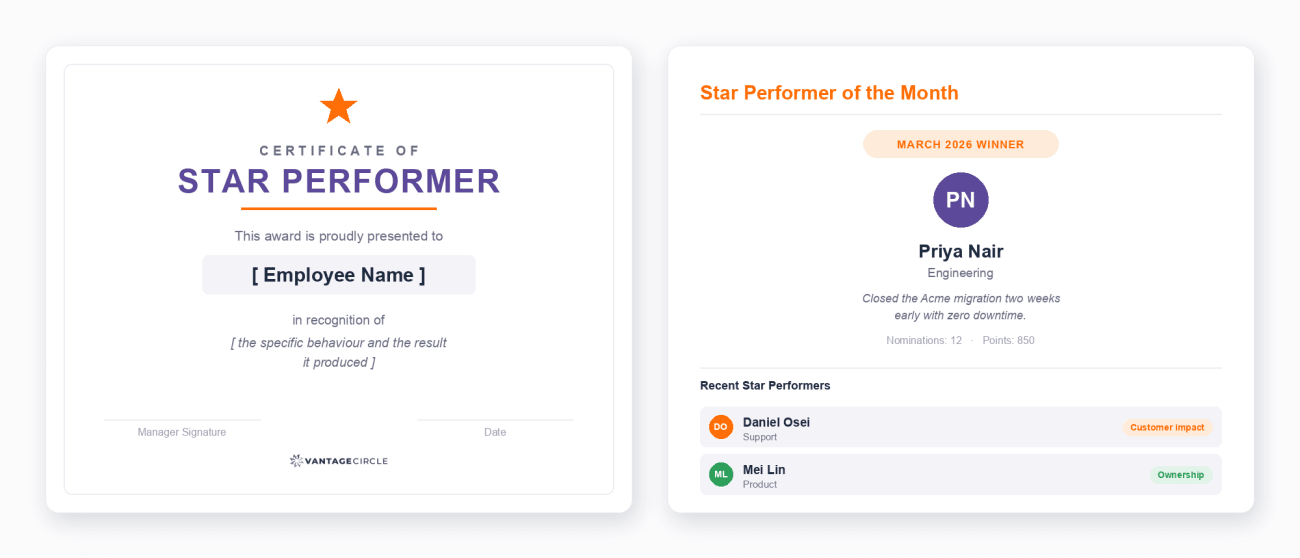
Star Performer Template
Free certificate, of-the-month, and town-hall slide to name your standout performers.
View Template ›