EN
EN  FR
FR  ES
ES  DE
DE 





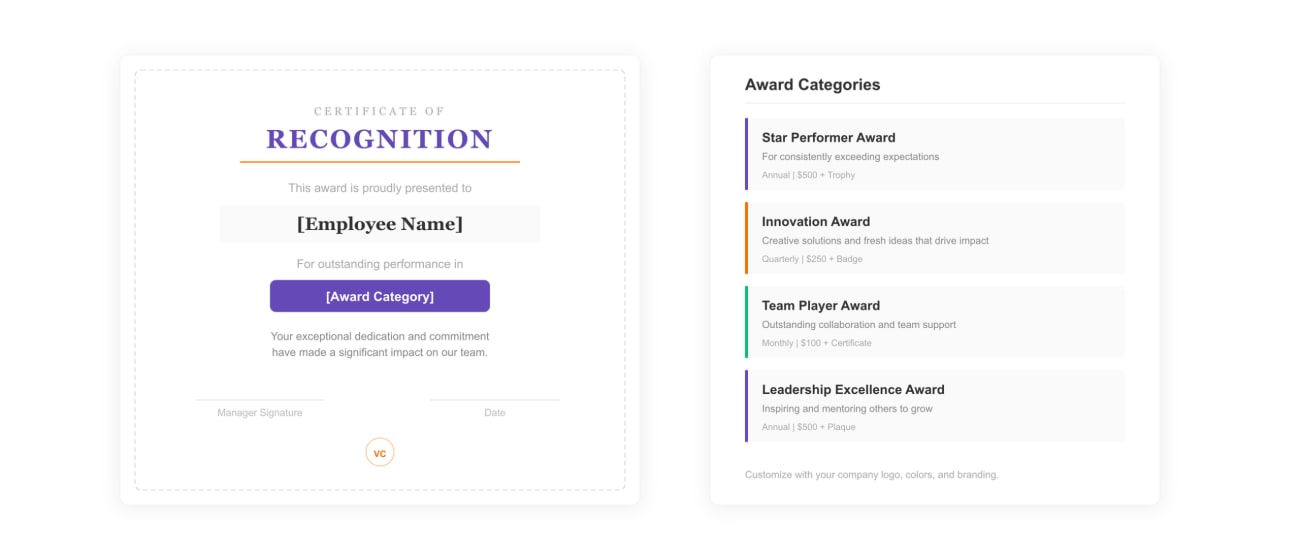
What Is an Employee Recognition Award Template?
An employee recognition award template is a pre-built framework that HR teams use to design fair, repeatable award programs — performance, values, peer, innovation, and milestone awards — without rebuilding criteria, citation copy, or governance from scratch each cycle.
The hardest part of giving an award is not picking the recipient. It is writing the citation that makes the award land as recognition rather than HR boilerplate. This template includes example citations, named criteria, and a nomination workflow you can deploy in a week.
Recognition tied to a structured award program correlates with measurable retention impact. Bersin / Deloitte research shows organizations with structured recognition see up to 31% lower voluntary turnover, and Gallup links regular recognition to a 4x increase in engagement. Pair this template with year-round workflows from the Recognition Templates hub.
How to Use This Employee Recognition Award Template?
A four-step setup that takes an award program from blank slate to a fair, governed cadence.
Step 1
Step 1: Choose Your Award Format
Decide how the award will be delivered: a printable certificate, a digital badge in your recognition platform, a public Slack/Teams announcement, or a paired physical reward presented at a town hall. Most companies run two formats in parallel — a digital certificate plus a public mention.
The format choice shapes the rest of the program. Digital-only awards scale across remote teams; physical awards work in single-site or front-line operations where a moment of presentation carries weight.
Step 2
Step 2: Define Award Categories and Criteria
Use up to five categories: Performance Excellence, Values Champion, Peer Recognition, Innovation, and Service or Milestone. Each category needs a one-paragraph definition and a 4–6 line criteria list so nominators understand what fits.
Customize names to match your values vocabulary. Performance Excellence becomes "Customer Hero" if your culture leads with customer language; Values Champion adapts to whichever value you most want reinforced this cycle.
Step 3
Step 3: Set Frequency and Governance
Monthly suits performance and peer awards. Quarterly works for innovation and values awards that need depth of evidence. Annual awards belong to milestone, leadership, and lifetime contributions.
Set governance up front: who collects nominations, who reviews, and who signs off. The template includes a one-page governance grid mapping HR, leadership, and culture-committee responsibility for each step.
Step 4
Step 4: Write the Citation, Then Present It
The citation is the part most programs get wrong. Use the citation framework below: name the recipient, name the specific behavior, name the impact in numbers, name the value, then close with future-orientation.
Present the award in a setting that matches its weight. A monthly performance award fits a team standup; a values champion award belongs at a town hall; a milestone award deserves a written letter signed by leadership.
The Award Citation Framework: 5 Lines That Make Recognition Land
A weak citation reads as filler. A strong citation tells a story in five short lines that anyone reading aloud can deliver with conviction. The template ships with this framework pre-formatted.
1. Name the recipient and award
"Priya Menon — Q1 Customer Hero Award." First line, no preamble. The recipient hears their name and award title in the same breath.
2. Name the specific behavior
"For coordinating the Harrington account onboarding across three time zones." A specific verb plus a specific situation. Not "for going above and beyond."
3. Quantify the impact
"Preventing a five-day implementation delay and protecting $180K of Q1 ARR." Numbers make the recognition credible. They also help the recipient retell the story.
4. Connect it to a named value
"This is what Customer Obsession looks like in practice." One value, named. Not a list of all your values strung together.
5. Close with future orientation
"Thank you for setting the bar that the rest of customer success now operates at." A line that signals continuity — the recognition is not just for what happened, it is for what the behavior establishes going forward.
A Complete Award Citation Example
Below is a full citation written using the framework. Read it aloud — that is the test for whether a citation works.
Q1 Customer Hero Award
Priya Menon, Customer Success
For coordinating the Harrington account onboarding across teams in San Francisco, Berlin, and Bangalore — keeping all three time zones aligned on a single implementation timeline through six escalation points.
Priya's coordination prevented a projected five-day implementation delay and protected approximately $180K of Q1 ARR. The client's CSAT score on go-live week was the highest we have recorded for an enterprise onboarding.
This is what Customer Obsession looks like in practice — not as a phrase on a values poster, but as the daily decisions that turn a difficult onboarding into a retained customer.
Thank you, Priya, for setting the bar that the rest of Customer Success now operates at. The team is better for having seen this work.
Presented by [Manager Name], VP Customer Success — [Date]
The same structure works for performance, values, innovation, peer, and milestone awards. The download includes pre-written variants for each.
What Makes a Strong Employee Recognition Award?
The awards that build culture share six characteristics. The ones that fall flat usually fail at least three.
1. Clearly defined criteria
Award purpose, criteria, and eligibility are written down and visible to nominators. Vague criteria let recognition gravitate toward the loudest voices.
2. Measurable and specific
Each award is tied to a behavior or outcome that can be named. "Closed three escalations without a single client churn" is measurable; "great team player" is not.
3. Fair across teams and tenure
A standard evaluation process across departments. Track award distribution by team, level, and location every quarter to surface bias before it becomes pattern.
4. Aligned to one named value
Each award reinforces one company value, named in the citation. Awards do double duty — they recognize the individual and they show the rest of the team what value-aligned behavior looks like.
5. Meaningful in the moment
The reward, the citation, and the presentation match the weight of the contribution. A milestone award presented in passing devalues the program more than no award at all.
6. Timely
Recognition lands hardest when it is close to the achievement. Quarterly cycles work for performance and values awards; spot recognition fills the gap for behaviors that cannot wait three months.
Sample Employee Recognition Award Templates
Two ready-to-deploy award frameworks. Each includes the objective, criteria, governance, and metrics you need to launch a fair program. The full pack adds innovation, milestone, and leadership awards.
Sample Template 1: Performance Excellence Award
Best for: monthly or quarterly performance recognition tied to measurable business outcomes.
Award Objective: Recognize employees who consistently exceed performance expectations and deliver measurable business impact.
Eligibility: Full-time employees with minimum tenure of 3 months. One award per cycle per team.
Recognition Criteria (weighted):
- Goal or target achievement (40%)
- Quality and consistency of work (25%)
- Ownership and accountability (20%)
- Collaboration and teamwork (15%)
Governance: Manager nomination, HR review, leadership panel sign-off. Cycle: monthly nomination close on the last Friday, announcement first Wednesday of the next month.
Metrics Tracked:
- Nomination participation rate (%)
- Department and team award distribution (%)
- Post-award performance trend
- Award fairness feedback score
- Retention rate of awarded employees vs company average
Sample Template 2: Values Champion Recognition Award
Best for: continuous, peer-eligible recognition tied to named company values.
Award Objective: Recognize employees who consistently demonstrate company values through behaviors that positively impact teams, customers, or culture.
Eligibility: All full-time and part-time employees. Peer and manager nominations both eligible.
Recognition Criteria:
- Behavior tied to one named company value
- Specific recognition story with named impact
- Visible influence on team or customer outcomes
- Consistent pattern, not a one-off moment
Governance: Continuous nomination cycle. HR or culture committee validates each nomination for value alignment. Monthly recognition announcements.
Metrics Tracked:
- Value-aligned recognition rate (%)
- Peer nomination participation (%)
- Cross-team recognition distribution (%)
- Engagement-survey correlation by recognized cohort
- Inclusion participation score across teams
Explore Employee Recognition & Engagement Templates
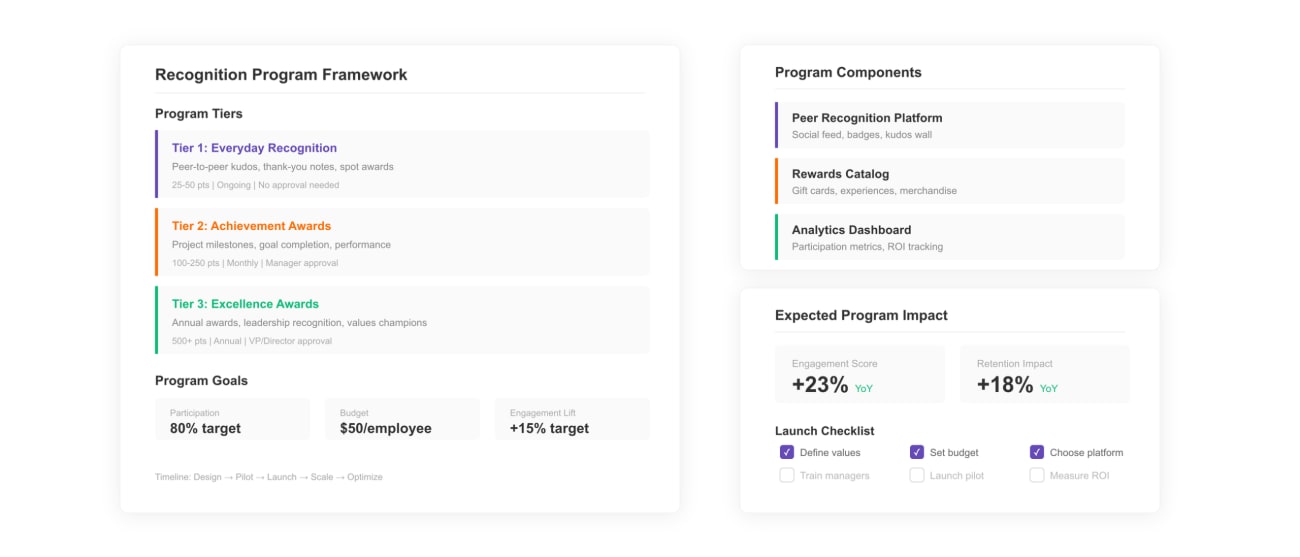
Employee Recognition Program Template
Embed your awards inside a complete recognition program with criteria and metrics.
View Template ›
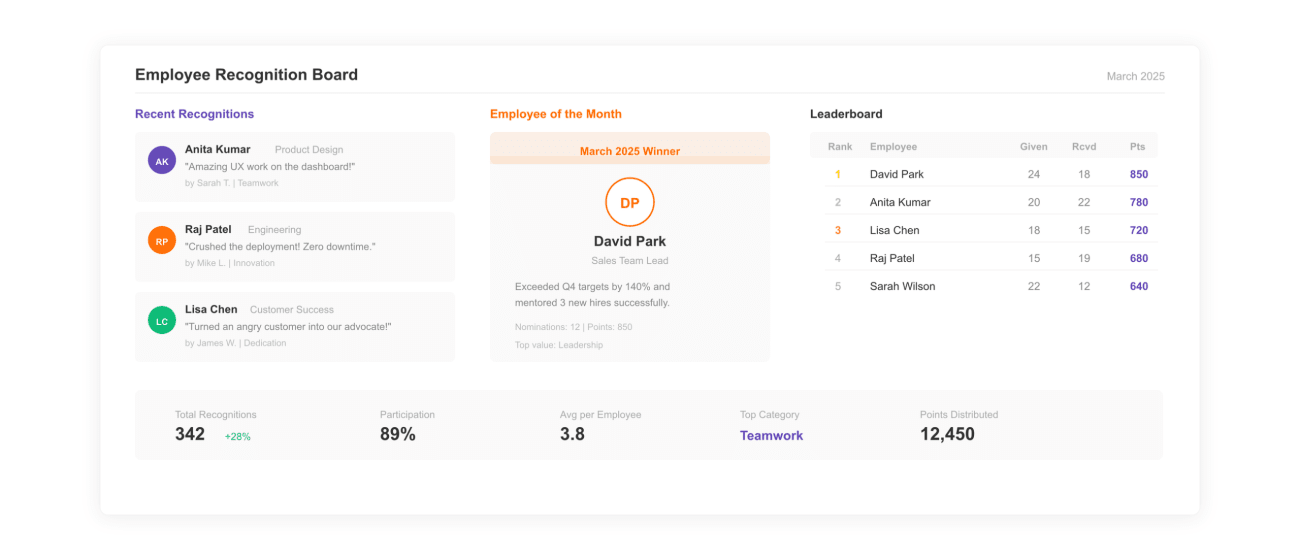
Employee Recognition Board Template
Display award winners on a physical or digital recognition board.
View Template ›
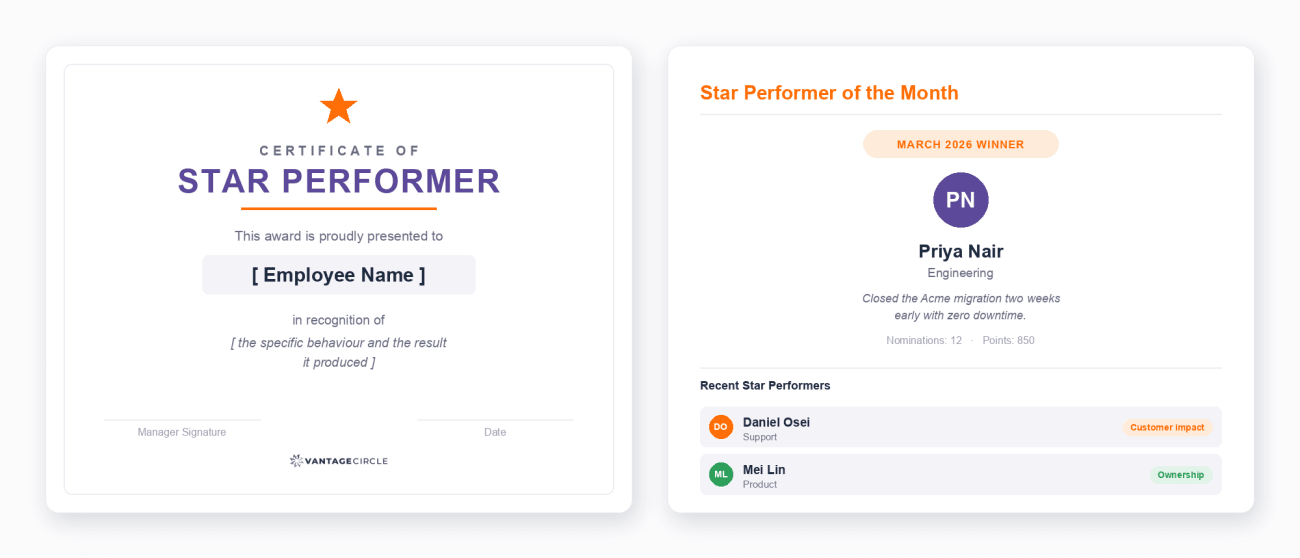
Star Performer Template
Free certificate, of-the-month, and town-hall slide to name your standout performers.
View Template ›