EN
EN  FR
FR  ES
ES  DE
DE 




What Is an Employee Recognition Board Template?
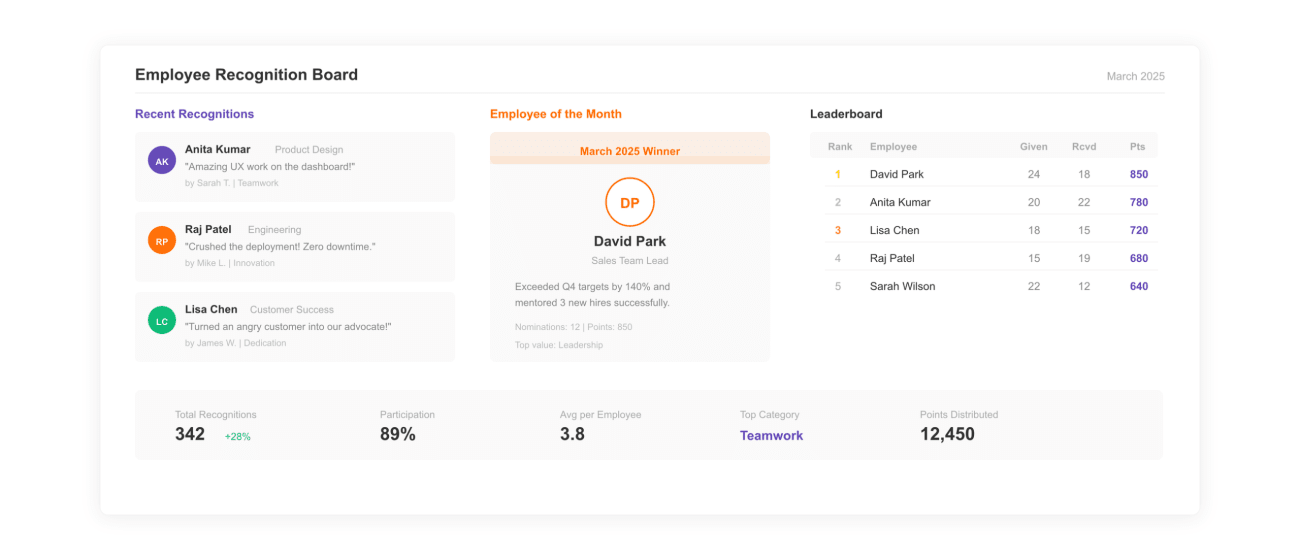
An employee recognition board template is a pre-built layout that organizes employee achievements, milestones, and value-driven behaviors into a single visible space — a physical office board, a Slack or Microsoft Teams recognition channel, an intranet page, or a recognition platform feed.
The template removes the design and governance work each time the board refreshes. Recognition categories, card formats, nomination criteria, and update cadence are decided once, then reused for every cycle. The result is a consistent visible record of who did what, instead of a scattered set of one-off shout-outs across email and chat.
Gallup's research shows employees who receive regular recognition are 4x more likely to be highly engaged. A recognition wall is one of the lowest-cost ways to make appreciation public, frequent, and culturally durable. Pair this with structured workflows from the Recognition Templates hub.
The download includes layouts for both physical and digital boards, recognition card formats (Above & Beyond, Values Champion, Customer Impact, Innovation, Milestones), and tracking metrics that prove the board is doing its job.
How to Use This Employee Recognition Board Template?
A four-step setup that takes a recognition board from launch to a sustainable, measured channel.
Step 1
Step 1: Choose Your Board Format
Decide where the board will live: a physical office wall (corkboard, whiteboard, or printed display), a digital intranet page, a dedicated Slack or Microsoft Teams channel, or a recognition platform feed inside Vantage Circle. Hybrid teams typically need a digital board with optional in-office mirroring.
The format choice determines update cadence and moderation. A physical board changes monthly because rotation cost is high; a Slack channel updates continuously and runs on lightweight peer moderation. Both designs are covered in the template — pick the one that matches how your team actually works.
Step 2
Step 2: Define Recognition Categories
Assign every recognition card to one of five named categories: Above & Beyond Contribution, Team Collaboration, Customer Impact, Innovation & Ideas, and Work Anniversary or Milestone. Categories give nominators a clear lens and let the board surface the values you actually want repeated.
Five categories is the practical maximum. More categories spread recognitions thin and make the board feel inconsistent. Customize the names to match your company's values vocabulary — if your organization uses "Customer Obsession" instead of "Customer Impact," rename the category and keep the rest of the structure.
Step 3
Step 3: Set Update Frequency and Governance
Weekly suits Slack and Teams channels. Monthly works for physical boards and intranet pages. Quarterly fits large-format anniversary or values displays.
Choose one cadence and protect it — recognition boards die when they go three months without a refresh. Set governance up front: who collects nominations, who reviews, and who publishes.
Step 4
Step 4: Track Whether the Board Is Working
Recognition boards lose impact silently when nobody measures them. Track participation rate (employees giving recognition per month), department coverage (every team appears at least quarterly), and the giver-to-receiver ratio. A healthy board has more than half the workforce participating monthly and no department absent for more than two cycles.
Archive each cycle's content. A year of archived recognition cards becomes a permanent evidence base for stay interviews, internal mobility decisions, and culture stories used in employer brand content.
Physical vs. Digital Recognition Boards: Which Setup Fits Your Team?
Physical and digital boards solve different problems. The download includes layouts for both — pick the format that matches how your employees actually spend their day.
Physical Office Board
Best for: in-person teams, single-site operations, manufacturing, retail, healthcare, hospitality.
- High visibility — everyone walks past it.
- Monthly refresh cycle (rotation cost is real).
- Owner: office manager or HR business partner.
- Format: A1 or A2 printed layout, magnetic cards, or chalkboard panel.
- Risk: stale boards damage culture more than missing boards. Schedule refresh dates as recurring calendar invites.
Digital Recognition Channel
Best for: remote, hybrid, distributed, multi-site, knowledge-work organizations.
- Continuous updates — recognition flows in real time.
- Channel options: Slack, Microsoft Teams, intranet feed, recognition platform.
- Owner: a designated HR partner plus light peer moderation.
- Format: emoji-tagged posts mapped to category names, weekly digest summary on Fridays.
- Risk: noise. Pin a "How recognition works here" message to set the tone and the categories.
Hybrid organizations usually run a digital board as the primary surface and mirror the monthly highlights onto a physical office display. The template includes both layouts and a one-page guide on keeping the two synchronized.
What Makes a Good Recognition Board?
The boards that drive culture share six characteristics. Without these, a board becomes another piece of office wallpaper.
1. Visible to everyone
Physical boards belong in high-traffic spots — near the entrance, the kitchen, or the elevator bank. Digital boards belong in channels everyone is already in, not a new tool nobody opens. If it takes effort to find, it does not exist.
2. Refreshed on a protected cadence
Weekly for digital, monthly for physical, quarterly for large displays. The fastest way to kill a recognition board is to leave March's content visible in June. Treat the refresh date as a non-negotiable calendar invite.
3. Fair and transparent criteria
Every category has a one-line definition that anyone can read. When criteria are vague, recognition gravitates toward the loudest voices. Clear criteria spread recognition across the workforce and make the board feel earned, not political.
4. Open to peer and manager nominations
Manager-only boards become quiet quickly because managers already have other recognition channels. Peer-eligible boards capture the daily collaboration moments managers never see — the colleague who covered shifts, reviewed a deck, or unblocked a deploy.
5. Aligned to named company values
Tag every card to a stated company value. Boards that reinforce values do double duty: they recognize an individual and they remind the rest of the team what value-aligned behavior looks like in practice.
6. Measured against participation and coverage
Track monthly participation rate, department coverage, and giver-to-receiver ratio. A board with strong numbers is doing its job; a board with declining metrics is a leading indicator of broader engagement issues.
Sample Employee Recognition Board Templates
Two ready-to-use board frameworks. Each shows the structure, governance, and metrics needed to launch and run a recognition board that lasts past quarter one. The full pack contains additional layouts and recognition card formats.
Sample Template 1: Monthly Performance & Values Recognition Board
Best for: physical office boards or monthly intranet pages.
Board Objective: Create company-wide visibility for high performance, business impact, and value-driven contributions on a monthly cycle.
Board Sections:
- Employee of the Month — performance-based recognition
- Values Champion — behavior tied to a named company value
- Team Achievement — project or delivery success
- Customer Impact — service excellence or client outcome
Example Recognition Card:
Values Champion — March
Recipient: Priya Menon, Customer Success
For: Coordinating the Harrington account onboarding across three time zones, preventing a five-day implementation delay.
Value: Customer Obsession.
Nominated by: The implementation engineering team.
Governance: Updated monthly. Nominations close on the last Friday of each cycle; HR and leadership review the following Monday. Published Wednesday.
Metrics Tracked:
- Department representation coverage (%)
- Manager nomination participation rate
- Recognitions linked to measurable business outcomes (%)
- Recognitions linked to company values (%)
- Retention rate of recognized employees vs company average
Sample Template 2: Continuous Peer Recognition Wall (Slack / Teams)
Best for: distributed and hybrid teams using Slack or Microsoft Teams.
Board Objective: Enable real-time peer appreciation and strengthen everyday culture through high-frequency, visible recognition moments.
Board Sections:
- Weekly Peer Shout-outs (#kudos channel)
- Cross-Team Collaboration Highlights
- Culture and Values Moments — tagged with the relevant value
- New Joiner / Onboarding Appreciation
Example Slack Post:
:trophy: Shout-out to @marcus.lee
For staying online late last Thursday to walk the EU team through the new deploy pipeline. Three engineers got unblocked the same evening.
Value: Team Collaboration
From: @sara.bhatt
Governance: Continuous submission via Slack/Teams emoji workflow or a recognition app. Friday digest summary auto-generated. Light HR moderation; archived at month-end.
Metrics Tracked:
- Monthly active recognition participation (%)
- Average recognitions per employee per month
- Cross-team recognition ratio (%)
- Peer vs manager recognition distribution
- Value-tag usage and alignment rate (%)
- Recognition reciprocity index (givers vs receivers)
Explore Employee Recognition & Engagement Templates
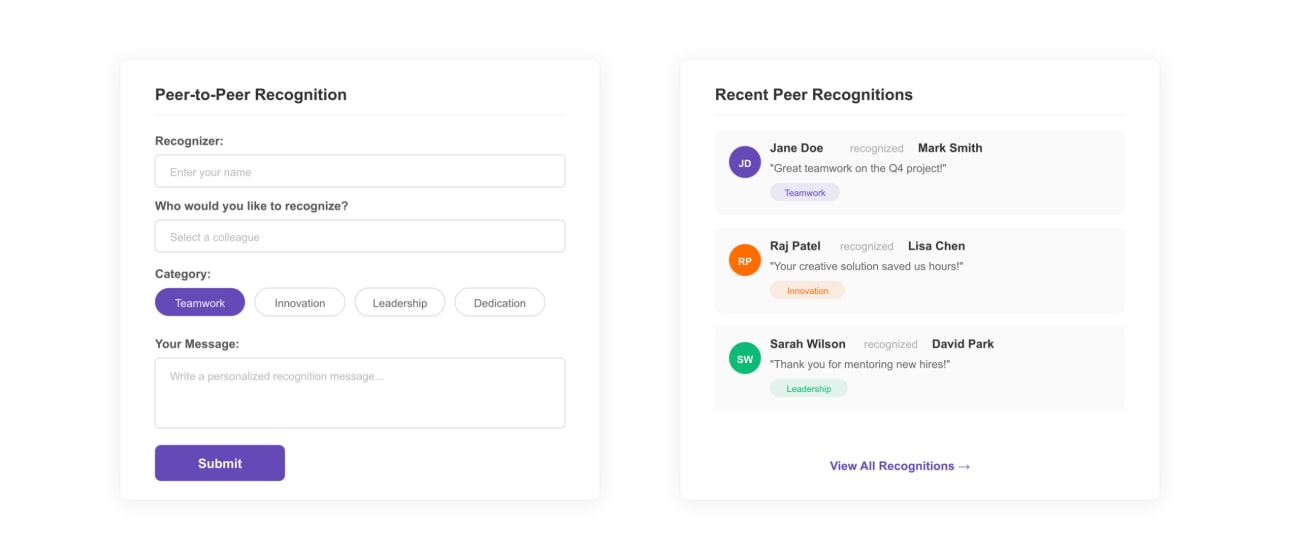
Peer-to-Peer Recognition Template
Encourage employees to recognize each other's contributions across teams.
View Template ›
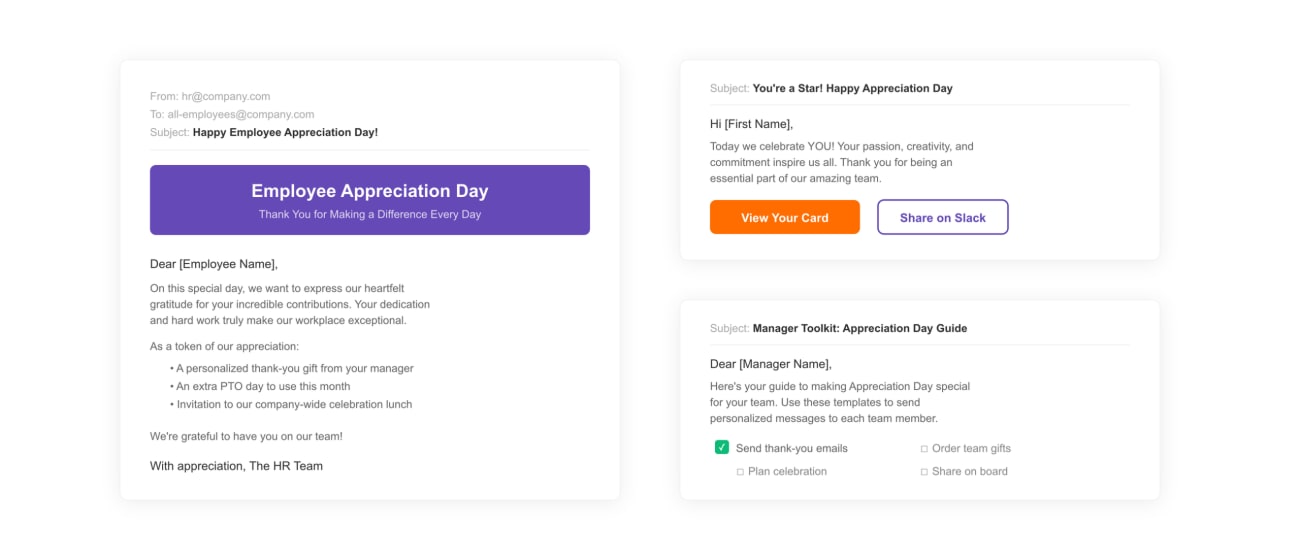
Employee Appreciation Day Email Template
Send heartfelt appreciation emails for Employee Appreciation Day in March.
View Template ›
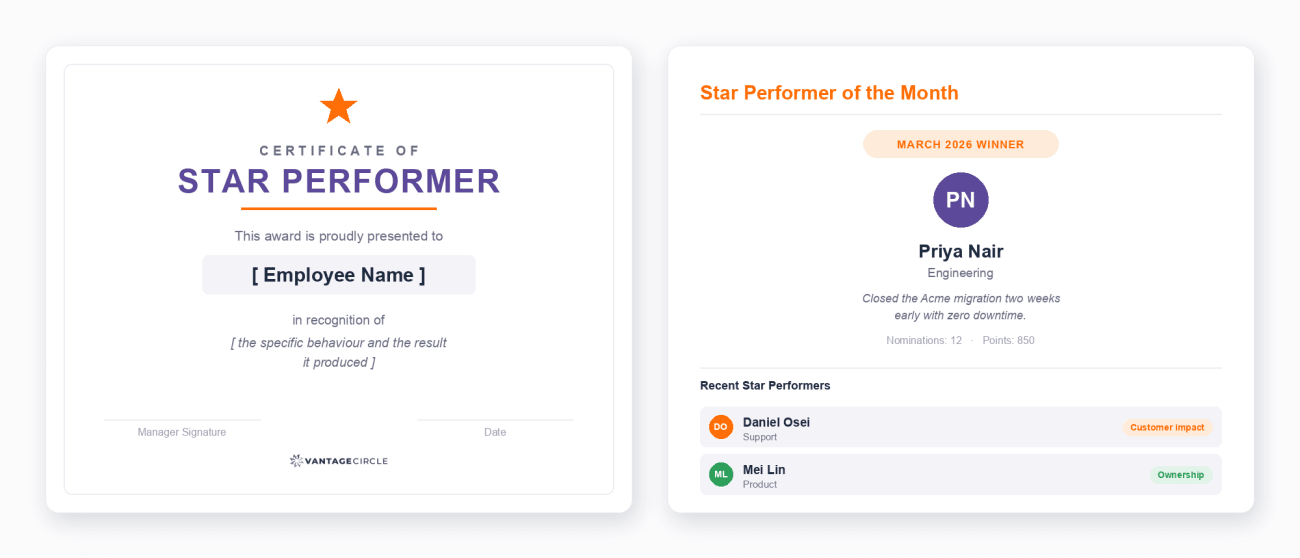
Star Performer Template
Free certificate, of-the-month, and town-hall slide to name your standout performers.
View Template ›