EN
EN  FR
FR  ES
ES  DE
DE 





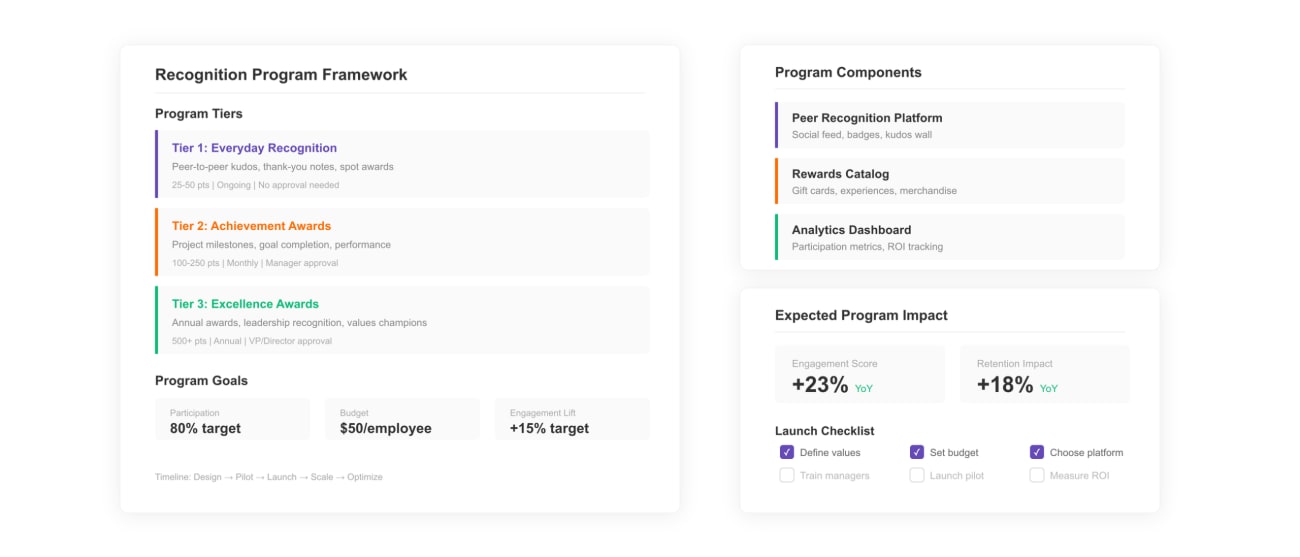
What Is an Employee Recognition Program Template?
An employee recognition program template is a pre-built framework that HR teams use to design a structured, fair, and scalable recognition program — covering objectives, eligibility, weighted criteria, frequency, rewards, governance, and measurement — without rebuilding from scratch each year.
Bersin / Deloitte research shows organizations with structured recognition see up to 31% lower voluntary turnover, and Gallup links regular recognition to a 4x increase in employee engagement. The gap between informal recognition and a structured program is what turns those numbers into business results.
This template includes six pre-built program types (performance, peer, spot, milestone, manager-nominated, values-based) plus a 30/60/90-day rollout methodology. Pair it with the broader Recognition Templates hub and Vantage Circle's AIRe Framework for end-to-end recognition design.
How to Use This Employee Recognition Program Template?
A four-step setup that takes a recognition program from concept to launch.
Step 1
Step 1: Define Program Objective and Scope
Decide what the program is for: rewarding performance, reinforcing values, building peer culture, or marking tenure. The objective drives every downstream decision — criteria, eligibility, cadence, and metrics.
Most organizations need two or three programs running in parallel, not one program trying to do everything. The template includes six pre-built program types so you can pick the combination that fits your stage.
Step 2
Step 2: Customize Criteria, Eligibility, and Rewards
Define weighted criteria (the template's performance program uses 40% performance / 25% teamwork / 20% innovation / 15% attendance), eligibility rules, and reward tiers. Document a recognition budget per employee per year — typical benchmarks are 1–2% of payroll.
Tax and compliance matter here: in the U.S., non-cash awards under $100 generally fall under de minimis fringe benefit rules; cash and gift cards are taxable wages. Document whichever rules apply in your region.
Step 3
Step 3: Launch With a Communication Plan
Recognition programs fail more often from poor launch than poor design. Brief leadership two weeks before launch, train managers one week before, and open the program with a CEO or CHRO message naming the program objective.
The template includes a 30/60/90-day rollout plan — see the methodology section below — so the program does not stall after week three.
Step 4
Step 4: Measure and Iterate
Track participation rate, department coverage, giver-to-receiver ratio, and value-tag distribution monthly. The template includes a measurement dashboard and a quarterly review cadence.
Programs need quarterly tuning — categories that overperform get scaled, categories that underperform get retired or rewritten. A recognition program left unchanged for 12 months loses 30–40% of its participation.
The 30/60/90-Day Rollout Methodology
Recognition programs do not fail at design — they fail at launch and sustainment. The template ships with a 30/60/90-day plan so the program lands and lasts.
Days 0–30: Launch
CEO or CHRO kickoff message. Manager training session. First wave of recognitions seeded by leadership. Weekly digest summary published.
Success signal: 30%+ of workforce participating.
Days 31–60: Adopt
Department-level participation reports go to functional leaders. Spotlight underrepresented teams. Add a peer-to-peer channel if performance recognition is dominating.
Success signal: 50%+ participation, no team absent for two cycles.
Days 61–90: Sustain
First quarterly review with leadership. Tune categories. Publish first ROI snapshot — recognition correlated with eNPS, retention, and engagement scores.
Success signal: Program tied to a business KPI in board-level reporting.
The methodology aligns with Vantage Circle's AIRe Framework (Appreciation, Incentivization, Reinforcement, emotional connection), which provides the design principles behind program structure.
What Makes a Good Employee Recognition Program?
Six characteristics separate programs that scale from programs that quietly die after six months.
1. Consistent
Recognition happens on a predictable cadence — monthly, quarterly, or continuous. Programs that recognize randomly lose credibility because employees cannot anticipate the cycle.
2. Transparent
Criteria, eligibility, and process are written down and visible. Vague programs get accused of favoritism within three months; transparent ones survive scrutiny.
3. Timely
Recognition is given close to the achievement — within 30 days for performance, within 24–48 hours for spot recognition. Delayed recognition reads as an afterthought.
4. Value-aligned
Each recognition tagged to one named company value. The program reinforces culture as a side effect of recognizing individuals.
5. Inclusive
Open to every team, level, and geography. Programs that exclude support functions, contractors, or remote employees create more disengagement than they cure.
6. Measured
Participation, coverage, giver-to-receiver ratio, and value-tag distribution tracked monthly. Programs without measurement do not get budget renewals.
6 Program Types Built Into This Template
Six pre-built recognition program frameworks. Each includes objective, eligibility, criteria, frequency, governance, and metrics. Pick the two or three that fit your stage and run them in parallel.
1. Performance-Based Recognition
Best for: rewarding measurable business outcomes on a monthly or quarterly cadence.
Objective: Recognize employees who consistently exceed performance expectations and deliver measurable business impact.
Eligibility: Full-time employees with minimum 3-month tenure.
Recognition Criteria (weighted):
- Goal or target achievement (40%)
- Quality and consistency of work (25%)
- Ownership and accountability (20%)
- Collaboration and teamwork (15%)
Frequency: Monthly or quarterly. Owner: Manager nomination, HR review.
Metrics: Manager participation, team representation, post-recognition performance trend, fairness feedback score.
2. Peer-to-Peer Recognition
Best for: building everyday culture through high-frequency peer appreciation.
Objective: Foster a culture of appreciation by enabling employees to recognize peers for collaboration, support, and value-driven behaviors.
Eligibility: All employees can give and receive recognition.
Criteria: Each recognition tagged to one named company value (teamwork, innovation, integrity, customer focus, etc.).
Frequency: Continuous, with monthly highlights. Owner: Self-service, light HR moderation.
Metrics: Active participation rate, average recognitions per employee, value-alignment rate, cross-team ratio, giver-to-receiver ratio.
3. Spot Recognition
Best for: small-dollar, high-frequency recognition for behaviors that cannot wait for a quarterly cycle.
Objective: Reward immediate, in-the-moment contributions — deadline rescues, customer saves, cross-team support.
Eligibility: All employees. Managers and peers both eligible to award.
Criteria: One specific named behavior tied to a company value or business outcome.
Frequency: On-demand, within 24–48 hours of behavior. Reward: Small reward (typically $25–$100 equivalent), tax-aware.
Metrics: Spot recognition volume per month, average reward value, distribution by team and tenure.
4. Milestone & Service Anniversary
Best for: marking 1, 3, 5, 10+ year tenure milestones with formal recognition and rewards.
Objective: Honor tenure milestones to strengthen long-term retention and acknowledge cumulative contribution.
Eligibility: All employees on their service anniversary.
Recognition Tiers:
- 1 year: written letter from manager + small reward
- 3 years: leadership recognition + reward catalog access
- 5 years: extended PTO bonus + significant reward
- 10+ years: town hall recognition + premium milestone reward
Metrics: Anniversary recognition completion rate (target 100%), tenure-cohort retention.
5. Manager-Nominated Award
Best for: quarterly leadership-level awards with formal review and a leadership panel.
Objective: Recognize sustained, high-impact contribution that warrants leadership-level visibility.
Eligibility: Manager-nominated, leadership panel reviews. One award per cycle per business unit.
Criteria: Pattern of impact across at least one quarter, named outcomes, value-aligned behavior.
Frequency: Quarterly. Reward: Significant — premium reward catalog plus public recognition at all-hands.
Metrics: Award distribution by team, level, and tenure; engagement-survey lift among awarded cohort.
6. Values-Based Recognition
Best for: continuous reinforcement of one named company value at a time.
Objective: Make stated company values visible in daily behavior by recognizing the moments they show up.
Eligibility: All employees. Peer and manager nominations.
Criteria: Behavior demonstrates one named value (Customer Obsession, Bias for Action, Integrity First, etc.). Specific story required, not value-tag alone.
Frequency: Continuous, with monthly Values Champion highlight. Owner: Culture committee or HR.
Metrics: Value-tag distribution (each value should appear regularly), value-alignment rate, monthly highlight visibility.
Explore Employee Recognition & Engagement Templates
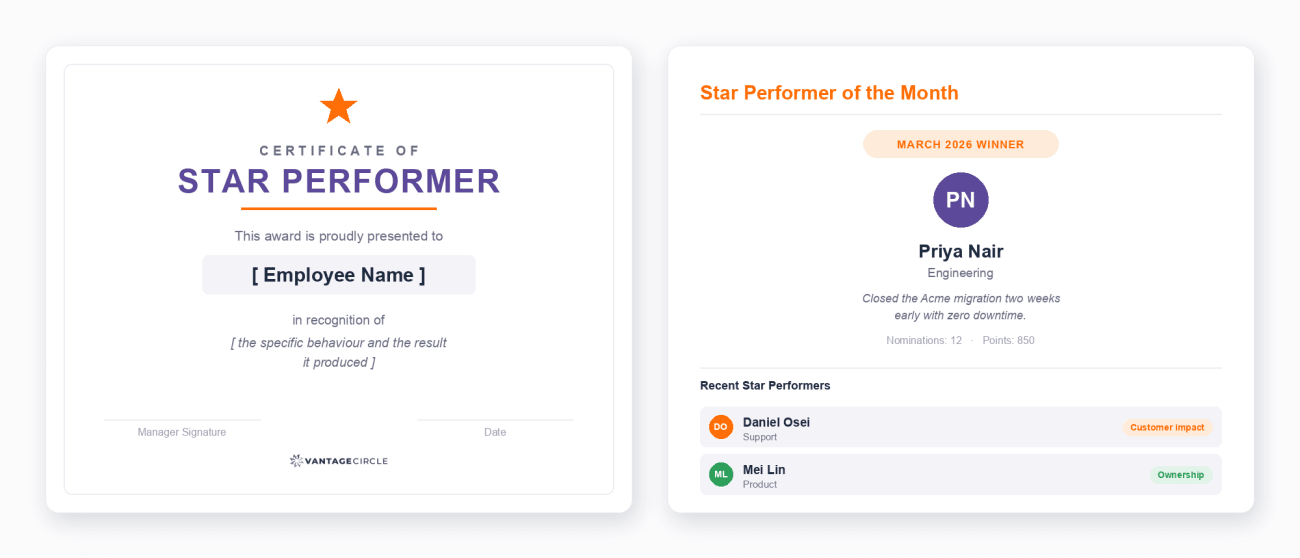
Star Performer Template
Free certificate, of-the-month, and town-hall slide to name your standout performers.
View Template ›
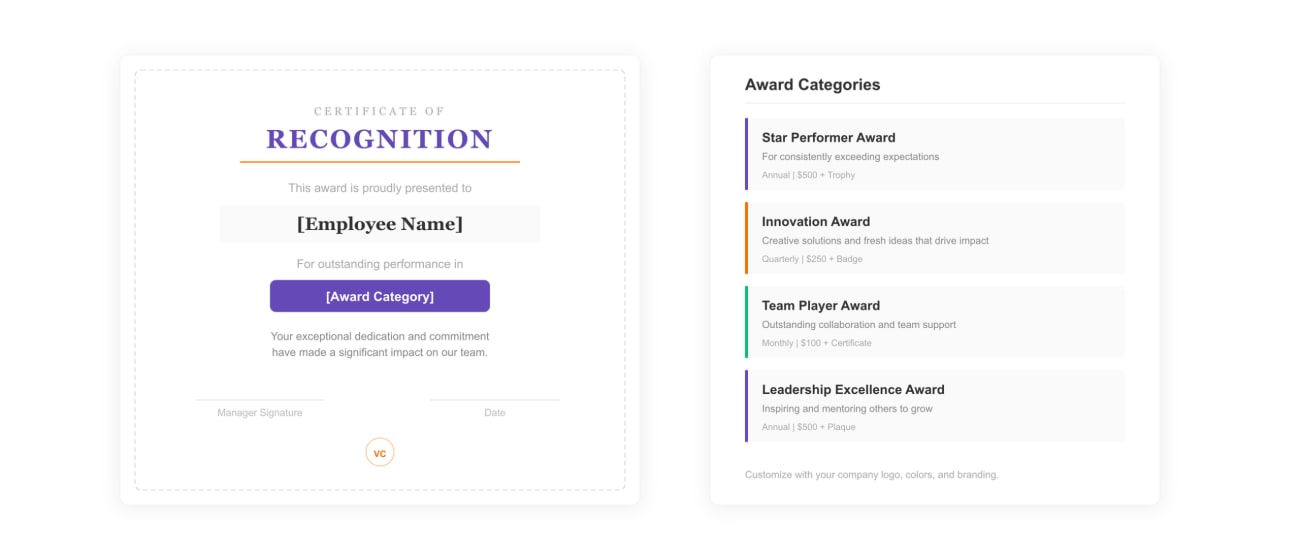
Employee Recognition Award Template
Award citation framework, criteria, and certificates for performance and values awards.
View Template ›
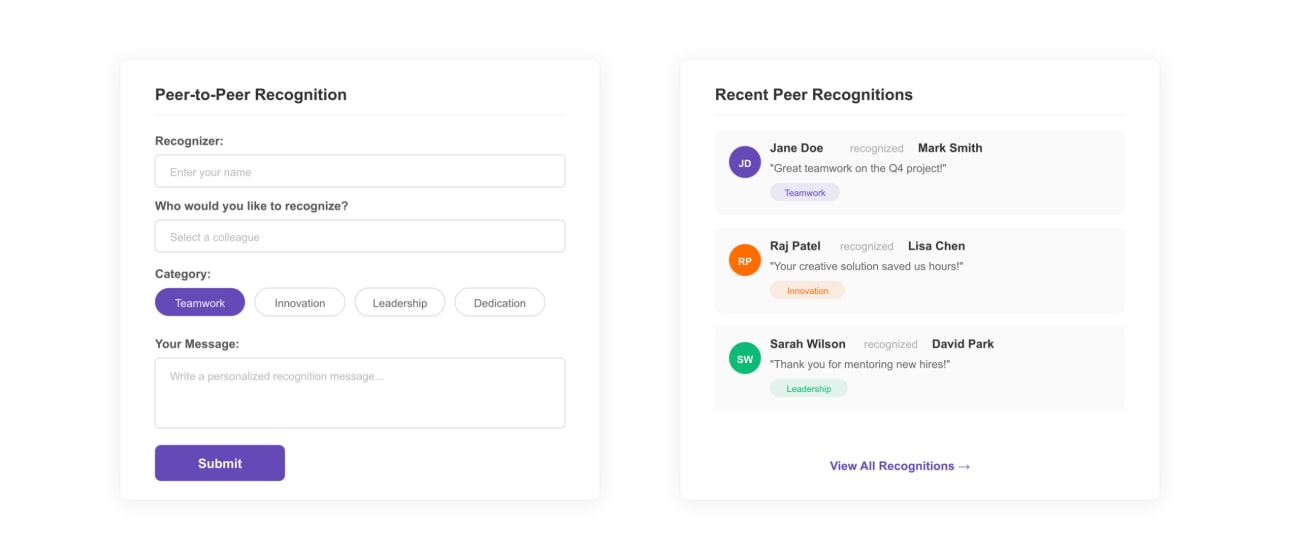
Peer-to-Peer Recognition Template
Ten message variants for Slack, Teams, and recognition platforms.
View Template ›