EN
EN  FR
FR  ES
ES  DE
DE 





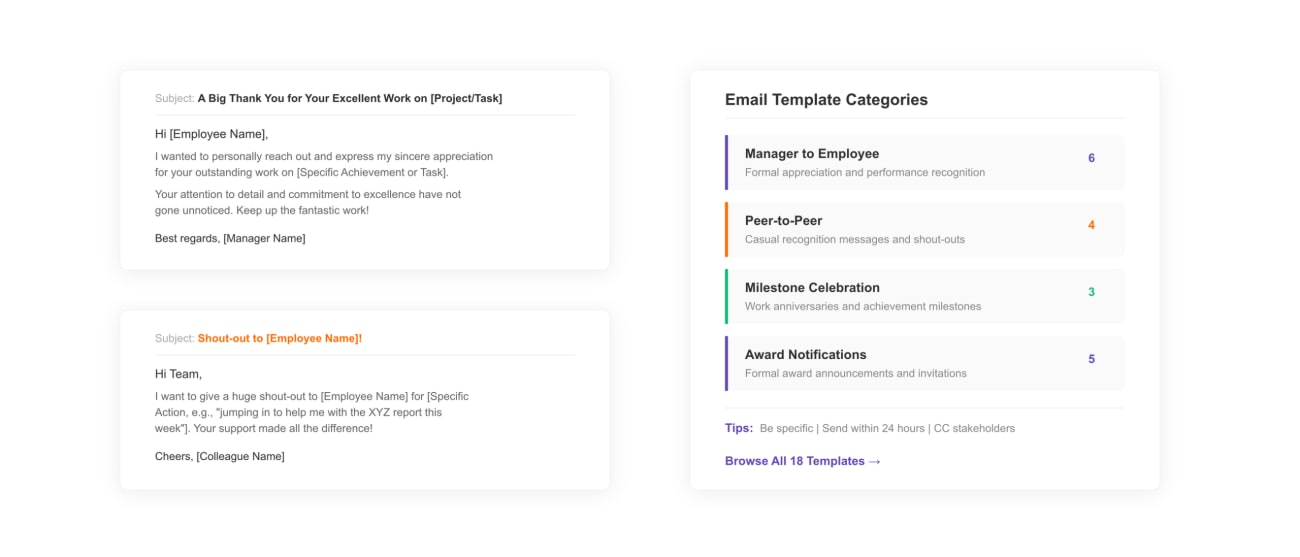
What Is an Employee Recognition Email Template?
An employee recognition email template is a pre-written message framework that managers, HR professionals, and peers customize to acknowledge an employee's specific contribution, behavior, or milestone.
Most managers facing a blank screen reach for generic phrases like "great work" or "keep it up." A template structures the message so it consistently includes what makes recognition effective: the specific behavior, the measurable impact, and a connection to shared company values.
According to Gallup's 2024 workplace research, employees who receive recognition are 4x more likely to be highly engaged at work. Yet 1 in 3 employees report receiving no recognition in the previous week. Structured, template-driven habits are designed to close that gap.
This page provides eight copy-paste-ready templates covering the most common recognition occasions: everyday appreciation, peer-to-peer recognition, work anniversaries, promotions, manager-to-team messages, remote team contexts, project completions, and values-based recognition.
Each template is fully written. Substitute the bracketed placeholders and send. For a complete recognition setup, browse the Recognition Templates hub or pair these emails with a structured Employee Recognition Program Template.
How to Use This Employee Recognition Email Template?
A four-step guide to choosing, customizing, and sending recognition emails that actually land.
Step 1
Step 1: Choose the Right Recognition Occasion
Identify what you are recognizing and select the template that matches the relationship and trigger. A peer-to-peer message reads differently from a manager acknowledgment tied to a quarterly result.
The eight templates each address a distinct scenario. Pick the one that fits the relationship (peer, manager, team-wide) and the trigger (milestone, behavior, completion, tenure), then customize from there.
Step 2
Step 2: Customize the Key Details
Replace every bracketed placeholder with specific information: the employee's name, the exact behavior you are recognizing, the measurable impact it had, and the company value it exemplifies.
Specificity is what makes recognition memorable. Without it, even well-meaning praise feels routine. "Great work on the Q3 campaign" is easy to dismiss. "Your copy increased our open rate from 18% to 31% in three weeks" gives the recipient something concrete to keep.
Step 3
Step 3: Match the Tone to Your Culture
Some organizations communicate formally, with structured paragraphs, full salutations, and signature blocks. Others are casual: first names, short messages, conversational language. The templates use a semi-formal default that works across most professional environments.
Read through your chosen template and adjust vocabulary to match how your team actually communicates. A recognition email that sounds like it was written by Legal will have less emotional impact than one that sounds like the person sending it.
Step 4
Step 4: Send at the Right Time
Recognition is most impactful when it is close to the triggering behavior. A message sent within 24 to 48 hours carries significantly more weight than a note sent weeks later as part of a performance review cycle.
For work anniversaries and promotions, send on the date itself. For project completions, send the day of or day after go-live. Recognition emails logged in Vantage Circle create a timestamped record that feeds manager dashboards and recognition reports.
What Makes a Good Employee Recognition Email?
The best recognition emails share four characteristics. Understanding them helps you write original recognition that sounds human, not automated.
1. They name the specific behavior
Generic praise ("great job," "team player," "always reliable") triggers less positive response than behavioral specificity.
Name the exact action: "You stayed until 9 PM to help the client team prepare for the board review" is specific. "You always go above and beyond" is not. Specificity proves the sender paid attention.
2. They quantify the impact
Numbers make recognition credible and memorable. If the employee's work reduced time-to-resolution by 30%, say so. If their change affected 200 customer accounts, include that.
Impact statements show the contribution mattered to the organization, not just to the sender personally.
3. They connect to a company value
Recognition that ties a specific behavior to a named company value (such as "This is exactly what we mean by 'Client First'") reinforces culture while appreciating the individual.
It also shows other employees what value-aligned behavior looks like in practice.
4. They are timely
A recognition email sent the day after an achievement reads as recognition. The same email sent three weeks later reads as an afterthought.
Build recognition into workflow triggers (project completions, client wins, peer nominations) instead of saving it for formal review cycles.
Generic vs. Specific Recognition: A Side-by-Side Example
The difference between effective and ineffective recognition emails comes down to one question: does this email prove that the sender paid attention?
✗ Generic (low impact)
"Hi David, just wanted to say great job on the project last week. You really helped the team out. Keep it up!"
No specific behavior named. No impact quantified. Could have been sent to anyone on the team.
✓ Specific (high impact)
"Hi David, your work coordinating the migration timeline between engineering and client success last week directly prevented a three-day delay on the Harrington account. The client's feedback was cited in Monday's executive summary. That kind of cross-team ownership is exactly what our scale requires. Thank you."
Names the behavior, identifies the impact, names the beneficiary, connects to organizational value.
Every template on this page is structured to produce the specific version. Treat the brackets as required, not optional. They are what makes the message memorable.
Sample Employee Recognition Email Templates
Eight fully-written, copy-paste-ready templates. Click Copy on any card, paste into your email, and replace the bracketed placeholders.
Template 1: All-Purpose Recognition
Use for: General outstanding work, specific achievements, or demonstrating company values.
Subject: Recognizing [Employee Name]'s Contribution
Hi [Employee Name],
I wanted to take a moment to recognize the work you put into [specific project or task] over the past [timeframe]. Your approach to [specific aspect: problem-solving / communication / execution / leadership] made a direct difference to [outcome].
What stood out most was [specific behavior or decision]. That kind of [quality: thoroughness / creativity / ownership] is exactly what [Company Name] needs at this stage, and it does not go unnoticed.
Thank you for the work you put in.
[Your Name]
Template 2: Peer-to-Peer Recognition
Use for: Praising a colleague for their help, collaboration, or teamwork.
Subject: Quick thank you, [Employee Name]
Hi [Employee Name],
I wanted to send a note to say thank you for [specific action — stepping in during the outage / reviewing my proposal before the deadline / covering my calls when I was out].
It made a genuine difference to [what it enabled: my ability to deliver on time / the client relationship / how the week went], and I did not want that to pass without acknowledgment.
You did not have to do that — and you did. That is what makes working on this team worthwhile.
Thanks again, [Your Name]
Template 3: Work Anniversary Recognition
Use for: Tenure milestones — 1, 3, 5, 10+ year anniversaries.
Subject: [X] Years with [Company Name] — Thank You, [Employee Name]
Hi [Employee Name],
Today marks [number] years since you joined [Company Name], and I wanted to mark it with more than a calendar reminder.
Over [the past year / these [X] years], you have [specific contribution: built the client onboarding process / helped grow the team from 5 to 22 people / led three product launches]. The people you have worked with are better for having you here.
What I find most consistently valuable is [specific quality that defines their tenure]. That is not something listed in a job description. It is something you bring.
Thank you for [X] years. Here is to what comes next.
[Your Name]
Template 4: Promotion Recognition
Use for: Promotions, role expansions, or significant career milestones.
Subject: Congratulations on Your Promotion, [Employee Name]
Hi [Employee Name],
Congratulations on your promotion to [new role title]. This recognition is well earned.
Over the past [timeframe], you have [demonstrated the capabilities of the new role before you were formally in it / taken on responsibilities beyond your current level]. The work you did on [specific project] is a clear example of the leadership this role requires.
The team is looking forward to working with you in this new capacity. Congratulations again.
[Your Name]
Template 5: Manager-to-Team Recognition
Use for: Recognizing a full team after a major delivery, quarter, or result.
Subject: A Note of Thanks — [Team Name]
Hi Team,
I wanted to take a few minutes to acknowledge what this team accomplished during [timeframe: Q2 / the last sprint / the past month].
[Specific achievement: We closed [X]% of our annual target ahead of schedule / Average ramp time dropped from [X] to [Y] weeks / This month's client satisfaction scores are the highest we have recorded.]
That result did not happen by accident. It came from [the way you supported each other when [challenge] happened / the individual ownership each of you took on your piece of [project]].
Thank you for what you put into this period of work. It matters.
[Your Name]
Template 6: Remote Team Recognition
Use for: Recognizing distributed or remote employees whose work is easy to overlook across time zones.
Subject: Recognizing [Employee Name] — [Brief Description]
Hi [Employee Name],
Working across time zones and primarily over asynchronous channels makes it easy for individual contributions to blur into the background. I did not want that to happen with what you did on [specific task or project].
[Specific achievement: You coordinated the cross-timezone review so seamlessly that the Paris and Bangalore teams reached genuine alignment for the first time this quarter / Your async documentation has already been used by six people across three offices this week.]
Remote work makes your kind of [communication / initiative / documentation] harder, not easier. The fact that you do it consistently is something I genuinely appreciate, and wanted to say directly.
Thank you, [Your Name]
Template 7: Project Completion Recognition
Use for: Acknowledging individual contributions after a significant project ships.
Subject: [Project Name] Shipped — Thank You, [Employee Name]
Hi [Employee Name],
With [Project Name] complete, I wanted to send a direct note to you specifically — separate from the team announcement.
[What they contributed: You carried the technical architecture decisions from discovery through deployment without a single escalation / You kept stakeholder communications accurate and timely when the scope changed midway.]
[Project Name] shipped [on time / under budget / with no client-facing issues] because of how you handled [specific challenge]. The outcome — [specific metric] — reflects your work directly.
Thank you, [Your Name]
Template 8: Values Champion Recognition
Use for: Recognizing behavior that demonstrates a specific company value in action.
Subject: Recognizing [Employee Name] — Living Our Values
Hi [Employee Name],
I wanted to recognize you for something specific I observed during [last week / [event] / the [project]]: [specific behavior that demonstrated the company value].
At [Company Name], [Company Value, e.g., "Client Obsession" / "Integrity First"] is not a phrase on a wall. The way you handled [situation], specifically [the decision you made / the way you communicated], is what that value looks like in practice.
Recognition for values-aligned behavior matters more in the long run because it shapes culture. I wanted you to know this was noticed.
Thank you, [Your Name]
Explore Employee Recognition & Engagement Templates
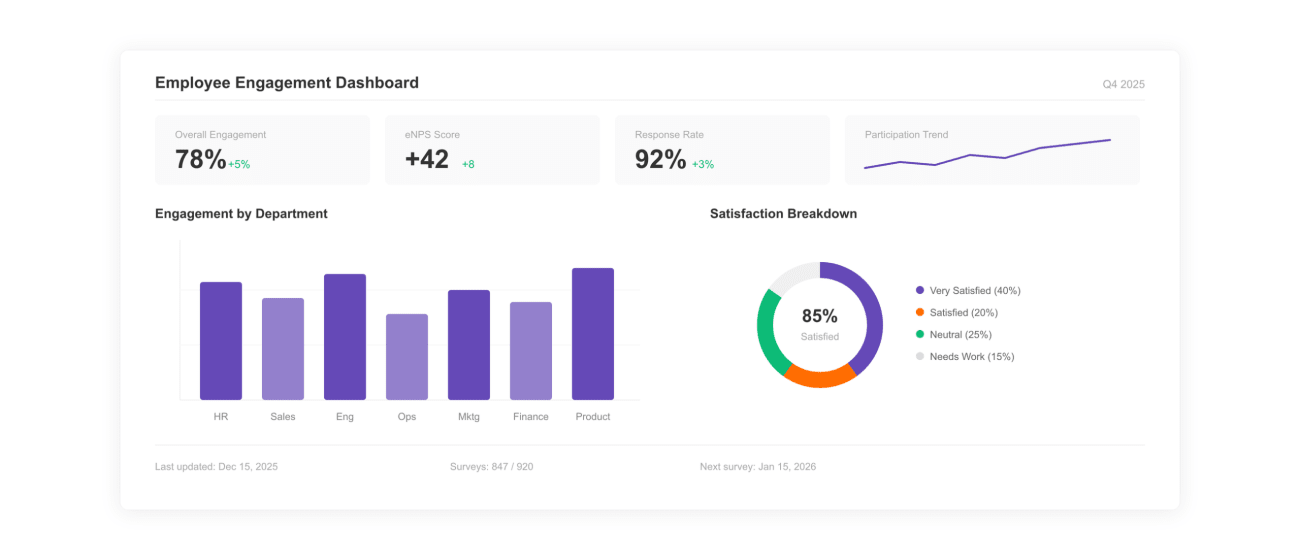
Employee Engagement Dashboard Template
Track and visualize key employee engagement metrics in one place.
View Template ›
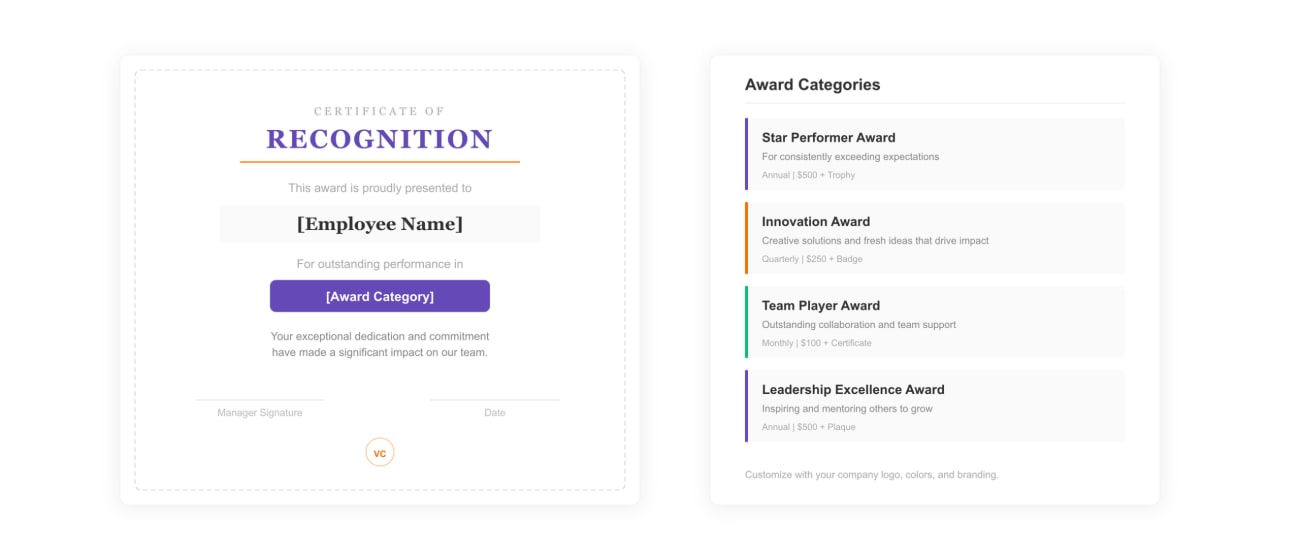
Employee Recognition Award Template
Design and present professional recognition awards to top performers.
View Template ›
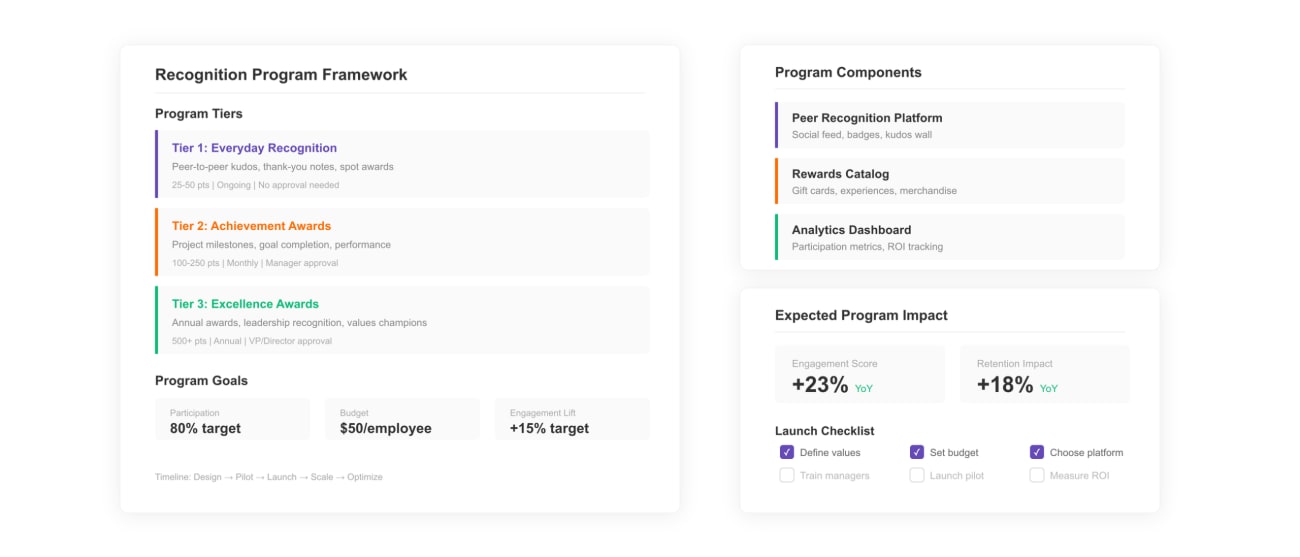
Employee Recognition Program Template
Build a structured recognition program with criteria, metrics, and governance.
View Template ›