EN
EN  FR
FR  ES
ES  DE
DE 





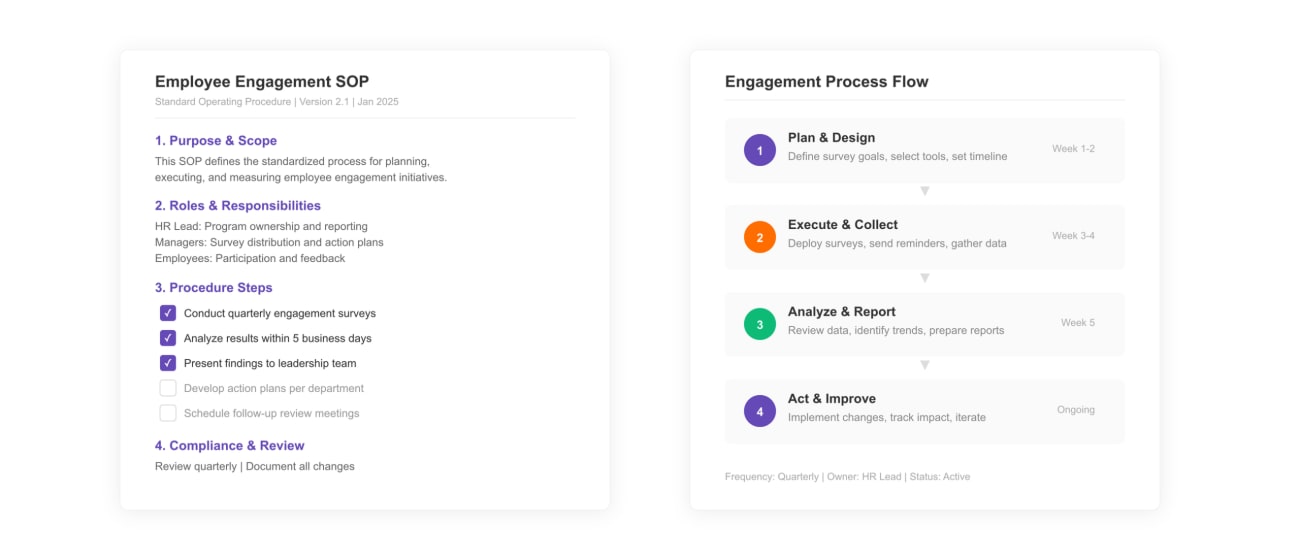
What Is an Employee Engagement SOP Template?
An employee engagement SOP template is a written Standard Operating Procedure that defines exactly how engagement initiatives are planned, executed, measured, and reviewed — with named owners, timelines, KPIs, and review cadence in one document.
An SOP is what turns engagement from a project that depends on one person into a system that runs whether the HR lead is in the office or on leave. It also makes engagement work auditable — useful for ISO 27001, SOC 2, and people-process maturity reviews.
This template ships with a complete written SOP (purpose, scope, RACI matrix, procedure steps, KPIs, and review cadence) plus monthly and quarterly variants. Pair it with structured workflows from the Recognition Templates hub.
How to Use This Employee Engagement SOP Template?
A four-step rollout that takes the SOP from blank document to a signed-off, in-use procedure.
Step 1
Step 1: Define Engagement Objectives and Scope
State the engagement objective in one sentence: improve morale, raise participation, reduce voluntary turnover, or strengthen team collaboration. Then bound the scope — which functions, locations, and roles the SOP covers.
A clear scope prevents the most common SOP failure mode: a document that tries to govern every form of employee experience and ends up governing none of them well.
Step 2
Step 2: Assign Roles Using RACI
Map every engagement step to RACI: Responsible, Accountable, Consulted, Informed. The HR or People team typically holds Accountable for the SOP itself; managers hold Responsible for team-level execution.
Without a RACI, engagement SOPs collapse into "HR's problem." The point of the matrix is to make ownership visible at every step.
Step 3
Step 3: Document the Procedure Steps
Write the procedure as numbered steps, each one observable and verifiable. "Run a pulse survey monthly" is too vague; "On the first Monday of each month, the HR analytics lead launches a 5-question pulse survey via Vantage Pulse" is an SOP step.
The complete written SOP below shows the level of detail required.
Step 4
Step 4: Set KPIs and Review Cadence
Tie the SOP to four numbers: engagement score, participation rate, eNPS, and recognition rate. Track each monthly and review quarterly with leadership against published benchmarks.
Schedule an annual SOP review on the first business day of January. SOPs that go unreviewed for more than 12 months drift out of sync with reality.
A Complete Written Engagement SOP
Below is a full SOP written using the framework. The download includes monthly and quarterly variants of this exact format.
SOP-HR-001 v1.2
Monthly Employee Engagement Procedure
Effective: 2026-05-01 | Owner: VP of People | Review: Quarterly
1. Purpose: Define a repeatable monthly cycle for measuring, communicating, and improving employee engagement across all departments and locations.
2. Scope: All full-time employees across HQ, regional offices, and remote locations. Excludes contractors and short-tenure (<30 day) employees.
3. Roles (RACI):
- Accountable: VP of People
- Responsible: HR Analytics Lead
- Consulted: Department Heads, Culture Committee
- Informed: Executive Team, All Employees
4. Procedure:
- Day 1 (first Monday): HR Analytics Lead launches a 5-question pulse survey via Vantage Pulse to all in-scope employees.
- Day 1–7: Survey window remains open. Daily participation report shared with department heads on day 4 and day 7.
- Day 8: Survey closes. Results compiled into the monthly engagement dashboard within 48 hours.
- Day 10: HR Analytics Lead publishes the dashboard with department-level cuts. VP of People reviews and signs off.
- Day 12: CEO/CHRO summary sent company-wide. Department heads receive their team-level report with recommended actions.
- Day 12–30: Department heads run a 1:1 conversation with at least one team member from any group scoring below the company average.
- Day 30: Cycle closes. Action items logged for the next monthly review.
5. KPIs (tracked monthly):
- Engagement score (target: ≥ 4.0 / 5)
- Survey participation rate (target: ≥ 75%)
- eNPS (target: ≥ +20)
- Recognition rate (target: ≥ 1.5 recognitions per employee per month)
6. Escalation: Department-level engagement score below 3.5 for two consecutive months triggers a stay-interview cycle and a meeting between the department head and VP of People within 14 days.
7. Review Cadence: Quarterly SOP review by VP of People and HR Analytics Lead. Annual deep review on the first business day of January with executive sign-off required.
8. Related Documents: Recognition Program Template, Employee Engagement Dashboard Template, Pulse Survey Question Bank, Stay Interview Guide.
Approved by: [VP of People], [Date] | Document version: 1.2 | Next review: [Quarter +1]
The full pack includes monthly and quarterly variants, the RACI matrix in editable form, and the supporting documents referenced above.
What Makes an Effective Employee Engagement SOP?
Six characteristics separate engagement SOPs that actually run from documents that gather dust on a SharePoint folder.
1. Specific procedure steps
Every step is observable and verifiable, with named tools and dates. Vague verbs ("ensure," "facilitate," "champion") have no place in an SOP.
2. Named roles via RACI
Responsible, Accountable, Consulted, Informed for every step. Without RACI, SOPs default to "HR's problem" and execution drifts.
3. Measurable KPIs
Engagement score, participation, eNPS, recognition rate — each with a stated target. SOPs without KPIs cannot prove they work.
4. Defined review cadence
Quarterly tactical review, annual deep review with sign-off. SOPs left untouched for 12 months drift out of sync with the organization.
5. Escalation paths
Defined thresholds that trigger a named action — for example, two consecutive months below 3.5 engagement triggers stay interviews. Without escalation, low scores get noted and ignored.
6. Linked to supporting documents
The SOP names related templates, dashboards, and question banks. Standalone SOPs become orphaned; linked ones become a system.
Sample Employee Engagement SOP Templates
Two ready-to-deploy SOP frameworks — monthly cadence for tactical execution, quarterly cadence for strategic planning. The complete pack adds the editable RACI, escalation paths, and supporting question banks.
Sample Template 1: Monthly Engagement SOP
Best for: tactical, repeatable monthly engagement execution.
SOP Covers:
- Monthly activity planning and approval workflow
- Pulse-survey launch and response window
- Department-level reporting and 1:1 cascade
- Action item logging and carry-forward to next cycle
KPIs Tracked:
- Engagement score (target ≥ 4.0 / 5)
- Participation rate (target ≥ 75%)
- Recognition rate (target ≥ 1.5 / employee / month)
- Activity completion rate
Owner: HR Analytics Lead, accountable to VP of People.
Sample Template 2: Quarterly Engagement SOP
Best for: strategic engagement planning and leadership-level reporting.
SOP Covers:
- Quarterly engagement strategy and theme selection
- Budget allocation and resource planning
- Cross-team coordination and accountability
- Performance review of engagement initiatives
KPIs Tracked:
- Quarterly engagement score (vs prior quarter)
- Department-level participation trends
- Retention vs engagement correlation
- ROI of engagement initiatives (cost vs eNPS lift)
Owner: VP of People, with executive team consulted.
Explore Employee Recognition & Engagement Templates
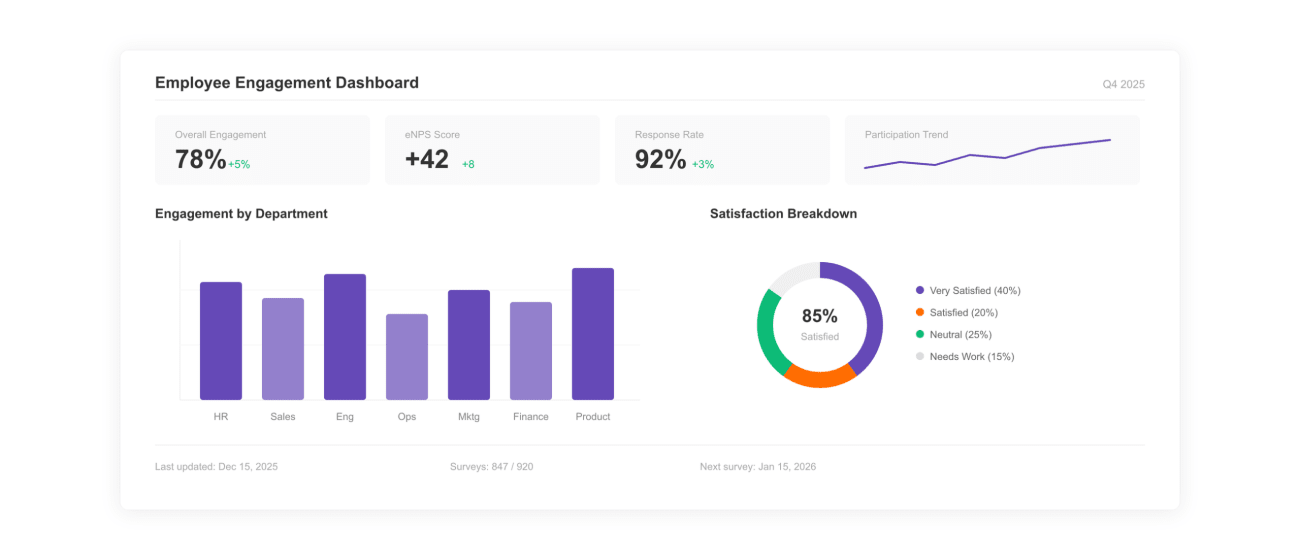
Employee Engagement Dashboard Template
Track engagement, eNPS, and participation metrics referenced in the SOP.
View Template ›
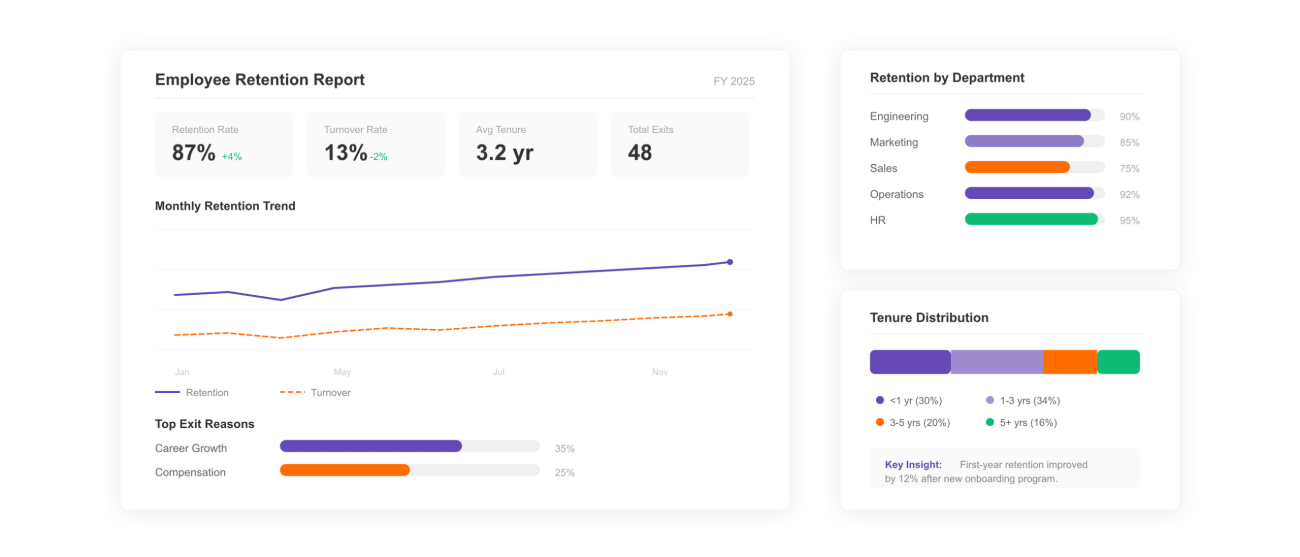
Employee Retention Report Template
Pair the SOP's engagement data with retention reporting and benchmarks.
View Template ›
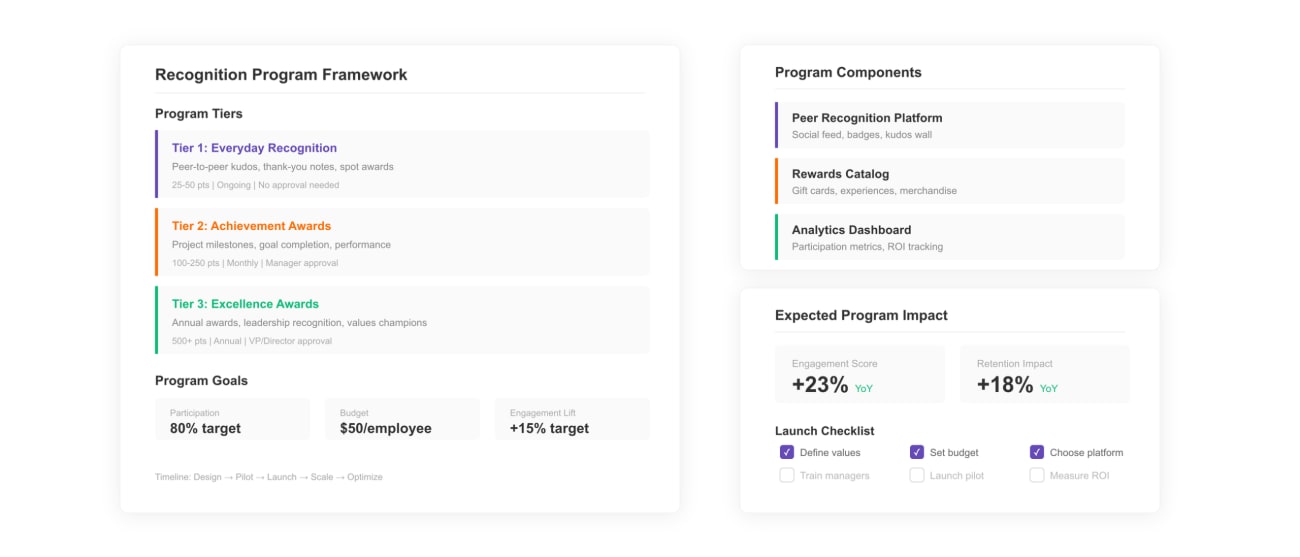
Employee Recognition Program Template
Six recognition program types referenced from the SOP's related documents.
View Template ›